
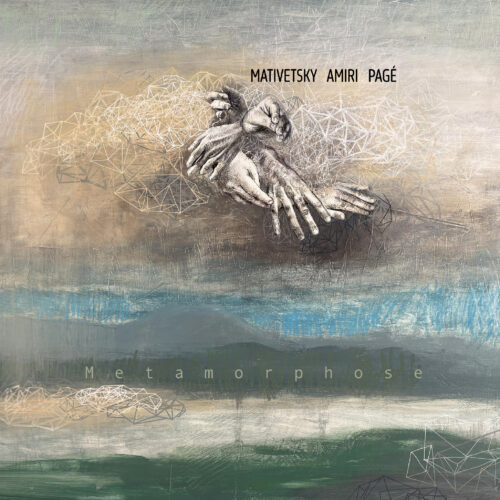
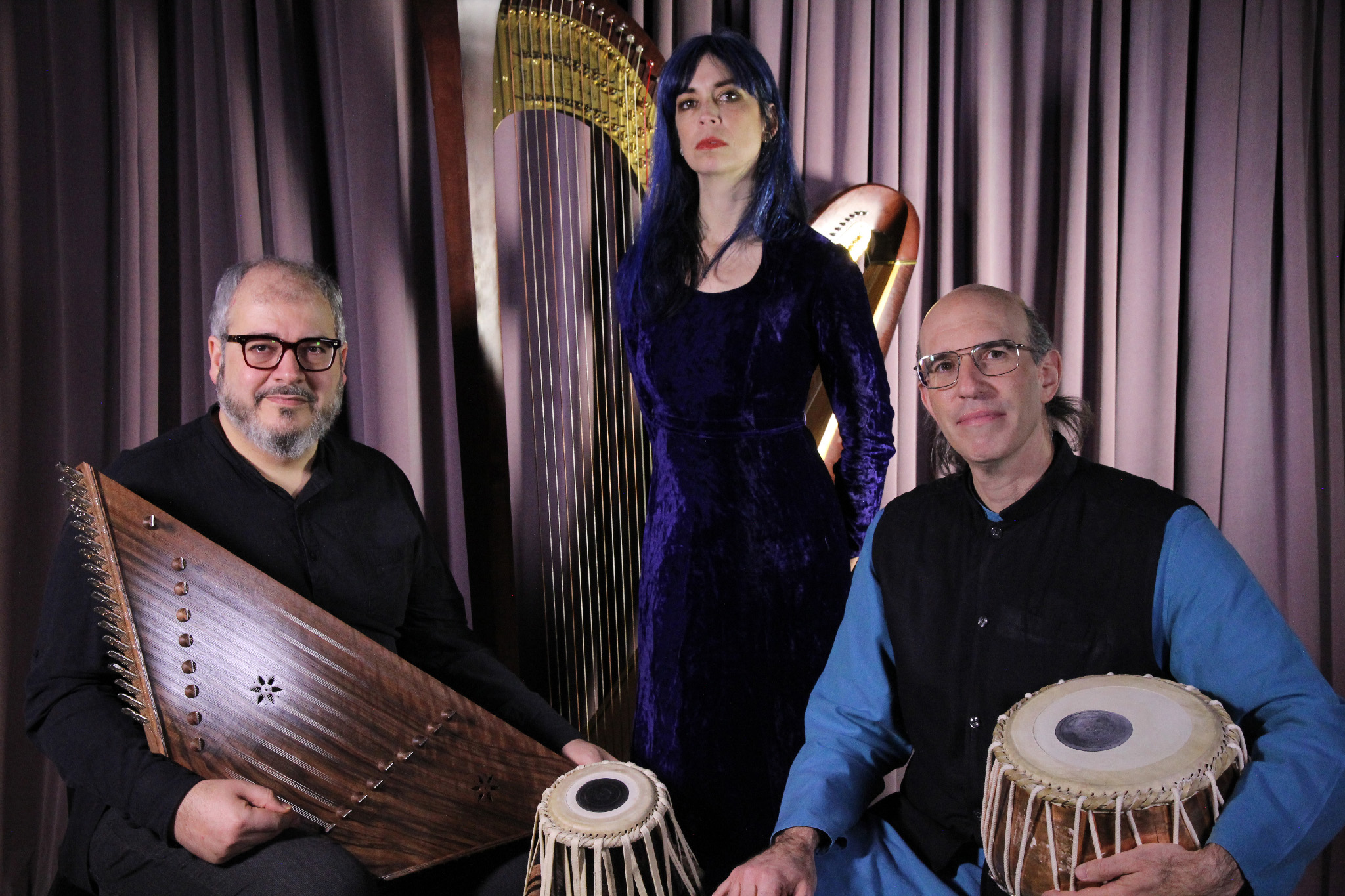
By the time Mativetsky Amiri Pagé got around to making Metamorphose, the trio had already been building its own internal logic for years. Formed in 2019, the group brings together three musicians whose paths through Montreal’s music community have been broad, restless, and hard to pin to any one lane. Shawn Mativetsky has spent years pushing at the edges of tabla tradition, both as a leading disciple of Pandit Sharda Sahai and through contemporary composition, improvisation, and his electronics-leaning project Temporal Waves. Amir Amiri, born in Tehran and trained in Persian classical music, has long treated the santur not as a fixed historical object but as something still full of unanswered questions. Sarah Pagé has moved with unusual ease from experimental solo work to The Barr Brothers, from Land of Kush to collaborations with artists like Nadah El Shazly and Juana Molina, all while developing a sound on harp that can feel earthy, aqueous, or quietly otherworldly depending on what the music asks of it.
None of that disappears on Metamorphose, released March 20, 2026 on Fifth House Music. You can hear those histories all over it. What’s striking is how little the trio seems interested in presenting those backgrounds as separate things to be carefully arranged side by side. The album doesn’t behave like a summit meeting. It sounds more like three musicians entering the same room with a lot of accumulated language behind them, then getting interested in what happens when they stop guarding the borders.
Amiri remembers the beginning in very concrete terms. “The first time Shawn and I met Sarah was at her home in Montreal. She played a chord progression, and I responded with a melody, it fit together effortlessly. Then Shawn introduced a rhythmic idea, moving seamlessly between 5/8 and 6/8. That moment was decisive. It stopped feeling like three musicians collaborating and started to feel like a shared language emerging. That piece became Yavaran, the first track we created together, and the opening track of the album.”
Mativetsky doesn’t really buy the distinction between collaboration and identity in the first place. “I’m not sure what the difference really is. It’s through our intense collaboration, through our combined artistic voices and experiences, that the group’s unique voice emerges. But collaboration isn’t something separate, it’s an essential foundation of what this trio is all about.”
Pagé felt that sense of openness right away. “Having known each other and played together in different contexts and projects over the years, it was clear to me from the start that we were coming together with the intention of creating something unique without a defined set of limits or expectations of what that would mean. We each brought in a couple of ideas to our first rehearsal and dove into breaking things open and creating arrangements from a fairly wide and unexpected perspective right away.”
That refusal to define the project too narrowly matters, especially on a record like this one, where Persian classical music, Hindustani rhythmic thought, ambient sonorities, chamber-jazz textures, and electronics-tinted details move through the same space without sounding like they were arranged there to make a point. The usual “fusion” language feels a bit flimsy next to what they’re actually describing.
“I think the main thing is sharing and openness to learning new things,” Mativetsky says. “Possibly there are some overlapping commonalities between traditions, but really each of us is interested in sharing our perspectives and adding to our breadth of musical understanding. It’s definitely not about compromise or watering things down, but rather about transformation and expansion of the realm of possibilities. Starting with a strong foundation in tradition, and then taking that somewhere new.”
Pagé says much the same thing from a more practical angle. “We’re all really keen collaborators and getting to learn from one another really satiates an appetite for music and creativity we all share. We also have enough experience to have a pretty good sense of what our strengths are as musically and technically. We know what perspectives and sounds we can bring to a group so we jump right in with a global view of what a song needs rather than what a tradition needs.”
Amiri pushes that even further. “For me, the question is not how to find a common language, but how to allow one to emerge without forcing it. I’m not interested in placing traditions side by side or blending them into something neutral. The real work happens in the space between, in listening.”
He’s precise about what that means. “Each tradition carries its own logic, its own relationship to time, to ornamentation, to silence. Persian music, for example, is deeply rooted in the idea of goosheh, these small melodic corners that open into something larger. Indian music unfolds through time in a very different way, with its own sense of expansion and rhythmic architecture. Rather than trying to reconcile these systems intellectually, we spend time inside them, and then we listen to what remains when they meet.”
There’s nothing vague about the mechanics of that meeting. “A big part of this process is actually technical. Tuning becomes a meeting point. The santur, harp, and tabla don’t naturally belong to the same system, so we had to rethink pitch, not as fixed, but as flexible centers. That changes everything. It allows the instruments to coexist without one dominating or adjusting artificially to the other.”
He comes back, again and again, to space. “If you fill everything, you erase the difference. But if you leave space, each voice retains its identity, and the dialogue becomes real.”
That restraint is one of the record’s real strengths. This is technically demanding music, but it rarely arrives with the look-how-hard-this-is energy that can make virtuosic records feel exhausting after ten minutes. Yavaran, the opening track and the album’s single, says a lot about how the trio works. The piece moves through shifting metres and modulating harmonies with a kind of quiet fluency, the harp and tabla guiding the motion while the santur floats above. It is also the only track with vocals, sung by Amiri and Pagé, drawn from the Sufi devotional song “Yavaran Masem,” a text that uses intoxication as a metaphor for spiritual ecstasy and divine love.
“It wasn’t a calculated decision, it felt like what the song called for,” Pagé says. “The voice is the most naturally relatable of all instruments, and although we wanted to keep this trio and album firmly rooted in the world of instrumental music, bringing that colour into the mix gave us another opportunity to welcome listeners into the sonic world we’re trying to create.”
Elsewhere, the album keeps opening out. The title track evolves its metric structure as it goes, using a Kurdish melody as a point of propulsion rather than something fixed to be restated reverently. Quarter Tone Suite, the album’s second-longest piece, circles the Persian mode Segāh and moves from melodic improvisation into something darker and more volatile, then into a finale shaped by flamenco buleria. Maktrismos starts in ambient electronics before pulling an ancient Greek dance melody into focus. Pathos, the closing piece, pays homage to the late Pandit Shivkumar Sharma while drawing on Raag Charukeshi, moving from alāp into Jhaptaal and then Teentaal with the kind of rising internal pressure that makes the final stretch feel earned rather than imposed.
Amiri’s comments on Quarter Tone Suite get at how the trio thinks about structure. “For me, the real boundary is not pitch, it’s rhythm. What ultimately differentiates musical traditions is not just the notes themselves, but how those pitches are organized in time. Rhythm is the architecture. It’s what gives meaning to the material.”
He keeps pulling the idea apart. “The microtones are important, but they’re not the whole story. What fascinates me is how these pitches behave rhythmically, how they sit, how they move, how they pulse. A quarter-tone, in a way, carries a different kind of internal vibration, a different pulse than a whole or half step. So the question becomes, how do you place that within time, how do you make it speak?”
Then he zooms out completely. “You have a pulse, you accelerate it, and it becomes pitch. You accelerate pitch, and it becomes colour. You accelerate colour, it becomes light. These are all subdivisions of the same phenomenon, just existing at different speeds within time and space.”
Mativetsky’s own approach feels less abstract, more fully absorbed into practice. Asked whether his work with electronics changed how he approached the tabla here, he is careful not to oversell it. “Not related to the tabla specifically, but with respect to electronics, in post-production, Sarah and I did spend some time experimenting with some of the effect pedals that I’ve been working with in developing Temporal Waves. But in terms of the tabla playing, it’s more to do with balancing playing within the traditional performance practices of Indian classical music versus contemporary or non-traditional ways of playing, ways of perceiving time, and ideas that might influence the structure of a piece. This would be the case for any ‘fusion’ or non-traditional project that I might play in. I think at this point, I’ve been doing this for such a long time that I just do it instinctively, always with a strong foundation in and respect for tradition, but re-interpreting to suit the specific musical situation.”
Pagé, who produced the album, talks about the record less in terms of genre and more in terms of focus and shape. “I often approach mixing and producing from a visual or even narrative perspective. In painting or photography, we think about composition and guiding the viewer’s eye into a piece and making sure it doesn’t just slide right off the page. The songs and the performances on this album are strong enough that I just need to make sure if a voice needs support for a solo it’s there, if anything is interfering with the dynamic arc of a song I try to track that down and take care of it so the whole experience is clear and enjoyable for the listener on the first listen while giving them something new to discover on subsequent listens.”
She wasn’t interested in preserving purity for its own sake. “I don’t feel precious about what tools I use to get there, whether they’re acoustic or electronic. The only thing I really wanted to preserve was the tone and intention of the 3 main voices. We’ve all spent a long time crafting our sound and representing that properly is vital.”
The trio’s sense of texture is just as important as melody. The core sound of these instruments spans a very particular range, tabla moving into harp, harp extending toward santur, attack and resonance constantly reshaping one another. Pagé hears that clearly in the arrangements. “We know the strengths of our instruments and traditions so we had a fairly clear understanding of our roles almost immediately. All 3 of us are essentially percussionists but playing with incredibly different timbres. There are a lot of ways in which our instruments naturally complement each other but we also chose our repertoire and arranged the music in such a way as to make sure each one of us had a moment to really open up and let our strengths shine without compromise.”
For Amiri, texture is structural, not decorative. “In this trio, what’s fascinating is that we’re all, in a way, percussionists, but operating in completely different temporal and sonic dimensions. The tabla articulates time with incredible precision, almost like drawing lines in space. The harp sustains and shapes harmony in an architecturally precise way. And the santur sits somewhere in between, it’s both rhythmic and resonant, both pointillistic and atmospheric.”
That interaction changes how the music breathes. “If I play a phrase on the santur, its resonance might still be present when Sarah enters, and that changes how her harmony is perceived. Or Shawn might place something rhythmically that reorganizes how we hear decay and silence. So yes, texture is essential, but not as a surface quality. It’s structural. It’s what allows three very different instruments to coexist without collapsing into each other.”
That idea of coexistence without collapse may be the cleanest way into Metamorphose. Not because it solves anything, but because the trio doesn’t sound especially interested in solving the tensions inside the music. They’d rather stay inside them a little longer.
“Working with Shawn and Sarah, I realized that transformation doesn’t come from adding something new, it comes from letting go of control,” Amiri says. “Allowing the music to exist without immediately defining it. That’s a vulnerable place, because you’re no longer protected by what you already know.”
Then he turns back toward where he started. “What feels more rooted than ever is my connection to the santur and to the Persian musical system. But it’s deeper now, less about vocabulary, more about instinct. I don’t feel like I’m ‘using’ the tradition anymore, I feel like I’m inside it, and it’s inside me, even when the music moves far away from anything recognizable.”
Photo credit: Shannon Harris & Peter Pagé
Share this :


