
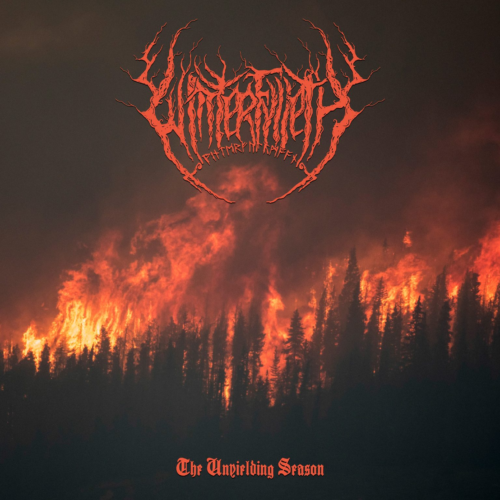
WINTERFYLLETH come straight in swinging on Heroes of a Hundred Fields. Drums are already running when it hits, guitars piling in behind them like they’re trying to catch up. The riffs stack quickly, not one idea then the next, more like several lines moving together, pushing upward while the vocals cut across them with that tight, strained rasp.
“Hold brethren dear now, close to hand, for victory’s day is only young.” It lands right in the middle of all that forward movement, urgent in a very physical way, like the band are trying to keep something from slipping.
They’ve always worked in that space between atmosphere and force, but this one leans harder on the force. Not faster exactly, just less patient. The guitars don’t hang back. They keep climbing even when the rhythm section is already locked into something heavy, and when they do open into wider, melodic lines, they don’t float. They press.
A Hollow Existence gets there differently. It circles first, drums holding steady while the guitars stretch things out, then everything snaps tighter and accelerates without actually speeding up that much. It’s about density more than tempo. More notes, more pressure, same pace. The vocal phrasing shifts too, less declamatory, more buried in the mix.
“A hollow grows within all things, lost truth will not enrich our souls.” You don’t need to catch every word, but when that line cuts through, it lines up with what the music’s already doing. The guitars don’t resolve cleanly; they tilt slightly off where you expect them to land, and that small shift does most of the work.
Perdition’s Flame strips it back to impact. No long build, just a single hit and then the band are moving. The riffing is tighter, more percussive, almost mechanical in the way it locks in with the drums. You can feel Simon Lucas pushing underneath it, not showing off, just keeping everything driving forward.
“The gates of heaven are now closed… the fire shall be the judge.” It’s blunt. The music matches it. No ornament, no pause to underline anything, just the band pushing through like it’s already decided.
The title track stretches out more but doesn’t drift. The melody comes in pieces, not fully formed. Fragments early, then gone, then back stronger, layered over itself. When the lead guitar finally breaks through properly, it feels like something’s been held back on purpose. Not a release exactly, more like a widening.
Then they pull everything down into Unspoken Elegy. Acoustic guitar, cello, space. But it’s not calm. The acoustic lines are clean but they don’t settle. The cello sits underneath with this low, uneasy movement, never quite resolving. Same tension as the heavier tracks, just stripped of distortion.
That carries into In Ashen Wake, which takes its time. Maybe longer than it needs to. The intro builds slowly, layers coming in one at a time, synths widening things out before the guitars take over. When it finally hits, it hits properly, but you can feel the weight of that long lead-in. Whether it works depends on how much patience you’ve got left at that point in the record.
Towards Elysium snaps things back. The central riff has that old, rising shape, the kind that feels like it’s always climbing even when it loops. One of the few moments here that feels almost straightforward, though the band keep shifting small details underneath so it never sits still.
They probably could have ended with Where Dreams Once Grew. Acoustic textures, a quieter kind of weight, a natural place to stop. Instead they close with the Paradise Lost cover, Enchantment. It’s well played and you can hear the respect in it, but it sits slightly outside the rest of the record. Different emotional language, different kind of heaviness. It doesn’t damage anything, but the album had already said what it needed to say.
Most of The Unyielding Season finds Winterfylleth at close to their best, and the parts that miss don’t linger long enough to matter.
The Unyielding Season is out now via Napalm Records.
Photo – Aaron Scott
Share this :


