
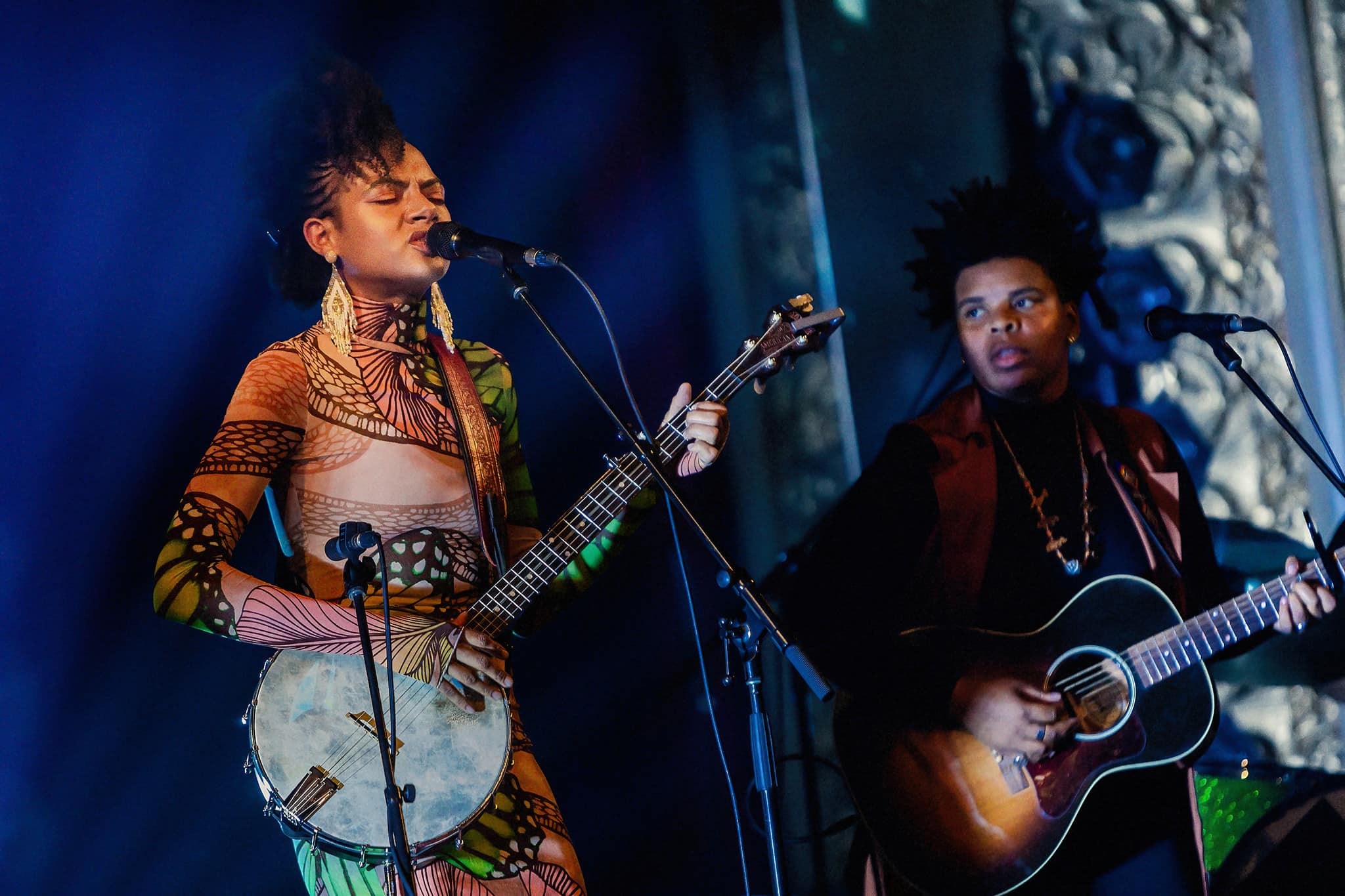
She calls it “the mixtape for musical that I haven’t written yet,” and it is the cleanest description of In the Hour of Chaos you could ask for. A mixtape implies other people. It is made with someone else in mind. It gets handed over with the quiet assumption that the listener will follow the sequence all the way through.
Allison Russell says, “I’ve populated it with many of the artists that I love the most and whose voices give me hope and make me feel joyful and who I want to be in creative communion and community and conversation with.”
That framing matters, because this record is not really built like a traditional “solo album,” even though Russell’s voice holds the centre. It is structured around shared vocal space, duets, choirs, close harmonies, the sound of songs being made in company. Russell talks about the project like an invitation that keeps widening, a way of introducing listeners to artists they might not know yet, and pulling them back toward artists they have not heard in a while.
“I’m excited for folks to maybe get introduced to some artists that I haven’t gotten into yet and maybe get to rediscover artists that they love, that they forgot how much they loved, like Norah Jones.”
Russell is speaking from East Nashville, in a house she moved into the day before Outside Child came out. Five years later, she describes returning after an intense run of touring, Broadway, and film work and feeling like she has walked into the wrong life.
“We moved into this home five years ago. I basically have barely been here since then,” she says. “When I walked in, I felt like a revenant. I felt like a ghost in my life.”
That dislocation, the sense of living at speed and then arriving back to yourself late, sits beside something sharper. Russell does not talk around the political atmosphere in the US, and she does not separate it from the record’s pull toward real-world closeness.
“I’m speaking to you from the US right now, as a Canadian immigrant, green card holder, queer black mom living in Tennessee right now,” she says. “It is pretty grim what’s happening politically here.”
She lists what is under attack and what can no longer be taken for granted.
“The kind of just wholesale attacks on human rights, civil rights, voting rights,” Russell says, “things that we take, I think, quite for granted, maybe at home in Canada, that cannot be taken for granted right now here.”
She insists she believes rights will be won back, but she does not soften the present tense.
“They’re needing to be once again fought for and won back. They will be won back, I believe that. But right now, it’s a grim time and there are a lot of people in distress here. Obviously, a lot of people in distress globally.”
In that context, In the Hour of Chaos reads less like escape and more like a deliberate push back toward proximity. Russell names it plainly.
“I was feeling the need very deeply to reconnect in real life with community. I think you hear that on this record.”
You can hear it, structurally. The album is built around duets and shared vocal space, and even when a track is not technically a duet, Russell still finds a way to fill the room. When we talk about how many voices appear across the record, she goes straight to the moment that feels like the opposite of isolation, a kids’ chorus that refuses to sound self-protective.
“There’s a choir of children on Cold April,” she says. “It’s actually my daughter’s middle school. Well, it’s a primary through middle school, Explore Community School. It is their Explore Community School pop choir. So it is a 30+ 10 to 12-year-olds that sang on that song. My daughter just turned 12, but she was 11 when she sang on it in the studio.”
Even without getting technical about the arrangements, the album’s effect is physical. It moves differently than Outside Child did. Where that earlier work could feel shadowed and solitary, this one keeps letting other voices brush up against hers, changing the temperature from song to song. The songs feel staged rather than diaristic, closer to scenes with entrances and exits. Russell stays central, but the record keeps insisting that the centre does not have to mean alone.
“When you’re young, it just feels like everything just feels so overwhelming because you can’t imagine what’s on the other side of the rainbow if there is rain,” she says. “And there’s always a rainbow.”
That line sits beside a harder piece of her story, delivered without polish. Russell talks about being unhoused in Montreal as a teenager, about the distance between that life and the present.
“If you had told me when I was, you know, 15 and didn’t think I would live to be 18, you know, and living like unhoused on the streets of Montreal and finding friends to stay over with and things like I would never I could never have imagined.”
She explains why she keeps saying it out loud, why she refuses to let the survival part get erased by the accolades.
“That’s part of what sort of drives me to share these things because I want people struggling through those situations right now to know that it does and can get better,” she says. “If it can get better for me, truly it can get better for anybody, you know, and like to hang in there.”
Then she says the thing that would have sounded like a lie to her at fifteen.
“These are not the best years of your life, by the way, and the best years are coming.”
Later, when you ask who she still wants to sing with, she answers instantly, like the name has been waiting at the edge of her life for years.
“Tracy Chapman,” Russell says. “I would do anything. I would do anything to do that.”
She describes seeing Chapman backstage at the Grammys but keeping admiration at the right distance.
“I saw her backstage and just you know, I just waved and left her alone because she’s such a private person,” Russell says. “I didn’t try to go talk to her, but in my heart, one day, I hope I get to sing with her.”
Russell’s idea of community is not only political and not only musical. It is also private, idiosyncratic, stubbornly childlike in the way it insists wonder is part of survival. She talks about writing haiku in liner notes, about honouring “our inner children,” and about the layers of living that make it easy to forget what you were before you learned to brace.
“The thing that brings me back every time is Jim Henson in the Muppets,” Russell says. “Like I am obsessed. The reason I play banjo is Kermit the Frog.”
She says it knowing how it sounds, and then complicates it, because she is also serious about lineage. She learned later, she says, about the banjo’s roots in the African diaspora, about what the instrument carries beyond her own origin story.
“I didn’t understand about like growing up in my white supremacist family. I did not understand about the lineage of the African diaspora and the banjo and you know, how deeply integral and that we brought it to these shores. But I learned that later from Rhiannon Giddens, but I play banjo because of Kermit the Frog.”
Russell describes the larger intent in blunt, human terms: “With this album, we want to take back some of the lost space between us.” The line matches what she keeps returning to in conversation, the insistence that when the macro becomes unbearable, you start with the micro. You start eye-level. You start with who is in the room. You start with the actual distance between you and the people you love.
The album title is not subtle. Russell does not pretend the chaos is going away. What she keeps insisting on is something smaller and harder to dismiss, the idea that connection is still possible, that it can still be made on purpose, voice by voice, hand to hand. A mixtape, passed forward, with the assumption underneath it that someone is still going to listen all the way through.
Russell’s Montreal antenna is still up, even from Tennessee. When I mention I was at Jazz Fest the night before, she immediately wants to know who I saw, and I tell her it was The Barr Brothers. Russell lights up. She calls them “such a beautiful band,” then starts talking about the strange closeness of the festival circuit, the way collaborations can feel inevitable but still somehow never happen on record. She’s played with them in different contexts, she says, but not in the studio, and she puts it out there plainly: she wants that to change. Another Montreal band, another shared language, another doorway back into the city, even when she’s speaking from East Nashville.
Russell starts talking about Montreal the way people do when it is still home in the nervous system, not just in the bio. She brings up last summer’s headline slot at Jazz Fest as one of those full-circle career moments that still does not quite compute, growing up on the city’s free outdoor shows and then ending up on that scale. She talks about Place des Arts with real affection, the idea of stepping onto that stage, carrying this new album, this bigger cast of voices, and letting Montreal hold it for a night.
In the Hour of Chaos is out July 10 via Fantasy Records.
Watch the full interview below:
Interview – Annette Aghazarian
Photos – Mason Poole and Steve Gerrard


