
I have a little history with Oasis.
I saw them live in the ’90s and always liked their music, although at the time there were other bands that meant far more to me. Then, in July 2000, Oasis played two nights at Wembley Stadium in London, shows that would be captured for the live album and DVD Familiar to Millions.
I was the DJ for the first Wembley show.
I stood on that enormous stage playing records between the bands, looking out at tens of thousands of people. Before Oasis began their set, I was the last person to walk off the stage. Moments later, Liam Gallagher was standing where I had just been, delivering Hello to a stadium that seemed ready to erupt.
It remains one of the most surreal experiences of my life.
Since then, I have met Liam in person, but I did not manage to see the band’s reunion tour in 2025. Watching Oasis: Don’t Look Back in Anger, then, came with a strange mixture of nostalgia, personal history and a nagging sense that I had missed something I should have been there to witness.
Directed by Dylan Southern and Will Lovelace, with Steven Knight credited as writer, the film documents the reunion of Liam and Noel Gallagher after the backstage confrontation at Rock en Seine in 2009 that brought Oasis to an abrupt end. The brothers did not speak for 15 years. For many fans, the possibility of seeing them together again had long since moved from unlikely to unthinkable.
The documentary begins with that uncertainty still hanging in the air. We see the band assembling for rehearsals, with Noel working through the arrangements before Liam arrives. Nobody seems entirely sure which version of Liam is going to walk through the door.
When he does appear, he immediately complains about the soundproofing panels around the drums. The old tension has not completely disappeared. Bonehead is positioned between the brothers, apparently serving as both guitarist and human buffer, while everyone cautiously gets back to work.
Then Liam begins to sing.
Whatever else may have changed, the voice is there. The band relaxes and the songs immediately sound like Oasis again. Liam may still carry himself with the same confrontational swagger, but the film reveals a professionalism and sense of responsibility that would have seemed unlikely during the band’s most chaotic years. He has given up cigarettes and alcohol for the tour because, as he explains, the songs have to be treated with respect.
That respect comes through in the performances. Wonderwall, Cigarettes & Alcohol, Slide Away, Live Forever and Champagne Supernova sound enormous, helped by a live mix that gives the songs the scale they need without losing their emotional weight. The film is at its best when it allows the music and the crowd to take over.
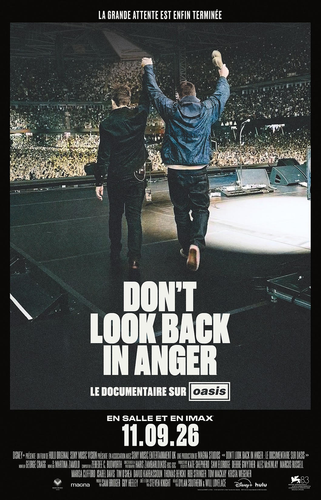
The first reunion show in Cardiff provides the documentary with its natural climax surprisingly early. As Liam and Noel walk onstage, Liam takes his brother’s hand and raises it in the air. The crowd’s response is overwhelming. Years of arguments, insults, solo careers and failed hopes disappear, at least for that moment, under the opening chords of Hello.
From there, the tour moves through cities including Manchester, Dublin, London, New York, Tokyo and São Paulo. The locations change, but the emotional response remains remarkably consistent. People sing, embrace, pray and cry. Parents bring children who were not alive when Oasis split up. Younger fans experience these songs live for the first time alongside people who have carried them for 30 years.
I am not ashamed to admit that I teared up more than once.
The film’s real subject is not the reunion itself, but what happened to these songs after the band released them into the world. People attached the music to friendships, families, losses and different periods of their lives. Oasis may have written the songs, but the fans took ownership of them.
One of the documentary’s most affecting images comes after a concert has ended. A teenage boy remains inside the stadium, his face red and wet with tears, apparently unable to process what he has just experienced. An older fan approaches and embraces him. They do not need to explain anything to each other. The music has already done that.
There are similar stories around the world. South Korean free-divers describe using Acquiesce for courage. A Brazilian fan introduces a dog named Bonehead. In Manchester, the film revisits the way Don’t Look Back in Anger became a communal anthem following the 2017 arena bombing. Elsewhere, fathers, sons, mothers, daughters and friends hold onto each other while singing songs that have followed them through much of their lives.
Some of these sequences are unapologetically sentimental. A priest comparing the concerts to a pilgrimage and delivering a sermon about forgiving one’s brother pushes the film’s central message rather hard. At times, the documentary appears so determined to make its audience feel something that its methods become visible.
But then the band starts playing again, the camera finds another face in the crowd, and it works.
It works partly because the emotion is not limited to the fans. Noel admits that seeing fathers and sons singing together affects him so deeply that he sometimes has to turn away from the audience. He appears genuinely surprised by the gravity of what the reunion means to people.
The gradual thaw between the brothers also gives the film some of its funniest and most touching moments. Noel describes Liam’s ability to balance a tambourine on his head like the halo in a religious painting. If Noel tried it, he says, he would look ridiculous. When Liam does it, Noel considers it one of the greatest things he has ever seen.
Liam, meanwhile, seems happy to see his brother receive the affection these songs generate. They laugh together, compliment one another and acknowledge that the power struggle that once defined their relationship no longer matters. Whether that peace will last is another question, but what we see feels more natural than a carefully staged reconciliation for the cameras.
The documentary is less convincing when considering what it chooses not to show.
We learn very little about how the reunion happened or who made the first move. The film avoids examining the deeper causes of the brothers’ estrangement and does not explore the effect it had on the rest of their family. Their children are shown enjoying the tour together, but the revelation that some of them had only recently met is left largely unexplored.
There is also no meaningful discussion of the controversy over ticket prices and dynamic pricing, despite the repeated emphasis on Oasis as a working-class band. Liam briefly jokes from the stage that there are no cheap seats, but the contradiction is allowed to pass without examination.
Noel repeatedly praises Bonehead as the sound of Oasis, yet the guitarist remains curiously underrepresented. His cancer diagnosis, which forced him to miss part of the tour, is not addressed. Other uncomfortable parts of the band’s history are either condensed into quick montages or omitted completely.
That leaves Don’t Look Back in Anger feeling less like a definitive documentary and more like an authorized celebration. It is not especially interested in questioning the reunion, the business behind it or the less flattering parts of the Oasis story. Anyone hoping for an unguarded examination of the Gallagher relationship will probably leave frustrated.
There is also a structural problem. Once Cardiff proves that the brothers can share a stage without everything collapsing, the film loses its main source of tension. The subsequent concerts are joyous, but they inevitably repeat the same emotional beat. Another city arrives, another crowd explodes, and another group of fans explains what Oasis means to them.
Yet reducing the film to a promotional souvenir would be unfair. Southern and Lovelace capture something genuine about live music and the connections it creates between people who may otherwise have very little in common. At a time when so much of life is experienced alone through a screen, there is something powerful about watching thousands of people gathered in one place, singing the same words and feeling free to be emotionally vulnerable with complete strangers.
The film also reminds us just how many extraordinary songs Oasis have in their catalogue. Removed from the arguments about Britpop, tabloid behaviour, and the endless question of whether they were overrated, the music remains remarkably direct. These are songs built to be sung by crowds, but their scale does not erase their personal meaning.
Perhaps that is why the documentary affected me as much as it did.
Oasis were never the most important band in my life. Even when I was standing on their stage at Wembley, I am not sure I understood what they would eventually come to represent. Watching this film, seeing fans young and old attach their own stories to these songs, made me reconsider my relationship with the band and with that night in 2000.
Oasis: Don’t Look Back in Anger is not the best music documentary I have seen. It is too polite, too selective and occasionally too eager to underline its message. It looks towards the joy of the reunion while deliberately turning away from some of the things that might disturb it.
But it is also funny, moving, and frequently exhilarating. It captures the emotional bond between Oasis and their fans around the world while showing two brothers beginning to understand what their music has meant to people beyond themselves.
Oasis are due to play three shows near Boston in August 2027, and I am seriously considering going to one of them. After seeing how much joy this reunion brought to people, I am not sure I want to miss them a second time.
Photo Credit: Simon Emmett
Share this :


