
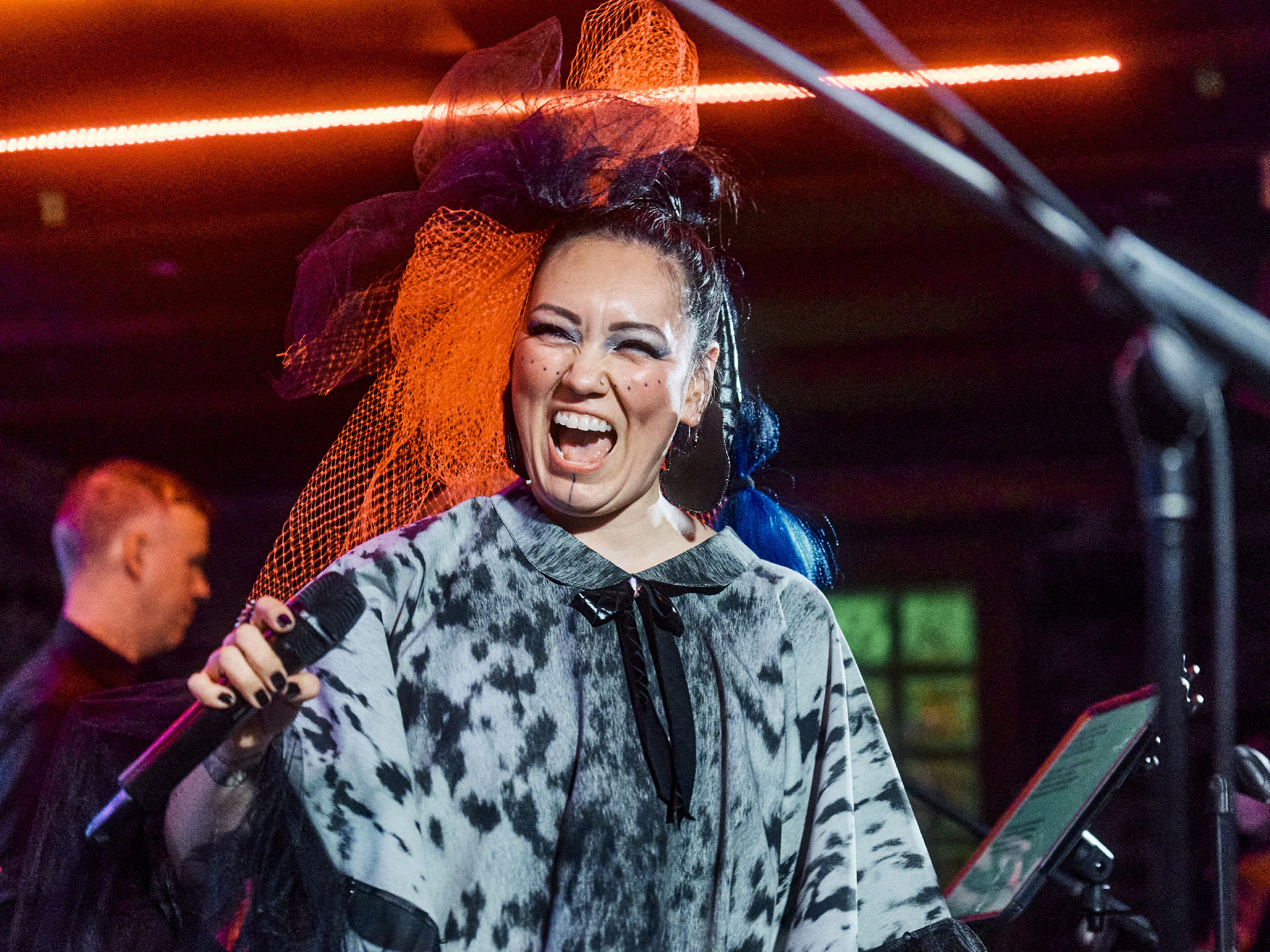
As soon as I heard Beatrice Deer‘s new album I knew that I had to speak with her. At the launch at l’Esco in April, she began by holding up framed photographs of her ancestors and her late sister before she sang a note. Over a zoom interview recorded in May, she explains why. “I found it important to include them because I’m here because of them, and I wanted people to see who my ancestors are, what they look like, what they were, where the stories come from.”
The stories are the theme of Inuit Legend, her eighth album, released on 3 April. Every song is a legend or a true tale from Nunavik, most of them sung in Inuktitut, with a few in English and one in French.
Where the legends come from
Deer grew up in Quaqtaq, one of Nunavik’s 14 coastal communities. She heard the legends mostly from her aunt. “My mother was too young when her mother died, so she doesn’t remember her mother, but my aunt does. And my aunt heard these stories from her mother and her grandmother.” That aunt was also her grade one teacher, which is when the stories started.
Some of the songs are myths and some are true. The Bear, about an old woman who killed a polar bear with her cane, is true. So is Aukkauti, the hunting accident. “Even the animal transformation stories were considered to be true, because that’s what my ancestors truly believed. But for us, today, I wouldn’t say I believe in them, but I respect and honour the stories.”
Asked whether young people in Nunavik still know the stories, she says it depends on the community. She puts the region’s population at around 14,000 and cites a census figure of 98 per cent of Inuit in Nunavik speaking Inuktitut. “A lot of people still hunt and fish. We eat our traditional food. We share our traditional food. A lot of women are seamstresses.” She makes her own stage clothes. “We’re very lucky that there is leadership that values preserving, promoting our language and culture.”
Writing the songs
The songs start alone, on guitar. “I write the music on my guitar by myself and I come up with the melody and I send it to [my bandmates], and they’ll make it a million times better. Then we’ll go in studio and I’ll start working on more melodies, and at the same time I’m looking for a story to go with the song.” She listens back and decides which legend fits the music, rather than writing music to fit a legend.
One song on the album is in French, The Fog. Deer’s mother is Inuk and her father is Mohawk, from Kahnawake. “I find it’s important to at least have one song in French, because it’s also honouring my paternal grandmother, who was Québécois and was married to my Mohawk grandfather. And we live in Quebec and I wanna be inclusive. And I’m sharing my life with a Quebec man, and we have a child who is Inuit and Québécois, so I think it’s important to also include French in my repertoire.”
Her favourites on the record are Aukkauti and Falcon and the Woman. The second is a story she could only half remember. “My auntie told us this story. I must have been six or seven years old, and I couldn’t remember the rest. I just remember that it was a falcon that kidnapped a woman and she escaped.” She couldn’t ask her aunt, who has dementia. “I really wanted to tell this story because I remember it a little bit. And then with the music, it just turned into my victory anthem, as a domestic abuse survivor and sexual abuse survivor. So I turned it into my song.”
Throat singing, and a children’s song
Throat singing runs through the album. “Throat singing songs are imitations of nature, imitations of the environment, and it’s a friendly competition between two people. We’re making the same sound one after the other, and it’s technically challenging. You’re using your vocal cords and vibrating your vocal cords, and using your inhale, exhale breath.” Traditional music had no instruments, she points out; the band is the modern part.
I first saw her perform at a benefit for a women’s shelter (Logifem), where she sang a song that sounded happy with an upbeat Johnny Cash style guitar. I didn’t understand a word but I loved it. (Immutaa). Deer explains it is a traditional children’s hide-and-seek song. “It doesn’t have a linear storyline. Sometimes some sentences make sense, but it’s mostly random words. But it’s a fun song.”
Sobriety, Instagram and Inuit youth
Deer’s social media accounts were set up for the band, but she uses them for more than music. “While I have people’s attention, I might as well throw in some positive information there. As someone who’s sober now, I like to talk about my sobriety just to inspire and encourage people that they too can make that change. And as someone who used to be overweight and unhappy because of it, if I can make these changes, so can everyone else.” She wants Inuit youth to see that coming from a small community with a difficult background does not decide the rest of your life. “Our trauma and our circumstances don’t need to take over our life. Things can be better. But we have to make choices if we want to have success in our life.”
I failed grade 10 Canadian history in the 1980s, because it was really boring for me and looking back there seems to be a lot of very important information missing. Deer is measured. “There’s a slight improvement, because there’s more awareness. The curriculum, I don’t think has changed that much, but it’s the teachers who are more awake, who are more conscious.” She gets invited into classrooms and corporate conferences now, for Reconciliation Day, Orange Shirt Day, Red Dress Day. “I see this new sense of pride and awareness in the youth, where it’s not as hopeless, helpless.”
What comes next
The singles have visualizers on YouTube, and there is a bigger project coming. “We just got a grant from Canada Council to make an artistic short film for She’s in the Abyss. We’re starting the process now.” The song is about the spirit of the sea; Sedna.
Deer also designs clothing. Her designs and the band’s merch are sold through her label, Uummati Clothing.
The weeks after this conversation were busy ones: a filming trip to Wendake, shows in Cambridge Bay, Nunavut, over a weekend, Ottawa on 25 May, Quebec City on 30 May and the SuperFolk Festival in Morin-Heights on 14 August.
Interview and photos by Annette Aghazarian.
Inuit Legend is out now.
Share this :


