
If you make a friend at a Josh Johnson show, he wants to hear about it.
“There’s an open invitation to always DM me anytime you make a friend at the show,” Johnson says. “It means that the sort of mission of the show is actually happening.”
That is an unusual measure of success for a comedian about to play four shows at L’Olympia. Ticket sales matter, and so do the laughs, but Johnson has built Comedy Band Camp around something less easily measured. He wants the people in the audience to feel as though they belong there, and perhaps leave knowing someone they did not know when they arrived.
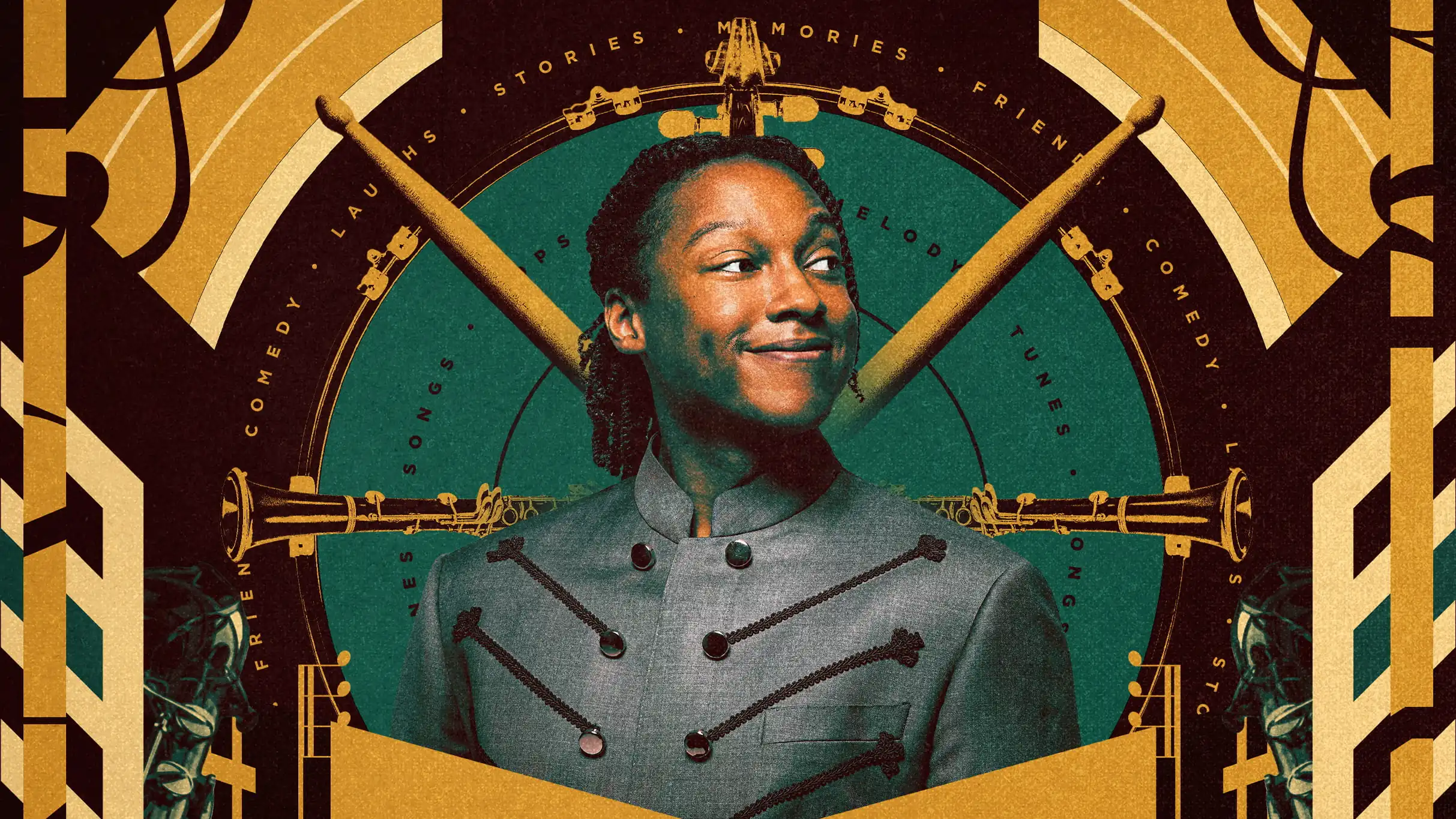
Part stand-up show, part live music experience, Comedy Band Camp is Johnson’s attempt to create the summer camp he never experienced as a child.
“I never really got to go to camp as I imagined it,” he says. “The big summer camp where you’re away from home for weeks or something. I never got the opportunity.”
Johnson could have left that experience in childhood. Instead, it became the starting point for his most elaborate live production yet.
“Whenever you make something, you’re making something that does not exist yet,” he says. “I think it’s still possible to make something for yourself and for other people that you maybe missed out on at the time, but now you’re creating it again.”
The show extends well beyond decorating the stage to look like a campsite. Before arriving, audience members can complete a personality quiz that assigns them to a troop. Each troop has its own personality, colours and merchandise, while the dancers serve as camp counsellors. When people spot someone wearing the same colours, they already know that person answered the quiz much as they did.
It might sound like an elaborate framework for delivering a stand-up set, but that framework reveals how Johnson thinks about comedy. The jokes are central, but so is the room in which they are told. Comedy Band Camp is designed to turn an audience into a temporary community.
Johnson opens with stand-up before the production expands to incorporate music. The change in tone is deliberate. He is not attempting to force every musical moment towards a punchline.
“The middle of the show, having the music element to it, isn’t necessarily just made to be funny,” he says. “It’s also made to immerse you in the sort of world that we’ve been building of what Comedy Band Camp is.”
Music has occupied a growing place in Johnson’s work, although he is quick to acknowledge his limitations when working alongside professional musicians. He does not enter the studio pretending to know more than the people around him. His contribution is often energy, curiosity and an instinct for what the larger project needs.
“I’m aware that I know the least about music theory and I know the least about playing,” he says. “But I am sometimes the most excited. It’s like you’re being a kid again and you’re just getting creative with your friends.”
His current listening moves freely between generations, from Prince and Dizzy Gillespie to younger hip-hop artists. Johnson is fascinated by the way music survives, long after the promotional money behind a record has disappeared.
“Even a label with millions of dollars is only going to push an artist or a record for so long,” he says. “I think the things that last over decades last because they were passed on by people who genuinely loved them to other people who genuinely loved them.”
That relationship between music and repetition also influenced Symphony, Johnson’s first HBO stand-up special. Released in May, it reached No. 3 on the platform during its debut week. What appears to mean more to Johnson, however, is hearing that viewers have returned to it.
Comedy rarely enjoys the automatic replay value of music. Once the tension and reveal of a joke are known, the experience changes. Johnson wanted Symphony to hold up after that surprise was gone.
“Maybe if the joke is written well enough or delivered well enough, you enjoy every part of the joke being told the same way that you enjoy every part of a song,” he says. “But there’s not the same feeling in repeating music as there is with repeating comedy.”
With a song, knowing what comes next can be part of the pleasure.
“You don’t listen to a whole song just to get to the guitar solo,” he says. “Every moment is what’s important.”
That idea also helps explain the scale of Comedy Band Camp. Johnson is not treating the music, personality quiz or camp counsellors as decoration around the main event. Each element contributes to the experience, just as every part of a song matters beyond its chorus or solo.
The production arrives at a point when Johnson’s work is reaching audiences through several very different formats. Alongside touring and releasing a steady stream of material through his own YouTube channel, he is now a rotating host and correspondent on The Daily Show, where he previously spent seven years as a writer.
Moving from the writers’ room to the host’s desk has required an adjustment, but Johnson credits the people around him for making that transition possible.
“All the support that I get is one of the reasons why I feel more and more comfortable every week that I get to host,” he says.
Writing about current events also means knowing that several comedy programmes may be tackling the same story on the same night. Johnson believes originality comes not from finding a subject nobody else has noticed, but from following that subject far enough into your own experiences and temperament.
“If you go deep enough into your own personality and feelings about how you approach a topic, you’re going to land some places that other people don’t,” he says.
The same principle applies to Comedy Band Camp. Summer camps, live music and audience participation are not new ideas. What makes the show Johnson’s own is the childhood experience behind it and his determination to build more than another setting for stand-up.
Montreal has watched that creative confidence develop over the past decade. Johnson first appeared at Just for Laughs as a New Face in 2016 and returned with the Flowers tour last year. He remembers Montreal audiences clicking with his comedy immediately, and the city has gradually become somewhere he looks forward to revisiting.
When he has time before a show, Johnson usually searches for a museum or comic book shop. He wants to spend part of each visit with somebody else’s art before stepping onstage to perform his own.
“I love Montreal’s art, not just in the comic book shops or the museums, but even around town,” he says. “The whole city is so beautiful.”
He is also looking for somewhere to eat after the final show, and welcomes recommendations. But the messages Johnson values most will arrive later, after the troops have dispersed and the temporary camp has packed up.
For all the music, staging and spectacle, his preferred sign that the show worked remains remarkably simple: two strangers met in line, recognized something of themselves in each other and left as friends.
The camp Johnson missed as a child may last only one evening. He still wants everyone there to feel like they belonged.
Josh Johnson performs Comedy Band Camp at L’Olympia on Friday, September 4 at 7 p.m. and 10 p.m., and Saturday, September 5 at 5 p.m. and 8:30 p.m.
Watch the full interview below:


