
In 2015, Chris Squire handed Billy Sherwood the most important bass in rock and asked him to keep going. He hasn’t stopped.
There is a particular kind of weight that comes with picking up where a legend left off, and Billy Sherwood doesn’t pretend otherwise. As the current bassist for Yes, he stepped into a role that Chris Squire, the band’s founding low-end architect, personally handed to him before passing away in 2015. Nearly a decade later, with the band’s 24th studio album Aurora out in the world on June 12, 2026, Sherwood is still making good on that promise.
“Chris knew my heart had been in this for decades,” Sherwood says. “So he entrusted me with something that was super important to me. I promised him I’d keep going and going for it and make it my full commitment.”
From a White Grand Piano to a Bass in the Garage
Sherwood grew up in Las Vegas in a household where music was in the air. His father was a big band jazz musician who had recorded on Capitol Records decades before the Beatles, and his mother was, by his account, still a great drummer and singer. Then there was his godfather, Milton Berle, whose television variety show featured his dad as a sidekick in the early days of broadcast TV.
“My first memories are playing with my Hot Wheels underneath my dad’s white grand piano while they were rehearsing the Dixieland jazz band,” Sherwood recalls. “Music was all I knew. I assumed that was my path.”
He eventually moved to Los Angeles in the late seventies, living with his brother Mike’s band Logic while figuring out his own direction.
By then, he was already carrying something most young musicians don’t have: a deep, early fluency in the American songbook. Waiting backstage at his parents’ gigs as a kid, he absorbed Sinatra, Cole Porter, and the great standards writers by proximity and necessity. “I actually took that in at a very early age and understood the value of what was going on there,” he says.
But his dad wasn’t playing it straight. Looking back now, Sherwood hears something in his father’s records that sounds almost like a blueprint: no vocals, all instrumental, trippy arrangements that pushed the boundaries of what a big band could do. “One could say progressive big band,” he says. “Because he was in that mindset.”
The notion that music could be genuinely adventurous, that creativity had no ceiling, was baked in early. That foundation would quietly inform everything he did later, even as rock and roll dragged him in a very different direction.
Rock and roll found him early, through the radio, through the kind of songs that stick to a kid whether he’s paying attention or not. Tell Me Something Good by Rufus and Chaka Khan. Love Roller Coaster by Ohio Players.
He still talks about the drum part on Tell Me Something Good with genuine awe. “The backwards nature of it still trips me out when I listen to it. The way he played those drums is amazing.”
His first ever concert was Earth, Wind and Fire. “I was a huge Earth, Wind and Fire fan,” he says. The funk, the groove, the rhythmic misdirection, it all got under his skin.
Then, a deeper musical education came through his brother Mike and Mike’s best friend Jimmy Hahn, both five years older and happy to play curator. “They’d always tell me of stuff to listen to,” he says. Weather Report. Genesis. Mahavishnu Orchestra. Gentle Giant. Yes. Pink Floyd. A steady diet of records pressed on him by two guys who clearly knew what they were doing. “Have you heard this? No. What is it? Oh, it’s amazing.” That’s how he came to prog.
Even before Mike and Jimmy got hold of him, the instinct was already there. He was drawn to the strange corner of whatever he was listening to, the drum part that didn’t quite sit where you expected, the arrangement that made you work a little. “I was always looking for the obscure within what I was listening to,” he says, “because I wanted to be challenged. I needed to listen to something a bunch of times to fully get it.” A kid like that was always going to end up somewhere interesting.
Logic‘s first record was produced by the guys in Toto. He was young, he says, and at the time he was already mentally picking out his Maserati and his house in Beverly Hills. “All those things you do when you don’t quite understand the business,” he says with a laugh.
The switch from drums to bass came courtesy of his friend Jimmy Hahn, the guitarist in Logic. After Sherwood spent most of an inheritance on a massive drum kit, set it up in the garage, and started jamming, his brother Mike walked in and shut it down immediately. Too loud. Six people in a small house.
“Jimmy came out to the garage and said, you’re going to think I’m crazy, but you should play bass,” Sherwood remembers. “You can play in headphones any hour of the day you want to.”
That advice, practically speaking, is why Sherwood went from roadie, to playing bass and singing for Logic, to now being the bassist in Yes.
The Church of Chris Squire
Once Sherwood picked up a bass, he went deep. The person he went deep into was Chris Squire.
“I sat in my room and learned Tales from Topographic Oceans from tip to tail, and Relayer. I used to play the Gates of Delirium every night. It was a ritual.” He pauses. “I never imagined in a million years I’d meet Chris, let alone that we’d become friends, let alone that we’d be having this conversation now, eleven years after his passing.”
His path to Yes wasn’t a straight line. He came in initially as a second guitarist in the nineties, later formed the side project Conspiracy with Squire, and worked in the band Circa alongside Tony Kaye and Alan White. By the time Squire asked him to take over on bass, Sherwood had been orbiting Yes for years. The role fit like a well-worn glove.
What Aurora Actually Is (And Isn’t)
Yes will release Aurora on June 12, 2026, the latest in what some are calling a trilogy alongside The Quest and Mirror to the Sky. Sherwood finds that framing mildly amusing, because he genuinely hadn’t thought of it that way until journalists started bringing it up.
“I’ve only recently discovered it’s a trilogy,” he says. “Every time I hear it, I kind of chuckle. I’m like, oh, it is?”
The record came together the way Yes albums tend to, with everyone writing in their own corners and then throwing the material into a communal pool. Sherwood and Jay Anderson jammed and co-wrote. Steve Howe served as producer and arranger, stitching the pieces together in ways no individual writer could have anticipated.
The Czech National Symphony Orchestra appears on two tracks, Aurora and Ariadne, though Sherwood is quick to direct that conversation toward Steve Howe, who drove that side of the production.
One song Sherwood did write entirely on his own is the bonus track River Roll, and he’s visibly happy it made the final cut as written. The lyric is straightforward in the best way: life as a river, the sea as the destination, the journey as the whole point.
“The joy of the ride, while it’s also filled with heartbreak and sorrow, it’s got amazing joy in it as well,” he says. “Just take it all on board and get down the river.”
On questions about the album’s deeper lyrical themes, specifically the title track’s themes of inner awakening and spiritual searching, he defers gracefully to lead singer John Davison, who wrote the bulk of the words. He does land on a broader point about how listeners inhabit music differently than the people who made it.
“People will come up to me talking about a particular song and tell me what they got out of it. When they’re done, I’ll say, that’s really cool that you perceived it that way, but it’s actually about this. So it’s up to the listener to decide those important things when they listen. That’s part of the beauty of art.”
Human Beings Playing Cool Music
Sherwood is a reels junkie. He said so unprompted. On the road, between soundchecks and hotel lobbies, he scrolls, and somewhere in that habit he stumbled across a Quebec duo called Angine de Poitrine before the band went viral. He watched them before anyone told him to. He was into it immediately.
“I heard the first track, I think it was Sherpa, and I was like, whoa, wait a minute, there’s something going on here,” he says. “It sounds like prog to me. It sounds like it could have been Gentle Giant. The way John Weathers would play four-four through bars of five, and the math would iron itself out after a few bars. But the thing about all that is, if it doesn’t feel good, it isn’t going to work. These guys have that funky thing going on where it just feels really cool.”
He sees the same phenomenon at play with the renewed interest in Yes, and in prog more broadly. It’s a human reaction to a world increasingly saturated with machine-made sound.
“When the drum machine came out, drummers were told it was over for them. But people went back to real drums and real playing. AI has a level of perfection that, on one hand, yeah, it’s perfect. But the soul, which creates the imperfections, how could it not? Because we’re not perfect. It comes into the music and there’s something magical and human there.”
He said in interviews years ago, when people would ask who might eventually take over his chair, that by then it would probably be some DARPA robot. “And yes, it might become robotic. I don’t know. But it’s nice to know that right now, there is some pushback.”
On the Road with Fragile and Something Brand New
While Aurora arrives in the world, Yes is simultaneously touring the UK performing Fragile in full, the 1971 album that cemented the band’s identity. Sherwood has played tracks from that record many times, but doing the whole thing front to back is different.
“My favorite part is just watching the fans,” he says. “When you get into Heart of the Sunrise, the bass lines riffing, these guys are jumping up and down. Then when you get to the singing, other people are just grabbing their chest. It’s lovely to watch.”
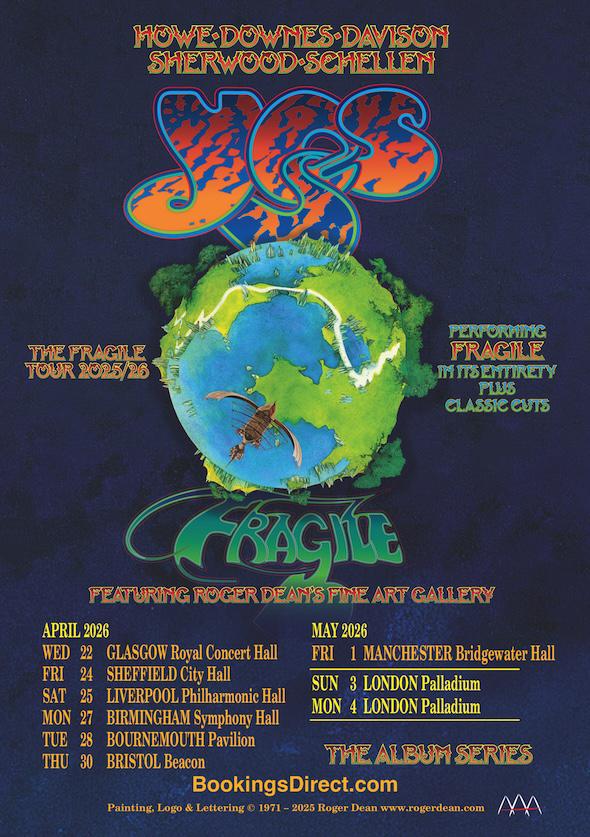
The Fragile UK tour is underway now, with new material from Aurora expected to be woven into upcoming setlists as well.
The Vinyl, the Package, and the Ritual of Inconvenience
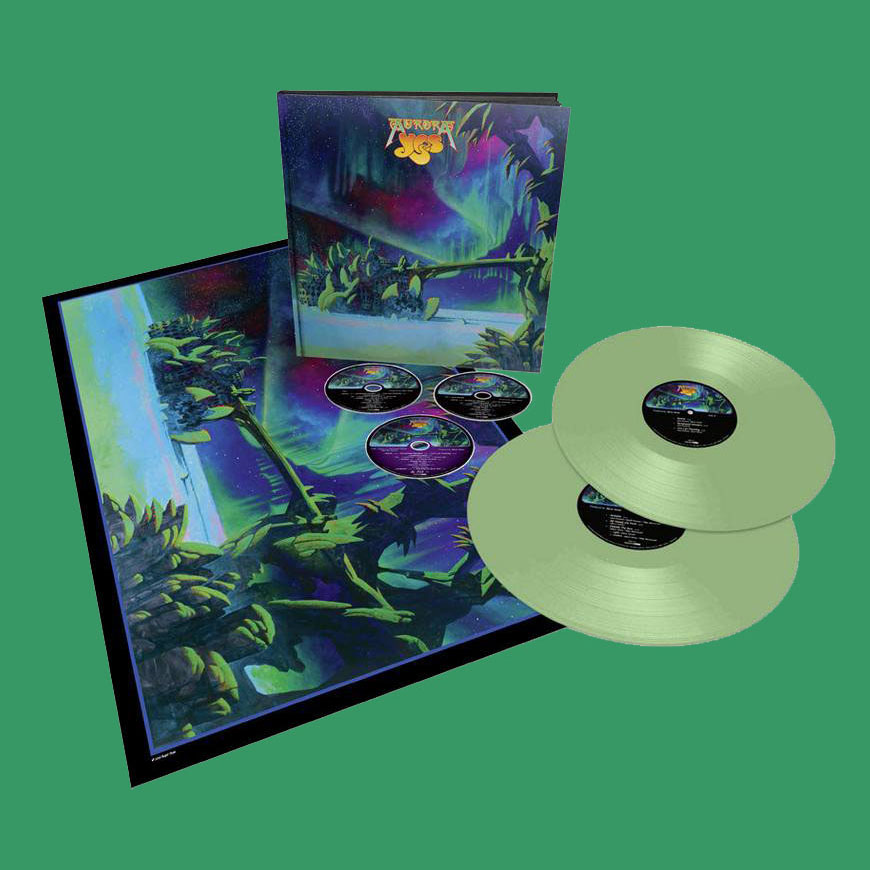
Sherwood showed up to our conversation with a box of Aurora product behind him: the vinyl, the CDs, a deluxe package loaded with studio photos that he described as almost like a tour program. Roger Dean, who has designed Yes album artwork for decades, handled the visual side, as he always does.
“When you’re listening to that music and gazing into the world of Yes, it’s the full experience,” Sherwood says. “It sort of takes you back to when we were young.”
I told him I collect signed vinyl specifically because of the ritual of it, the deliberate inconvenience. You pick a side. You commit to it. You have to get up and flip it. It is nothing like a Spotify playlist, and that’s exactly the point. He nodded.
“I think it’s cool in the way that you fully detach from your phone for five minutes or however long you’re going to listen, and get into the experience of what that piece of art is about.”
The full deluxe package, vinyl, and CD versions of Aurora are available for pre-order here.
Writer: Randal Wark is a Tech entrepreneur, Managing Partner of MTech Cyber with a focus on cybersecurity along with a passion for live music. You can follow him on Instagram, Twitter and YouTube. His Podcast RockStar Today helps musicians quit their day jobs with out-of-the-box advice from Ted Talk Speakers, Best Selling Authors and other interesting Entrepreneurs and Creatives. He created the Rock Star Today Music Business Jam Session for musicians. Randal is a collector of signed vinyl, cassettes and CDs.
Share this :


