
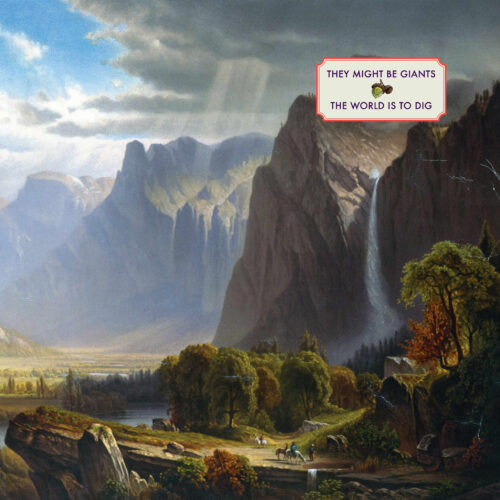
The World Is to Dig is exactly the kind of title They Might Be Giants would choose. It sounds like a private joke and a worldview at the same time, which is pretty much their wheelhouse. Four years ago, BOOK came out, got a Grammy nomination, and confirmed that John Linnell and John Flansburgh were still making proper records rather than coasting on goodwill. The new album took longer than anyone planned.
“For a band that has been making albums pretty consistently for a long time, we got momentarily derailed,” Flansburgh says. “The pandemic DEFINITELY kept us out of the studio for a bit, and to make things worse, a couple of years back, I was in an Uber that was hit by a drunk driver and broke a lot of ribs in that accident. It was pretty serious, and that set me back for a good spell. But I am happy to report I am healed and optimistic about the future!”
He says it like someone who’s decided not to make it a whole thing. Fair enough. What’s worth noting is that The World Is to Dig doesn’t sound like a record made by someone who spent time recovering. It sounds like a band that was eager to get back in a room and start making noise. Quick, slightly overclocked, following odd little pathways, finishing songs when they feel done rather than when they hit some predetermined length.
The title traces back to a kids’ book. “It is my own self-invented phrase, with the word ‘dig’ functioning in the beatnik mode of the word,” Flansburgh says. “I grew up with a sweet little kids’ book entitled ‘A Hole Is to Dig,’ which was an early book illustrated by Maurice Sendak, and the images in that book just rattle around in my mind.”
It doesn’t become a grand statement. It’s just a phrase that stuck around long enough to become useful. That’s pretty consistent with how They Might Be Giants operate. Their songs don’t arrive with a thesis. They come in sideways, built out of odd bits of language, half-remembered pop forms, nervous jokes, melodies that seem obvious until they suddenly aren’t.
Flansburgh has a trampoline metaphor he uses to describe the songwriting process, though he’s slightly self-conscious about how much mileage it’s gotten. “I have used the trampoline metaphor in describing how we bounce off of smaller ideas to make complete songs,” he says. “Some smart person who wrote our current bio picked up on the idea and might have turned it into a better quote, and I certainly don’t disagree.”
When he talks about the actual mechanics of writing, though, it gets more interesting. “These days, at least from my perspective, I feel like John L. writes pretty efficiently and focuses up on essential stuff early on so his efforts aren’t wasted and he crosses the finish line early. It seems like he doesn’t waste a lot of time. My efforts in comparison feel pretty vague. On the music side, I cook up a lot of beats, chord progressions, and bass lines. And on the lyric side, I have notebooks with lists of single words, turns of phrase, and couplets, fragments all waiting to be revisited when I get down to the actual business of finishing a song. As I said, it’s not that efficient, but I always feel like I have strong ingredients on hand to finish what I’m starting.”
That gap in working styles probably explains why their records feel stuffed rather than manicured. Songs don’t get sanded down. There are rough edges in the language, little catches in the melody. Something got built and someone decided it was done and they moved on.
Take “Wu-Tang.” A song about the Wu-Tang Clan done in the style of bright ’60s pop should be a disaster. It isn’t. “John put that song together and, to be candid, I loved it completely from the jump,” Flansburgh says. “While the form and the content might seem in opposition, it’s the friction between the subject of the song and the form of the song that gives it energy. A song about someone enthralled by the Wu-Tang Clan in the style of the Wu-Tang Clan could only come across as a timid tribute.”
That’s the whole game, really. They Might Be Giants don’t replicate influences, they bend them until they snap into something else. The risk of sounding ridiculous is part of the point. Always has been.
“Outside Brain” runs on a different kind of energy. Flansburgh describes it in practical terms. “Well, just like in ‘Wu-Tang,’ it’s a balance between lyrics and music. The lyric to ‘Outside Brain’ is like a slalom course. We’ve been rehearsing it for shows, and it’s a mouthful. The arrangement of the song, specifically the drum track, has this relentless snare that drives it, and actually matches the energy of the lyric. That Bobby Fuller machine gun beat got picked up by the Clash and a lot of folks since.”
The song feels cornered by its own momentum. The panic in the lyric is also in the beat, the arrangement leaning forward the whole time, not quite able to stop.
“Sleep’s Older Sister” arrives from somewhere completely different. It goes into Greek mythology without turning ponderous, which is a trick They Might Be Giants can pull off partly because they never seem especially concerned with sounding important. Flansburgh says, “I started working on the song before my accident, but I had a lot more time to think about it afterward. Reading about Greek mythology, it just reaffirms to me the notion that the struggle with death is pretty universal. It’s a little bit of melodrama mitigated with a large dose of melancholy.”
The extra time shows. There’s something in the track’s atmosphere that feels like it was given space to develop, something that opens out and gets darker and doesn’t rush toward a resolution.
Packing 18 songs onto the album is a deliberate choice. “If we made it a dozen songs, the album would be under 30 minutes, and I’d imagine that would probably generate some grumbles,” Flansburgh says. “Our songs often are missing the intros or fade-outs or solo breaks that a lot of bands have built into their arrangements, so they end up closer to two minutes than three. We always want to deliver a full-length album, which means 35 to 40 minutes of music, and for us, that usually ends up being 18 songs rather than 10 or 12.”
Their songs tend to start as if they’ve already been going for a while, say whatever they came to say, and disappear. Eighteen of them back-to-back doesn’t feel like too much. It’s a lot of ground covered fast.
The Bigger Show Tour, which starts this month with multi-night stands across the U.S., spotlights different records from the catalogue each night. Flansburgh is quick to clarify. “Just to be clear, we don’t play them straight through, we usually just play about half an album, and yes, subjectively I’d say the better half!”
What he says next is worth sitting with. “Our perspective and our audience’s perspectives have changed a lot over the years, and some albums that just kind of floated past the general public years back are now among the most appreciated by our audience. We have committed to a half dozen albums so far and have spotlighted some of our most successful, like Flood, and some of the most overlooked, like Factory Showroom and Mink Car. We have a healthy amount of self-doubt, and I feel like our quality control has been pretty solid, and these sets seem to illustrate that. For some folks, it’s like an impossible dream to hear these less celebrated albums, but I’m proud of those songs, and it’s exciting to see how well they go over now.”
Four decades in, and they’re still not entirely sure they’re right about their own work. That’s probably a feature, not a bug.
The touring format has changed the pace of things in a way Flansburgh sounds genuinely relieved by. “We get to sleep in as well as actually see some of the places we play, and that all feels like a revelation. We also have a great invitation to change up the show each night, which keeps things fresh. I wish we had figured out how to do this years ago.”
Sleep and time in a city. After years of the usual grind, those things start to sound almost radical.
Asked why They Might Be Giants seem to have outlasted so many of their peers, Flansburgh isn’t interested in giving a heroic answer. “Music as a profession is filled with double-edged swords. A lot of my favorite music never found its way to bigger audiences, so maybe it’s easier for me to see the bright side of a mid-sized career like ours. I’ve seen a lot of things arrive, blow up huge, and then get kind of tied to a time and a scene that then fades, kind of nullifying the artists. But I bet they thought they still had plenty to say! So, we never experienced that and get to keep on working. But who knows, maybe we’ll get over our hangups and get down to making that credibility-destroying novelty hit! We’d shake the critical interest, but we’d have some money to cheer us up!”
He gets the joke in before anyone else can. Probably wise. The World Is to Dig sounds like a band still curious enough to go looking in corners other acts have given up on, and there’s something genuinely good about hearing that kind of restlessness still going after all this time.
The World Is to Dig is out now.
Share this :


