
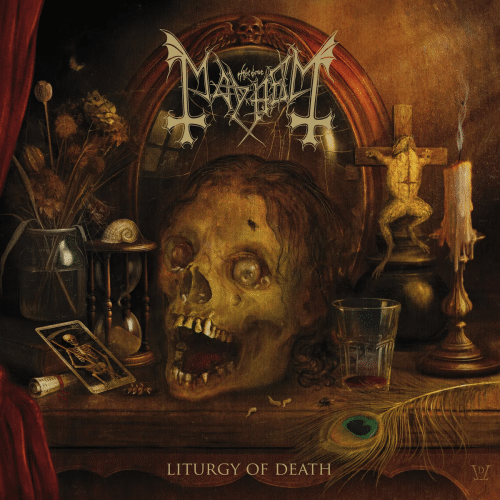
Mayhem release Liturgy of Death with all edges intact. The album consists of eight tracks, clocking in at just under fifty minutes, without any interludes feigning mercy. The record arrives with the confidence of a band that knows exactly what it is and has zero interest in explaining itself to newcomers. Black metal has always been about tension, about refusing comfort. This album delivers on that premise.
Ephemeral Eternity hits immediately. Muted percussion and synthetic haze hang in the air, not cinematic, more like a warning system humming before impact. The guitars grind into place. Attila Csihar’s voice arrives early, elastic and theatrical, tangled directly into the music. The track shifts shape constantly. Time signatures buckle. Riffs appear, dissolve, then re-emerge mutated. Jan Axel “Hellhammer” Blomberg’s drumming is central here, not just propulsive but architectural, shaping how each section breathes or suffocates. The song never settles.
That restlessness continues on Despair. This isn’t introspective sorrow or slow-burning gloom. It’s anxious, forward-leaning, and almost claustrophobic. Blast beats push relentlessly, guitars stacking patterns on patterns. Csihar’s operatic flourishes might feel exaggerated in another context, but here they sound warped by the surrounding chaos, like the voice itself is being stretched beyond comfort. The final stretch runs long and the impact softens slightly, but the intensity never fully drops. Live, this would be suffocating in the best possible way.
Weep for Nothing zeroes in on precision. The guitar interplay gets clearer, especially when the drums briefly fall away. Necrobutcher’s bass sits low and physical, felt more than heard, anchoring the track while the riffs keep shifting overhead. Motifs recur but they don’t just loop. Even the drums feel melodic at times, patterns circling back with subtle variation. The closing build tightens the screws until release becomes inevitable.
Aeon’s End goes straight for classic second-wave aggression. Endless blast beats drive forward while Csihar cycles through snarls, growls, and cavernous chants. A guitar solo surfaces briefly, almost shocking in its clarity, before being swallowed again. Technical flourish still exists here, but only when it serves the atmosphere.
The middle stretch deepens. Funeral of Existence introduces groove without relaxation. Riffs blur into one another, constantly evolving, while the rhythm section keeps everything grounded. Necrobutcher’s bass work stands out here, providing cohesion where the guitars refuse stability. The track never resolves in a traditional sense. No cathartic release, no harmonic closure. It ends as it began, unresolved, fitting for a song about death as a state, not an event.
Realms of Endless Misery attacks more directly. Sections pivot between almost melodic phrasing and outright brutality. The slower central passage opens into a billowing soundscape, repetitive riffs circling while Hellhammer fractures the beat with sharp fills. When the chant-like groove emerges later, it feels earned, a moment of grim unity before the track surges forward again.
Propitious Death treats mortality as inevitability, not horror. The opening is immediate and violent, then collapses into disjointed rhythms where Hellhammer’s patterns feel almost guitar-like in their phrasing. Death metal influence weaves into the black metal framework here, integrated naturally. The track feels physical, muscular, but never simplistic.
The album closes with The Sentence of Absolution, the longest track and the most developed. Synth textures drift beneath dissonant guitars, setting a ceremonial mood. Sections flow into one another with unusual grace for something this abrasive. The dissonance becomes controlled, almost melodic in places, while maintaining tension. The final moments turn ritualistic, percussion shifting toward something tribal, voices layering before Csihar delivers the last word. It ends with something closer to acceptance than triumph or collapse.
The record returns to mortality constantly, not as spectacle but as condition. Death appears as release, as process, as constant presence. The album edges toward feeling conceptual, even if it never declares itself as such. That continuity can be demanding. This is a dense listen, and fatigue is part of the experience, especially for anyone outside the genre’s inner circles. Still, the production clarity allows each instrument space, even when everything is happening at once.
The settled sound of this lineup stands out most. No reinvention for its own sake. The band just sharpens what it already does well. Four decades in, Liturgy of Death documents ongoing intent rather than legacy. Unyielding, focused, comfortable with discomfort.
Liturgy of Death will be released on February 6, 2026 via Century Media.
Share this :


