

I’ll be honest: I came to Amenra late.
I’d listened to them in passing a few years back and it hadn’t clicked. Then I saw them at Damnation Festival in Manchester last November, and that was that. Everything changed. I came home a convert, spent the winter obsessing over their records and live videos, and had already booked tickets to see them twice at Prepare the Ground in Toronto before the Montreal date was even announced.
So when Beanfield Theatre went dark on May 27th, it was the first of three shows in four days — Montreal on the Wednesday, then Toronto on the Friday and Saturday, a heavy set and an acoustic set at Prepare the Ground, both exceptional. That kind of itinerary tells you something about what Amenra do to people once they get hold of you.
The Montreal show, though, was something apart.
Presented by Extensive Enterprise, the show marked Amenra’s first Quebec appearance since 2024, though their history with Montreal reaches back further, to early visits opening for Converge and Neurosis. What’s striking about their trajectory is how little it resembles a conventional rise. Amenra haven’t grown their audience through streaming algorithms or festival slot-climbing. They’ve done it through the oldest mechanism in music: word of mouth from people who can’t quite explain what happened to them at one of these shows. That reputation is earned, and on this night, they proved exactly why.

The evening opened with Dopethrone, Montreal’s own sludge institution, who transformed the room into a slow-moving haze of distortion and menace. Their deceptively simple riffs landed with a physical force that felt less like sound and more like weather. They didn’t just open the show — they primed the room.
The Keening occupied the middle slot, and it’s worth being straightforward: the set struggled. Hesitant vocals and tentative arrangements couldn’t hold the room, and audience chatter crept over the quieter passages in ways that undermined the work. It’s a genuinely hard slot to own, and Amenra’s audience is a specific and demanding one. But the gap in momentum was real.

Then the lights went down.
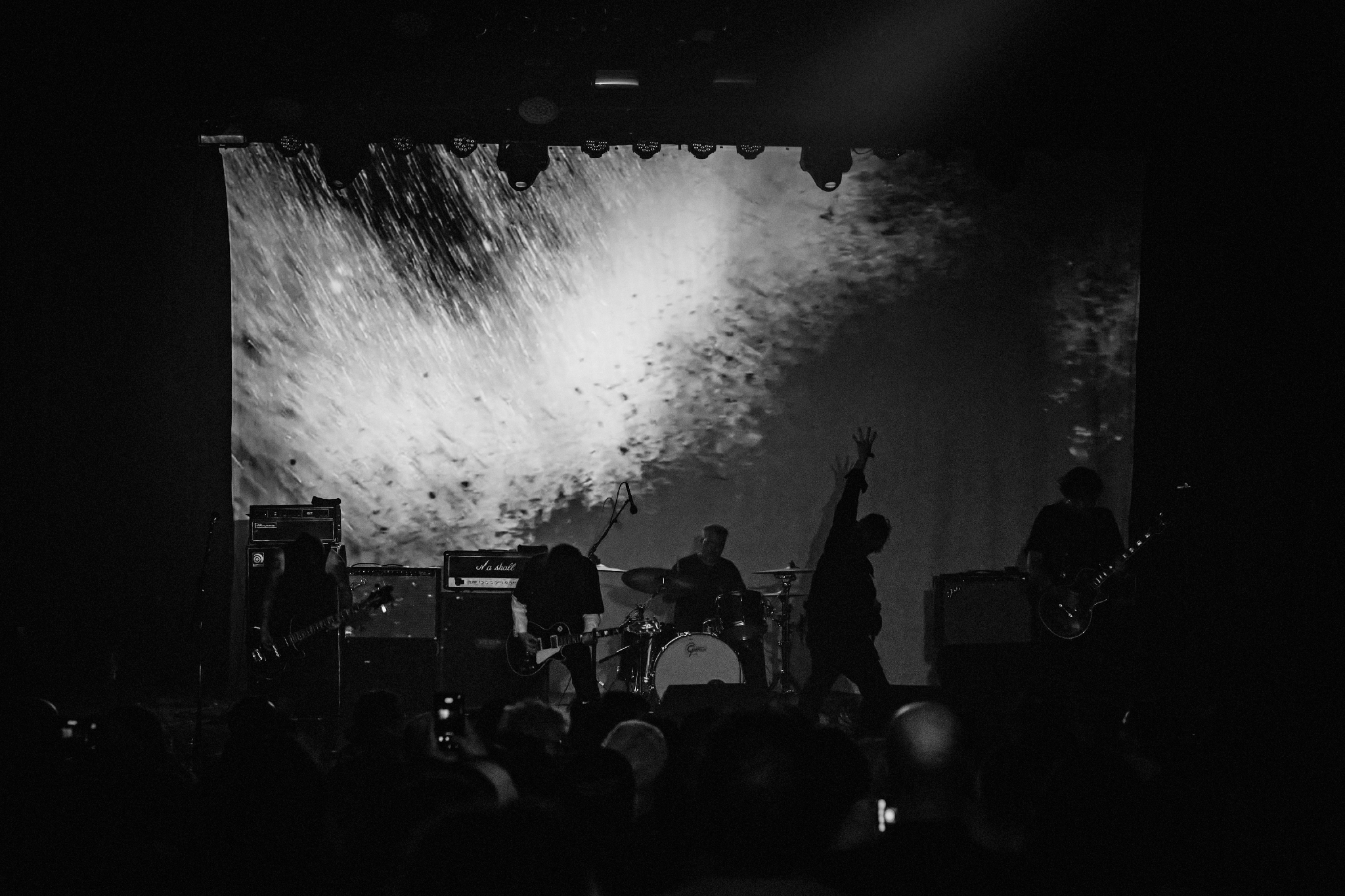
Amenra appeared beneath sparse illumination and slow-moving monochrome projections, and the room went quiet without being asked. That moment, the spontaneous collective silence before a note was played, said more about this band’s relationship with their audience than any formal introduction could.
From the opening notes of “Boden,” the dynamic was established, and it runs counter to almost everything modern live performance has decided it should be.

What makes Amenra genuinely unusual is how little they perform at you. Vocalist Colin H. van Eeckhout spends much of the set facing away from the crowd, turned inward, disappearing into the music rather than projecting it outward. In an era of maximalist stage presence, where engagement is measured in eye contact and between-song banter, this refusal to court the audience creates a paradox: you feel closer to something, not further from it. Rather than being performed to, you feel admitted into something private.
“Razoreater” arrived second and was as close to a conventional rock moment as the evening would get. Its colossal riffs shook the walls of Beanfield with a physicality that clarifies immediately why this music rewards a live setting over a streaming session. Colin’s screams, when they came, had the quality of something involuntary. Not performed anguish, but a convincing and unsettling channel of the real thing.
“Salve Mater” shifted the room again, establishing the emotional logic that would govern the rest of the set. This is what Amenra have refined over nearly three decades: the understanding that restraint and devastation aren’t opposites. The quiet passages weren’t breathing room. They were loaded. “Plus près de toi” followed, sung in French, and brought the most quietly affecting moment of the night. Delivered with bare-boned tenderness, the song seemed to suspend the room in collective reflection. For a Montreal audience, there was something additionally pointed about hearing those French lines rendered with such care. “De evenmens” completed the run, the three songs forming a sustained arc that moved from grief to something more complicated and harder to name.

“Am Kreuz” was the structural peak. The song has always occupied a specific place within the Amenra canon, but hearing it live in a room of this size revealed something recordings can’t fully capture: the way the band controls the space between sounds as deliberately as the sounds themselves. What begins in sorrow accumulates toward something that feels like release without quite arriving there. The crescendos didn’t land as musical events. They landed as emotional ones.
“A Solitary Reign” pressed the same point about dynamic range, moving between near-silence and obliteration with an absolute control that never reads as technical. The architecture serves the feeling, and the feeling is always the point. “Diaken” closed it out, and then the silence came again, self-imposed by a room that wasn’t quite ready to return to normal.

This is ultimately what separates Amenra from most of their peers in the heavy music landscape, and it’s worth being specific about it: they don’t offer resolution. Amenra’s songs explore grief, devotion, suffering, and survival without tidying any of it up. There are no clean conclusions here. The songs end, but the feelings they excavate don’t. What they offer instead is space, a temporary and collective permission to sit with the things that don’t fit anywhere else.
That’s not a small thing. It’s actually quite rare.
Nearly thirty years in, Amenra remain one of the most singular live acts working. Not because of technical virtuosity or production scale, but because they’ve built something that functions differently to a concert. It’s closer to a container, a temporary space where the parts of human experience that don’t have clean daily outlets can surface, be witnessed, and slowly subside.
Montreal was not watching a metal show.
It was inside one.



Review & photos – Steve Gerrard
Share this :


