
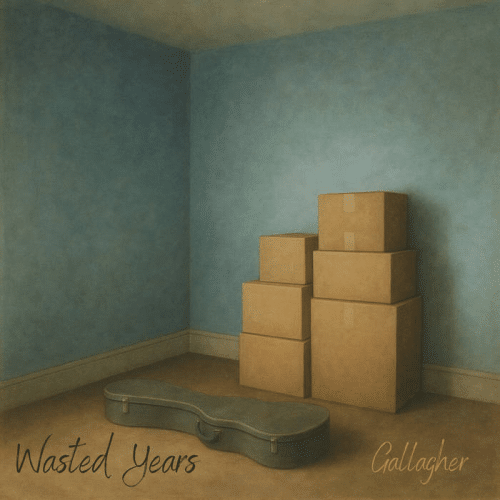
There’s something about the way certain records settle into your evenings that makes you wonder why anyone bothers shouting anymore. Brian Gallagher‘s Wasted Years, arriving October 3rd, belongs to that increasingly rare category of albums that trust silence as much as sound. This is music for late drives when the radio feels too crowded, for kitchen counters after midnight, for recognizing exactly where you are in your life without being sure how you arrived.
Gallagher has been circling this territory for years now, first with Happenstance, then through a string of solo records that steadily refined his approach. What’s different here is confidence bordering on stillness. The ISS A recognition as 2024 International Emerging Male Artist of the Year, the songwriting accolades, and the shift from band member to solo architect: all of it seems to have granted him permission to stop proving anything. Wasted Years doesn’t announce itself. It sits down across from you and waits.
The sonic architecture stays mostly consistent across these eleven tracks. Fingerpicked guitar patterns feel like someone thinking out loud, piano enters conversations rather than dominating them, Ram Ko‘s violin arrives with the emotional precision of a good editor cutting unnecessary words. Dan Legault‘s drums and the rotating bass duties from Bob Stagg and Joe Larkin provide a pulse that never hurries, never lags. The production, handled by Legault at Third Eye Studios, understands that space matters as much as sound. Everything breathes here. You can hear the room.
“After Goodbye” opens the record with that particularly difficult emotional math of sorting through someone’s absence via the objects they left behind. The arrangement builds from just voice and guitar into something fuller, but the growth feels organic rather than calculated, like grief itself, which starts private and eventually demands witnesses. Gallagher‘s voice carries the kind of wear that suggests he’s lived these scenarios rather than imagining them, though there are moments where the delivery sits so comfortably in its restraint that you wish for a bit more risk, a sharper edge somewhere.
The title track operates as a slow reckoning with pride and time. Piano leads here, with strings providing warmth rather than drama. Lyrically, Gallagher does what he does best: takes the big themes (regret, redemption, the years we misuse) and renders them through specific, tangible details. He’s not interested in grand pronouncements. He’d rather show you the exact texture of remorse by describing how someone sits at a kitchen table counting losses like coins.
“Manitoba Love” might be the album’s most immediately appealing track, a highway song that moves between Windsor heat and prairie cold with the easy authority of someone who’s actually driven those distances. The folk-country cadence feels natural here, the chorus built for windows-down singing without pandering to it. There’s genuine affection in how Gallagher treats geography as character, landscape as emotional state. You believe he knows these roads. The song earned recognition as a top 10 finalist for Folk Song of the Year in the 2025 World Songwriting Awards, and you can hear why.
“That’s Not Me” brings welcome self-awareness to the proceedings, offering a wry examination of the gap between who we are and who we present ourselves to be. The groove here has a gentle roll to it, almost conversational, and the black-humour touches keep things grounded. Gallagher knows identity shifts constantly, and he’s comfortable with that instability.
The album’s emotional centrepiece might be “Clear Blue Room,” which achieves devastation through subtraction rather than addition. New Year’s stains, Montreal sweaters, emptied drawers: Gallagher catalogues absence like an accountant of heartbreak. This is the sound of someone learning to live in spaces shaped by what’s gone.

“At the End of the World” flips the script, turning apocalypse into devotion, catastrophe into vow. The hymn-like progression refuses drama, insists on steadiness. Love is what we turn to when everything else fails, and this can be seen as either deeply romantic or deeply stubborn, depending on your mood at the time. Seiji Gutierrez and Briana Doyle add some beautiful harmonic layers that round out the sound.
Mid-album, “Dancing Through the Years” offers nostalgia without drowning in it. Old vinyl, FM radio, the mixtape as love language. There’s genuine warmth here, the kind of mid-tempo sway that feels like muscle memory from every road trip you’ve ever taken. Gallagher understands that shared music creates community, and he’s generous enough to write a song that feels like it already belongs to everyone.
“Sunday Jenny” provides necessary levity, a tongue-in-cheek folk-country shuffle about wishing every day could be the weekend. It’s slight, sure, but deliberately so, a palate cleanser before the record turns heavier. The wit feels earned rather than forced, and you can imagine this one getting audiences moving at shows, which is probably exactly what Gallagher intended.
“The Lament for Cynthia Rose” arrives like a punch you saw coming but couldn’t dodge. Narrative folk at its most unsparing, tragedy reported with the kind of restraint that makes it hurt worse. The fiddle work here is extraordinary, carrying emotional weight the lyrics wisely leave unspoken. This is Gallagher at his most devastatingly effective, trusting the story to land without embellishment.
“As Long As You’ll Always Be Mine” brings the temperature back down, offering uncomplicated tenderness after all that grief. The porch-light glow of the arrangement, the soft shuffle, the easy harmonies from Nikki Girard and André Maillet: it all adds up to simplicity that doesn’t feel simple-minded. Sometimes love is just love, no complications required.
“This Is the Last Song” closes the album with fitting self-awareness, a candlelit goodbye that knows it’s a goodbye. The curtain-call language, the comet-tail imagery: Gallagher sticks the landing by not overstaying the moment. It settles like evening, which is exactly the right temperature for an album this committed to quiet revelation.
The sequencing throughout shows real care. Grief and warmth alternate, wit arrives when heaviness threatens to become oppressive, the pacing never stalls. There’s an indie-rock attitude lurking in the margins, not through distortion or volume, but through rhythmic choices, guitar voicings that carry a bit more steel than pure folk would allow, drum accents that suggest sitting up straighter. Gallagher‘s east-coast roots (he previously served as a juror for the 2025 Ottawa Capital Music Awards and the 2026 Canadian Folk Music Awards) show in the hospitality of these arrangements. Every chorus feels like an invitation rather than a demand.
The album’s main limitation lies in its comfort zone. Melodically, Gallagher rarely ventures into territory that feels genuinely risky. The vocal delivery, while warm and worn-in, occasionally lacks the dynamic range that could push these songs from good to great. Some verses would benefit from a bit more exploration, a willingness to crack the voice open and see what’s underneath. Whether that reads as tasteful restraint or missed opportunity probably depends on what you value in a singer-songwriter record.
Wasted Years succeeds as memoir more than as revelation. Gallagher has crafted something that feels lived-in, human-scaled, genuinely warm. It won’t change your life, but it might give you better language for the one you’re already living. The record holds still and lets you arrive at your own pace, which in our current climate of oversaturation and manufactured urgency, feels almost radical.
Steve Gerrard
Share this :


