
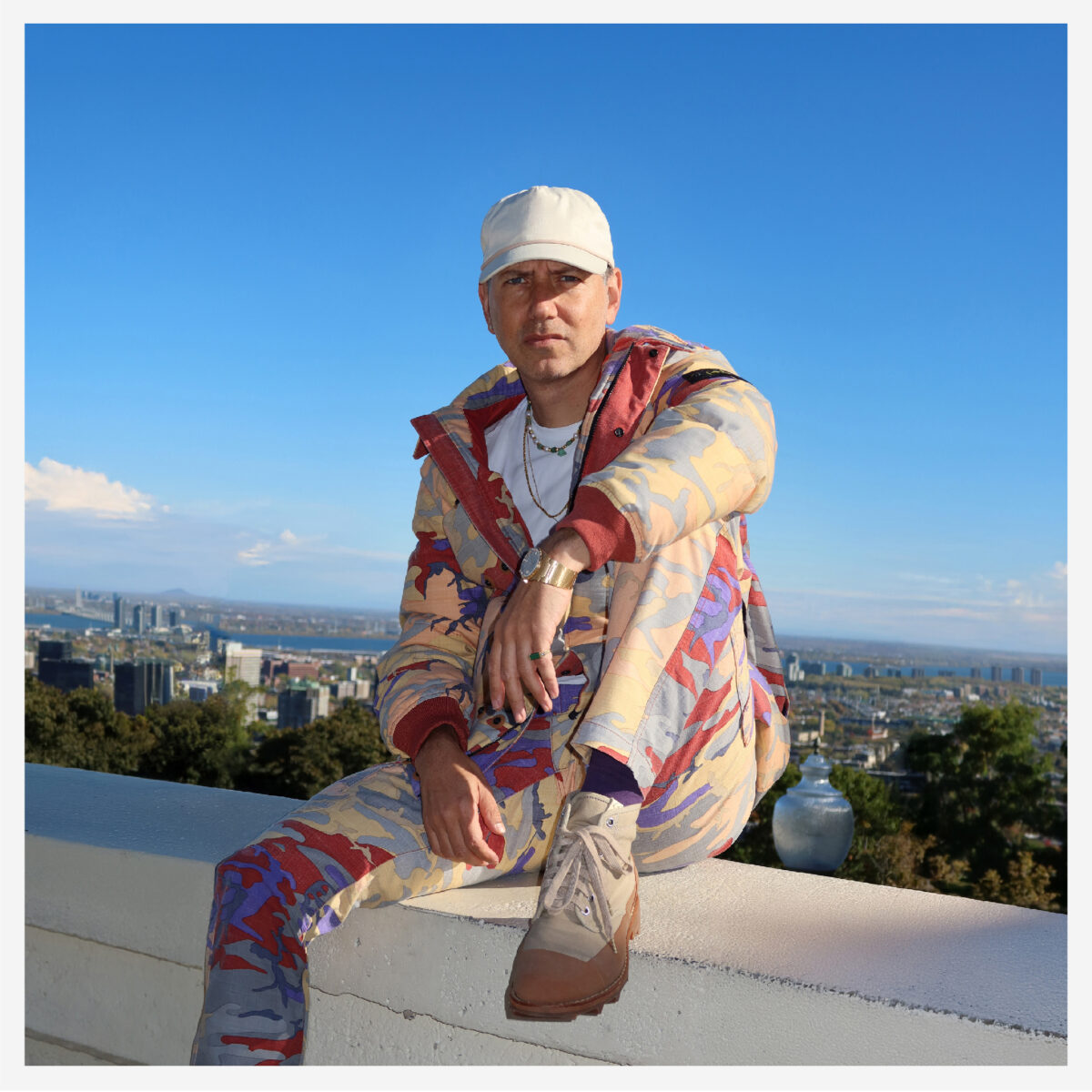
There wasn’t a dramatic turning point where TIGA decided to make Hot Life. No grand plan, no clean narrative. It crept up on him.
“I don’t remember the exact moment,” he says. “I do remember it was probably like, I don’t know, maybe a year ago. I do remember kind of all of a sudden getting quite excited, realizing that I had a lot of music again. Usually what happens is like, I guess when I get more than like four or five tracks done that I like, I start to get quite excited. And I can kind of visualize a record.”
That’s usually how it happens for him. Not a decision so much as a shift in energy.
“I’m extremely, moody is not really the right word, but I’ll have like real episodes of incredible excitement followed by kind of quiet periods. So probably in one of those really exciting periods, like an excited day with a lot of tracks, I fired off lots of messages to my manager and everybody and said, yo, I think we have an album here.”
The album lands April 17, his first in a decade, even if that gap doesn’t feel quite as dramatic from his side.
“The touring has been going kind of off and on forever. So that’s a little different. But as far as the decision to do a record, it’s just when I have enough music out and I started to feel good and I can see an album happening.”
From the outside, those years might read as a pause. He doesn’t see it that way.
“No, no, no. Well, the nine preceding years, I don’t know, listen. It’s a bit of a mystery to me where the time goes. Generally, I’m always busy. The first time in my life I wasn’t busy was during COVID.”
Even then, it wasn’t inactivity, just a different kind of pace.
“There was like a five-year period where it was relatively quiet, where it started with lockdown. Then I had some health issues. And everything did kind of slow down considerably. So like between 2020 and 2024, 2025 was definitely slower than the rest. But I grew to really like it. I mean, it was really nice. Kind of miss it a little bit.”
That slower stretch ended up reshaping how Hot Life sounds, especially in the way certain ideas were allowed to sit and come back around.
“I don’t work on music every day. Like I’m not a studio rat. For me, it’s a lot more, I’ll book studio time for, let’s say, a week. And I’ll know I’m going in. So creatively, there are a lot of periods where I’m not making stuff, where I’m doing interviews, or I’m doing admin work, or record label work. Even just the touring and the DJing requires a lot of preparation.”
One of those ideas was “Ecstasy Surrounds Me,” which had been around in a different form for years.
“I made the demo a long time ago with Matthew Dear. And at the time that I made the demo, first of all, it was quite an 80s sounding record, which I generally didn’t like to do. It was a bit easy for me. So I tried to stay away from that. And it was also a very forceful, very character driven version of myself that was quite bold and unapologetic.”
At the time, neither of those instincts quite landed.
“And then a few years passed. And then as I was exiting this dormant COVID-induced period, both those things that had previously felt a little out of place suddenly felt completely right.”
It’s less about reinvention and more about timing lining up.
“Some of that 80s kind of synthy stuff that I avoided for a long time, I don’t know, it sounds fresh to me again. There’s enough distance for me now that I can do it in a way that I like.”
That sense of distance carries into how he thinks about his own persona, which has often been read as ironic. He pushes back on that pretty directly.
“It’s not a bit. And I think if it does work, it’s partially because you’re committing to it. But I think it’s also partially because it’s real. I think people can detect that. For me, it’s not ironic.”
He understands why people read it that way, but he doesn’t recognize himself in that interpretation.
“I mean, I understand how people see some of it as ironic. But that’s more them seeing it through their lens. Like, they think, oh, if I were to do that, that would be ironic. But for me, no, there’s no irony in what I do. There is fun in what I do. But there’s no irony.”
What he’s doing instead is closer to exaggeration than performance.
“I would say it’s all a slight exaggeration of who I am. That’s the best way to put it. So it’s like all of it’s true, but I will add a little 15% just to make it a better story. It’s how I like to look my best. It’s how I like to sound, to sound like the most clever version of me.”
That clarity matters, especially because the part of the music he takes most seriously isn’t always the part people latch onto first.
“The much more important part of the song is the rhythm, is the groove, like the foundation of the song. And in that area, that’s where I really put a lot of the work. There’s no room for bullshit at all, because it either performs or it doesn’t.”
That standard comes from a different place than the vocal or visual identity.
“Those criteria actually come much more from a techno background. So it’s like the instrumental and the loops involved have to really do a lot of the work. In that area, it’s got to be pretty serious.”
A big part of keeping that edge intact on Hot Life came from who he was working with, particularly Montreal producers Priori and Patrick Holland.
“The generational thing is really important. Just to work with younger people really. Young artists are the best. They have a lot of good ideas. Mainly, they’re enthusiastic. They’re excited about the future.”
It shifts the dynamic immediately.
“That new relationship brought about a lot of the other collabs. That’s when I kind of felt like, OK, there’s a new chapter in all the music. And I was having fun again. We were just hanging out every day making music. And that was really, really central to the whole record.”
It also keeps him from getting too comfortable in his own habits.
“The longer your career goes, no matter how good you are, you start to come up against forces. One of those forces is your own confidence, which can become overconfident. You start to think you know too much.”
And once that sets in, things flatten out quickly.
“You have to stay a bit like a kid, stay a bit stupid, but also stay a bit naive. The process of starting over again with a new collaborator kind of puts you in that headspace. You can’t just tell yourself your own bullshit over and over.”
The album arrives at a moment where attention has swung back in his direction, with a heavy touring schedule and a run of major appearances, including Coachella .
He’s aware of what that shift feels like, mostly because he’s been through it before.
“There’s a very distinct feeling when no one really cares what you’re doing or when everyone kind of cares what you’re doing. I know both sides very well. I’ve had several cycles of being very, very popular and several cycles of no one giving a shit.”
Right now, things are leaning the other way.
“Clearly right now 2026 is one of the cycles of everyone liking me. So that’s nice.”
It doesn’t mean he’s chasing it in the same way he might have earlier on.
“I’m much more appreciative than I used to be. I’m really excited. I’m also a little bit, it’s a little bit daunting. The touring, especially. I don’t like to be as busy. I used to like to be busy. I really don’t like being busy. I refuse to multitask. I hate having more than a few things to do in one day.”
Still, there are parts of the year he’s looking forward to.
“I am excited for Coachella, actually. And I’m going back to Ibiza for the summer in July. I’m very excited about that. I’m always excited for the music to come out. I’m excited when you see people actually hearing your stuff and commenting. It’s a nice feeling.”
What’s different now is the perspective that comes with having seen the cycle repeat itself enough times.
“It’s just change. The less attached, the more chill you are about that, the happier you’ll be. I’ve been doing this since I’m 16. There are times when you’re the hottest kid in the city, and there are times when nobody really cares. It just goes back and forth.”
He’s never really adjusted his approach to try to smooth that out.
“I never really pay attention to what’s going on outside. So because of that, it’s almost even more exaggerated. You’re just doing your own thing. And then periodically, it kind of just somehow magically gets in phase with what people like.”
And when that happens, it still catches him a little off guard.
“You’re like, oh, wow, these things that I like, other people actually like too. Because there’s other periods where you’re like, how come what I like nobody cares about?”
Interview by Irene Wang
Photo – Qarim Brown
Share this :


