

A festival that requires strategic planning, spontaneous pivots, and accepting you’ll miss half the acts you wanted to see. POP Montreal, in its 24th year, remains committed to this philosophy: nearly 200 artists scattered across twenty-ish venues, most sets kicking off around 7 PM. The math is impossible.
The festival’s reputation for spotting talent early stays intact. Those early lineups featured Interpol, Arcade Fire, the Unicorns before anyone knew their names. This year carries that same spirit, booking bands that haven’t hit big yet but might soon. Most names won’t register unless you’re deep in the Canadian indie scene. That’s the idea.

Wednesday, September 24
The festival kicked off at Clubhouse Rialto with a welcome from the POP Montreal team and Nora Kelly in acoustic duo mode, all haunting harmonies and rambunctious twang. The Mile End natives, born from friends jamming by train tracks until cops chased them off, seemed genuinely moved to play their neighbourhood haunt. Their music ranges from slow burners to foot stompers, and the stripped-down duo format highlighted the songwriting at the heart of their alt-country sound.

Kinji00, the 17-year-old Gatineau rapper, brought Quebec independence energy to opening night with his producer brother lb66. The kid’s already racked up nearly 5 million TikTok views loudly declaring his favourite flower is the fleur-de-lis. Brilliant marketing or genuine passion? Probably both. Together they represent the rise of “plug” music in Quebec hip-hop, and their recent mixtape À la suivante showcases exactly why this movement is gaining traction.

Berta Boys delivered their Alberta-themed country DJ set, mixing reverence and absurdity in equal measure. The trio has carved out a niche at the intersection of country music, performance art, and DJ culture. Since their debut album Dans Les Prairies dropped on Alberta Day 2024, they’ve released everything from ambient Western instrumentals to a nü metal truck banger called “Trucksickoman.” They’ve won over line dancers, drag queens, and former Olympians with their inventive comedic spin on the cultural heritage of both Alberta and Quebec. Their two-year residency at Spaghetti Western has clearly honed their skills at reading a room.

Erika Hagen served garage rock meets alternative folk at the Rialto. Her characters speak of grief and ghosts, escapism and uncertainty. Brilliant, demanding, embodied women. Drawing from Riot Grrrl energy and poets like Patrice Desbiens, she combines intimate poetry with catchy melodies that deserved a more energetic setting. The seated venue format dulled some of her natural fire. These songs wanted people on their feet, not politely arranged in chairs.

Thanya Iyer transformed La Sala Rossa with music that felt like drifting through different states of consciousness. Daniel Gélinas’ meditative drumming anchored the performance while Pompey’s multi-instrumental work and Emilie Kahn’s celestial harp created constantly shifting textures. The 2025 release TIDE/TIED formed the backbone of the set, and the live arrangements gave each song room to breathe and evolve. This was experimental pop that embraced mindfulness without ever feeling overly earnest or precious about it.

Fashion Club‘s Pascal Stevenson played in near darkness at Sala Rossa, sporting huge hair and electric guitar. Fashion club, the recording alias of Pascal Stevenson, is an experimental force to be reckoned with. Her use of looping synth and bass has you feeling like you’re the only one that matters and somehow a million light years away from your body. She’s so knowable yet otherworldly at the same time. A quiet magnetism. Sitting for her whole set with only a few lamps to light her, she still commanded the entire audience. The kind of artist who grabs your attention and melts away the fabric of the stage to swallow you whole into the abyss.

Hand Habits is a solo band of Meg Duffy’s creation. As indie folk as they come, they create a world where you can return to the places that you normally can’t. They weave nostalgia and longing together as they pluck their guitar. The space between traffic lights while someone you love drives you home. The pause before blowing out a birthday candle. The tragedy of yesterday tinged with the hope of tomorrow.

Blanc Dehors brought Saguenay-Lac-Saint-Jean’s interpretation of new wave and post-punk to l’Esco. The quartet, driven by Caroline Tremblay’s lyrics, deployed a wide range of moods throughout the set. Well-paced and enthusiastic one moment, atmospheric and mysterious the next. The rhythm section provided solid, weighty ground for everything else to take flight from. Their second album Diaphane, produced by Gab Bouchard, has been praised for its originality and sonic strength, and the live show proved those weren’t empty words. This is an utterly original contemporary band making their mark on the French music scene.

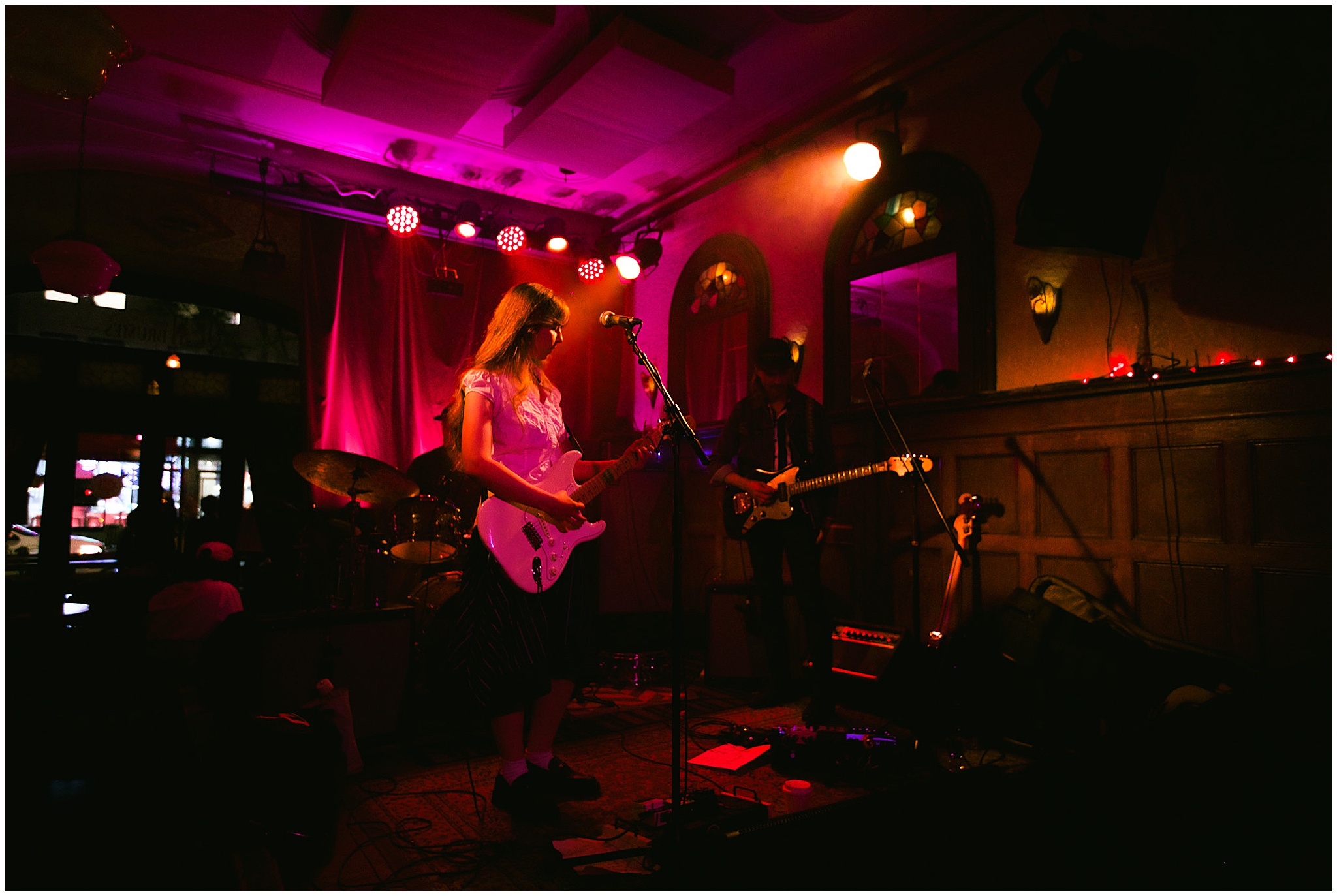
KT Laine delivered one of the festival’s standout moments at Quai des Brumes, a venue I’d never been to before. She played to a packed room and had some technical issues but handled them without seemingly panicking. Her subtlety is the real story here. Songs that radiate warmth, sweetly burnished and unhurried. The performances make everything seem effortless, but they’re clearly finely constructed pieces brought to life with cool, collected stage presence. Easygoing yet laser-focused, cut through with languid vocals and equally mellow between-song asides. You could hear the influence of ’60s and ’70s folk legends, but Laine’s approach belongs entirely to her.

Flower Face (Ruby McKinnon) at Casa del Popolo has been on my radar for a while (I interviewed her back in 2024 for this very site), so finally catching her live felt overdue. Her goth-folk heartbreak songs from Girl Prometheus moved between whispered, acoustic intimacy and cinematic, room-filling intensity. Each of the tracks celebrates survival and revival in its own way, deeply personal yet somehow universally relatable. Following 2022’s critically acclaimed The Shark In Your Water, this new project shows McKinnon refining her approach to confessional songwriting without losing any of the raw emotion.


Nora Kelly Band returned in full electric mode at Quai des Brumes, and the transformation from the acoustic duo at Clubhouse Rialto was striking. Kelly looked like she was having a blast rocking out, the band locked in tight. Their twist on alt-country delivers rambunctious energy when they want it, and seeing them toggle between the two modes in a single night revealed just how versatile they are.
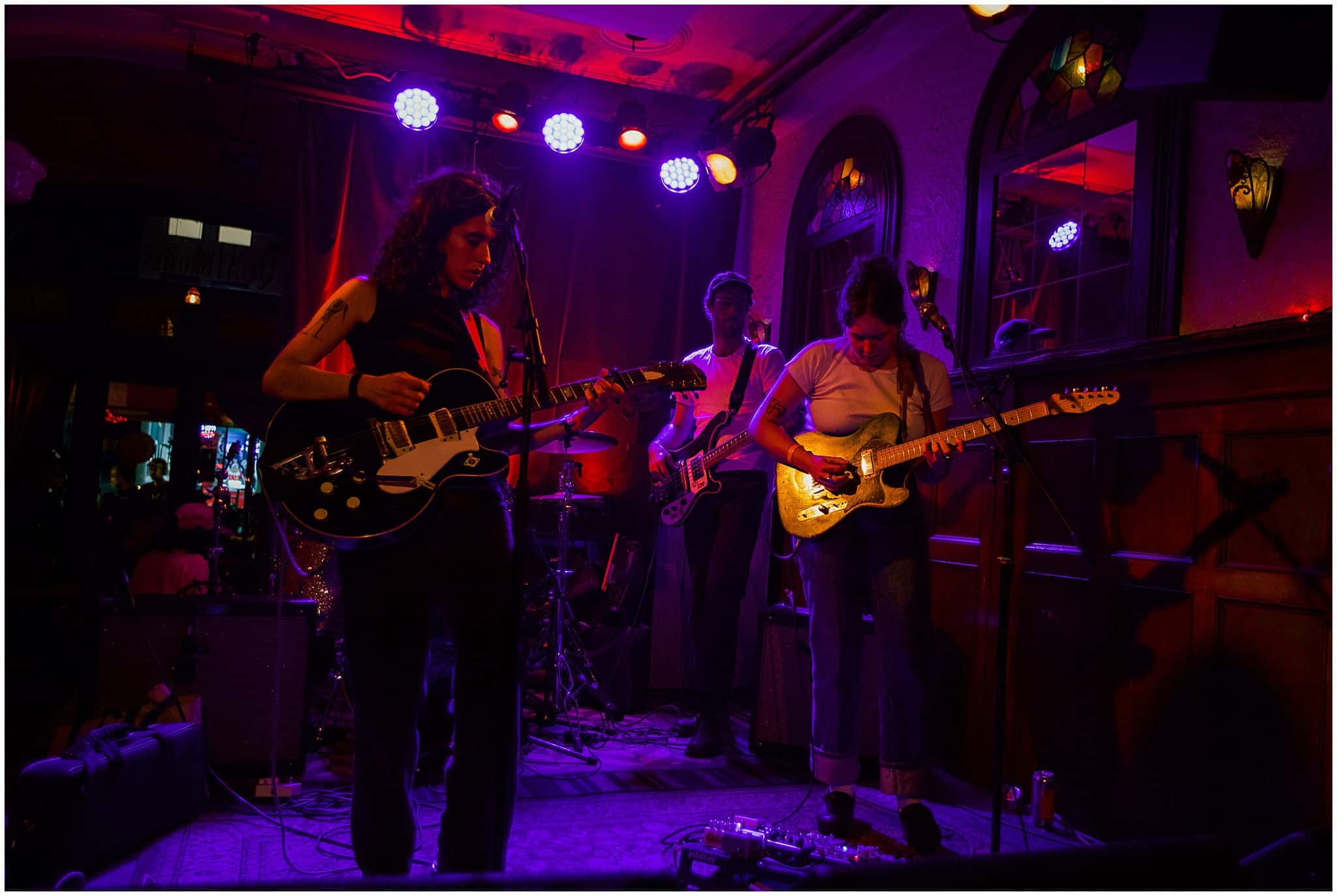
Stumbling upon Antenna93 at l’Esco captured POP Montreal’s organic discovery spirit perfectly. This is the beauty of the festival – it allows you to stumble across artists in a very organic way. The Montreal post-punk/garage rock/noise rock trio, consisting of Trevor Yardley-Jones on guitar and vocals, Derek Robinson on bass, and Michael Tomizzi on drums, delivered angular guitar riffs, noise, odd time signatures, and off-the-wall lyrics. Founded in 2022, their sound is marked by all the best chaotic elements of the genre. This is why you wander between venues at festivals like this.


Thursday, September 25
Thursday began with missing Cœur de pirate, originally planned for the Rialto rooftop but moved to the Foil Gallery due to rain. pure pulp at Le P’tit Ours made up for the disappointment. Sam Sarty’s solo project explores textural soundscapes built from landscapes and found sounds, looping voice memos, thrifted keyboards, bass, guitar, vocals and Casio drum machines. Working as a projectionist in Winnipeg for over a decade, Sarty created pure pulp to accompany images of prairie life. The project was dreamed from film scores and ambient moments in movies, an effort to bring visuals to ears. The live show has an improvised edge – Sarty’s opened for avant-garde composer William Basinski, incorporating live arrangements of overlapping Casios, trombone and vocal looping. The upcoming debut EP arch above your head is definitely one to watch for.


Circuit des Yeux‘s Haley Fohr, joined by Alan Sparhawk of Low, turned a schedule delay into serendipity at the Rialto. Their mellow acoustic harmonies and cold blue fortitude felt perfectly calibrated for troubling times. Sometimes the best shows are the ones you catch by accident while killing time before another set.
Eliza Niemi at Le P’tit Ours played cello and bass, singing songs described as “slice of life” and “oblong.” Backed by a second cello, guitar, drums, keys, and vocals, she showcased serious talent. The performance had echoes of Arthur Russell’s experimental approach and The Roches’ vocal interplay, but Niemi’s bringing her own vision to the table. So much talent crammed onto a tiny stage.

SUUNS replaced the cancelled Lankum, who I’d been very excited to see, but they proved to be a great replacement and made the most of the opportunity. The trio of Ben Shemie, Joseph Yarmush, and Liam O’Neill came equipped with a huge inflatable logo and moody lighting that set the tone immediately. They’re leaning more zealously than ever into their pop instincts while simultaneously mining a more extreme sonic palette, stretching far beyond their core fundamentals as a band. The current work finds them gleefully experimenting with loops, synths, samples and MIDI instruments like a post-millennial Tangerine Dream messing with downtempo trip-hop beats.

AHSIA has a voice that floods your chest and warms it from the inside out. This was probably the most intimate crowd I will see at this festival, as a notorious pop, rock and punk lover I was a little out of my depth with such a polite and quiet crowd. Usually at least one person tries to shove me out of the way but this crowd was so awestruck and bewitched by AHSIA’s music they didn’t care where I was. AHSIA’s at the beginning of putting out music. She’s also a notable activist in Vancouver, supporting children’s access to music education and collaborating within the Black community including “Black Woman” created with Vancouver legend Dawn Pemberton. Blending pop with Jazz, Soul, R&B and Hip Hop, her music goes down smooth and gets stuck in your brain.

Les Shirley: The last time I saw Les Shirley, they were opening for Green Day at Bluesfest in Ottawa. So imagine my surprise and delight to find out that not only are they from Montreal but that they’re also performing at a local music festival. Playing Piccolo Rialto on September 25th I couldn’t believe how small the space was. Some bands thrive in small venues and others fall flat but I am happy to report that across all sizes of stage Les Shirley THRIVE. The intimacy of the venue made me feel like I knew them but they were too cool to know me. They even did a shot of vodka on stage and called on friends to deliver them beer. They lost me a little with how liberal they were with the smoke machine but I didn’t mind when I was bopping around, only when I was trying to get photos. The band’s sound smells like cigarettes, spilled beer, a vintage leather jacket, Vans caked with mud and TV static.

Zola Jesus (Nika Roza Danilova) brought her opera-trained voice to La Sala Rossa. Since 2008, she’s released five EPs and seven full-length albums, mostly on Sacred Bones. She began training as an opera singer at age 10, then dismantled that training to deliver her breakthrough lo-fi record The Spoils in 2009, most of which she recorded as an undergrad in her room. NME declared her “goth’s new figurehead” on the release of her EP Stridulum, and her unmissable voice cuts through everything. Managed to catch a couple songs before heading downstairs, but even that brief encounter proved why she’s maintained such a devoted following.

Rachel Bobbitt‘s set at La Sotterenea felt like swimming through sound, which makes sense given her upcoming album is called Swimming Towards the Sand. I drifted into the basement just as the Toronto artist was coaxing lush chords from her guitar. The room hung mostly empty at first, but somewhere around two songs in, figures materialized through the haze, trailing cigarette and weed smoke, and the show dissolved into motion. Alongside her two-piece band, who swam through guitar, bass, synths and some esoteric sampling, Bobbitt pulled us into the rippling currents of her forthcoming album. Memory and water blur together throughout, themes that seem to seep from her childhood home in Nova Scotia. Her voice is mesmerizing and soft, though it can slip beneath the surface into alt-rock rasp, buoyed by swelling shoegaze moments. But these heavier waves crest and recede quickly for some truly multicoloured underwater moments like the song “Sweetest Heart.” Absolutely captivating.


PISS should come with a trigger warning. It could hardly have been a more dramatic change from Rachel Bobbitt’s dreamy set. The Vancouver post-hardcore punk quartet’s brutal passion and unruly rage are palpable as lead singer Taylor Zantingh runs around the stage, taking on the role of a woman who has dealt with sexual trauma and coercion, usually from older men. The instrumentation is heavy and dirty, guitars like buzzing chainsaws slowly sawing the audience’s limbs as drums mash them into paste. In between songs, I recognized a sample interview with radical feminist writer Andrea Dworkin, calling for “violence” to solve the constant problem of women being attacked. After witnessing PISS, I’m inclined to agree. Cathartic violence as art.

Friday, September 26
Friday at POP began with a real treat. Angine de Poitrine playing on the Ubisoft rooftop as the sun went down to a packed crowd. Mysterious cultural substance or absurd cult from another space and time, this musical act is rooted in pure rock’n’roll exuberance while sprinkled with Dada-Pythagorean crack-pot cubist math-groove and wacky visuals. Their immersive live performances carry the audience on an absurd journey, through a polka-dotted paper mâché vortex of feel-shifting dead-drum grooves and dual-neck microtonal guitar loop entanglement. It was magical.

Jules Reidy is an incredibly talented non-binary musician based in Berlin, Germany, who performed at Rialto Hall. Playing both electric and acoustic guitars while incorporating electronic elements they sound like a robot in a post apocalyptic world playing indie folk punk. Call me crazy but it even has a slight country twang. It’s hauntingly beautiful in a way that’s hard to articulate. A spark of hope at the end of the world. While most performers jumped around and engaged with the crowd, Jules had a quiet confidence and assurity as they adjusted their table of equipment. Their performance was mesmerizing to watch. Almost like seeing a person waltz in perfect time with a partner who adores them.

Holy Fuck proved that two decades hasn’t dulled their edge. Last time I saw them was almost twenty years ago in a pub in Brighton, England. Their setup of electronics and gadgets has grown considerably since then, and they looked very at home on the large Rialto stage. Holy Fuck started with an ambition to make music in a way foreign even to themselves, to embrace limitations, commit to the joy of noise and experimentation. The plan worked. Soon they found themselves backing hip hop artists, opening for MIA, remixing Radiohead, and earning the praise of artists like Lou Reed while earning the ire of former conservative prime minister Stephen Harper. What once appeared unconventional – tables of gear, wires, random electronics – has now become the norm. Maybe they’re some kind of pioneers. The deafening chaos of their danceable electro-industrial rock landed differently than it might have in their Pitchfork-acclaimed heyday. Arguably better. Time’s been good to them.

Una Rose (Rosie Long Decter of Bodywash) traded Bodywash’s walls of sound for delicate synths, crystalline vocals and deft lyricism at Rialto Hall. Her layered arrangements link grounded folk realism to ephemeral atmospherics that reach beyond. The solo project approaches songwriting with wry curiosity, and her debut EP Myth Between was named a Best EP of 2022 by Exclaim! and Gorilla vs. Bear for good reason.

Mint Simon is what would happen if Mable Pines from Gravity Falls was successful at bringing one of her extremely androgynous 80s boyband fantasies to life. So it’s a marvel that they’re from Montreal AND own DD’s, a gay club down the street. Dreamy 80s synth notes, a little bit of 90s androgyny, a little 70s post punk, unapologetically full of queer desire and in my humble opinion the best crowd I saw in all of POP. Mint is a natural performer. Their depiction of queer desire goes beyond lust into belonging and understanding of their own self and gender. Their discography comes across as an open letter of acceptance to themself in the past, present and future.

I did miss the beginning of their set at Le Belmont because I was running over from Jules Reidy. But apparently they apologized for being sick and on cold meds before they started. According to multiple friends in the crowd they were incredibly at ease and more themselves on stage than ever. Constantly telling the room full of family, friends and fans that they loved them, cracking several jokes and diving into the crowd. The queer community in Montreal may seem big but if you show up to enough queer events you’ll start to recognize a lot of people and that’s what this felt like. Pure unadulterated trans joy and a homecoming tailgate all in one.

Spill Tab (Claire Chicha) commanded full attention. The Los Angeles-based singer-songwriter sings in both English and French, noted by music media outlets for her lo-fi vocals and sound. The nature of POP Montreal means you dip in and out of shows trying to catch as many artists as possible. I rarely stayed for an entire set, but I made sure to be there for the entirety of Spill Tab’s show. She warranted sticking around.
No Joy packed Toscadura, another venue I’d not been to before. The room was nicely full and had some well-known misfits in the audience. Five albums deep, No Joy is still awake and alert enough to conduct the train for the foreseeable future. Jasamine White-Gluz, now the sole full-time member and songwriter after the band’s transition from full-band mode, uses shoegaze as a jumping-off point. She never leaves the genre but is never willing to adhere to what she views as rigid rules. There was a five-year gap between full lengths, and White-Gluz spent that time in rural living, tuning out the noise of the music biz to focus more inward, taking her time. Also spending time on things she didn’t have time to do when touring a lot – like learning about birds or wild swimming. The 2020 album Motherhood signified and solidified her voice as a solo artist and her commitment to using shoegaze as a starting point rather than a destination.

Saturday, September 27
Comet opened the night at Casa Del Popolo, bringing the raw energy of New York’s underground scene alongside her best friend Taraneh. Her nu-grunge sound hits with the force of Nirvana meeting contemporary rage, vocals shifting from ghostly whispers to blood-curdling screams over walls of fuzzed-out guitars. Her breakout EP Two-Winged makes it clear she’s not interested in subtlety. Every lyric feels like an unfiltered examination of the world’s wreckage. With a band that plays like they’re summoning the apocalypse, Comet doesn’t just make noise. She ensures you feel every second of it. Watching these friends share the stage offered a glimpse into the new rock sound emerging from NYC’s underground.

Ribbon Skirt packed La Sotterenea to uncomfortable sardine levels. Polaris-shortlisted and generating serious local buzz, the room was so packed I’ve never had to say “sorry” so often in my life while walking past people to get from the crowd to the bar. Given how many people showed up, perhaps it would’ve been best to have them perform upstairs instead. Nonetheless, that minor annoyance was worth it. The Montreal duo of Tashiina Buswa and Billy Riley, plus two backing musicians, delivered a raucous set full of tunes calling back to ’90s alt and indie rock with some hints of grunge. Bass lines and guitars with dark, ominous undertones drove the performance. Buswa, of Anishinaabe descent with Indigenous themes a core part of the band’s identity, thanked the crowd saying “miigwech” when songs ended. They sounded tight together, the crowd received them warmly. They desperately need a bigger room next time.

Taraneh brought rock-centered multi-genre sounds to Casa Del Popolo. The Iranian-American singer/songwriter and producer from New York City delivered a heavy rock set with die-hard fans singing every lyric to favourites like “Prophet” and “Face of Fear.” She also premiered several unreleased tracks from the upcoming album Unobsession. Taraneh (meaning “melody” or “song” in Farsi) weaves hypnotizing electronic ballads with hard-hitting grunge riffs, creating gritty landscapes of modern rock.
Fat Dog at La Toscadura felt like a portal back to the New Rave era of the mid-2000s. The six-piece crammed onto the tiny stage, nearly hitting the ceiling tiles. After intermittent countdown reminders (30 seconds, 20 seconds…), album opener “Vigilante” exploded with beats reminiscent of Justice’s sinister electronic pulse. They were loud across the entire 50-minute set. Rare to see such fervour at such a tiny show, especially for a band with just one album. The set closed with “Running,” another circle pit forming during the verse, everyone literally running in circles by the time that Klaxons-esque chorus detonated.

Fat Dog photo – Simon Williams
U.S. Girls (Meg Remy) headlined Rialto Theatre with the kind of theatrical performance that earned her Paste Magazine’s best live act of 2018. Originally from Illinois but now a fixture in Toronto’s underground scene, Remy commanded the stage with her extended U.S. Girls band, delivering politically astute commentary wrapped in poetic Americana through a feminist lens. The show drew heavily from her three Polaris-shortlisted albums on 4AD, with tracks spanning Half Free (2015), In A Poem Unlimited (2018), and Heavy Light (2020).
Her most recent album Bless This Mess (2023) showed a different side – more at peace with restless truths and moods – and those songs translated powerfully in the live setting. The theatrical elements never overshadowed the music itself, instead amplifying the emotional weight of her songwriting. After 15 years of building a celebrated discography and touring extensively through Europe and North America, Remy knows exactly how to hold a room.

Sunday, September 28
NIIVI is a Two Spirit Inuk artist from Nunavik. They effortlessly and seamlessly blend rock and punk styles with throat singing and Inuktitut to weave themes of colonialism, racism, genocide, sexism, homophobia and transphobia. They look like a neon rock star with an 80s/90s shag haircut currently dyed hot pink and the only thing sharper than their eyeliner is their tunniit. Their set at Le P’tit Ours sold out with people waiting outside to see if space opened up and people in the bar craning their necks to try to catch some of the music. They paused their set a few times to discuss the ongoing genocides against indigenous people worldwide including Sudan and Palestine as well as talking about how much of an addiction crisis there is in indigenous communities as a direct result. Their voice is smooth with a distinctive rock edge and they’re currently working on their first EP. Definitely an artist and activist to watch out for.

Steeple is a four-person math rock group based in Montreal that also played Le P’tit Ours. With their recorded songs being more indie than rock I was pleasantly surprised that live they sounded like South Arcade, All American Rejects and Avril Lavigne with that 2000s Alt grit that’s making a resurgence. From Evan’s (the drummer) curly mullet to Mat’s (the guitarist) buzzcut to Adam’s (the bassist) skater style to Syd’s (lead singer) Mikey Way-esque glasses, bleach blonde hair with pink streaks and Gorillaz sense of style they’re a force to be reckoned with. They have that weird vibe that Canadian rock bands end up with when they’re influenced heavily by both British and American bands simultaneously but they make it work beautifully for them. There’s also some insane time signatures, especially from the guitarist, that make me excited to see what they come up with next.

Do Make Say Think capped the festival at the Rialto, their first Montreal show in eight years. The Broken Social Scene-adjacent post-rock veterans brought a massive live band: two violinists, two left-handed drummers, three horn players. They moved between calm ethereal passages and urgent grandiose swells. After Constellation Records signed them in 1998, they fell in love with this city’s music scene. Fans stomping for a second encore proved that love gets returned.
POP Montreal keeps doing what it does best: creating impossible choices, facilitating accidental discoveries, platforming artists before everyone else catches on. You’ll miss shows you wanted to see, stumble into ones you didn’t know existed, and probably brag about both decades from now.


Review – Steve Gerrard & Ashtyn Turner
Photos – Steve Gerrard, Ashtyn Turner, Maggie Aulman & Sydney Bishop


