
When Chicken Suit broke up, drummer Gaël Parnas-Zver did not take it well. “I was much younger and way dumber and naive and felt it was the end of my career,” he says now, with enough distance to find it funny. “Obviously it was not that deep. However, it worked for me by driving me to start this band, which has exceeded my expectations in all aspects, whether it be musically, personally, and professionally.”
Guitarist Raffaele Calabrese had a more practical problem to solve. “Chicken Suit ended when our bassist and singer left the band to focus on their own musical projects. Neptune was a fan of Chicken Suit and a talented bassist and singer, and so we started off as a three-piece with a repertoire largely consisting of Chicken Suit songs.”
Neptune Lightburn came to the band with something most prog musicians do not: zero investment in prog. “When I first joined the band I didn’t know much prog at all. I had never listened to any of the essential prog albums, but I was really into a lot of post punk, goth, and new wave.” The first Mellonella song came out of that collision. “The first song we ever wrote as Mellonella was Saturday. Ralph played that guitar riff at my audition to join the band and the bassline came to me immediately. Heavily inspired by early Simon Gallup Cure bass parts and Andy Rourke of The Smiths.”

Neptune is also the daughter of The Dears frontman Murray Lightburn and keyboardist Natalia Yanchak, which is the kind of fact that tends to follow a musician around. She is not particularly interested in making it disappear. “I have a lot of touring experience, and being constantly surrounded by musicians with endless wisdom has been a wonderful gift. Inevitably, a lot of people will go into our music with whatever preconceived expectations they have because of who my parents are, but again, I am my own person, I write my own music and this is my own band. Musically we don’t sound like The Dears at all, but there are some moments where you can hear bits of my dad or my mom shining through. I’m very proud to come from such a musical family and I’m extremely lucky to have been born into such a lifestyle.”
Saturday turned out to be a good indicator of where the band was headed. “I never thought when I wrote these lyrics that I’d hear people singing them back to me at shows,” Neptune says. “I was mostly worrying about getting the album out in one piece. I wasn’t too focused on much else or how people received Saturday. At the end of the day, I just hope the words and music resonate with people and that it makes them feel seen, heard, or just happy in general.”
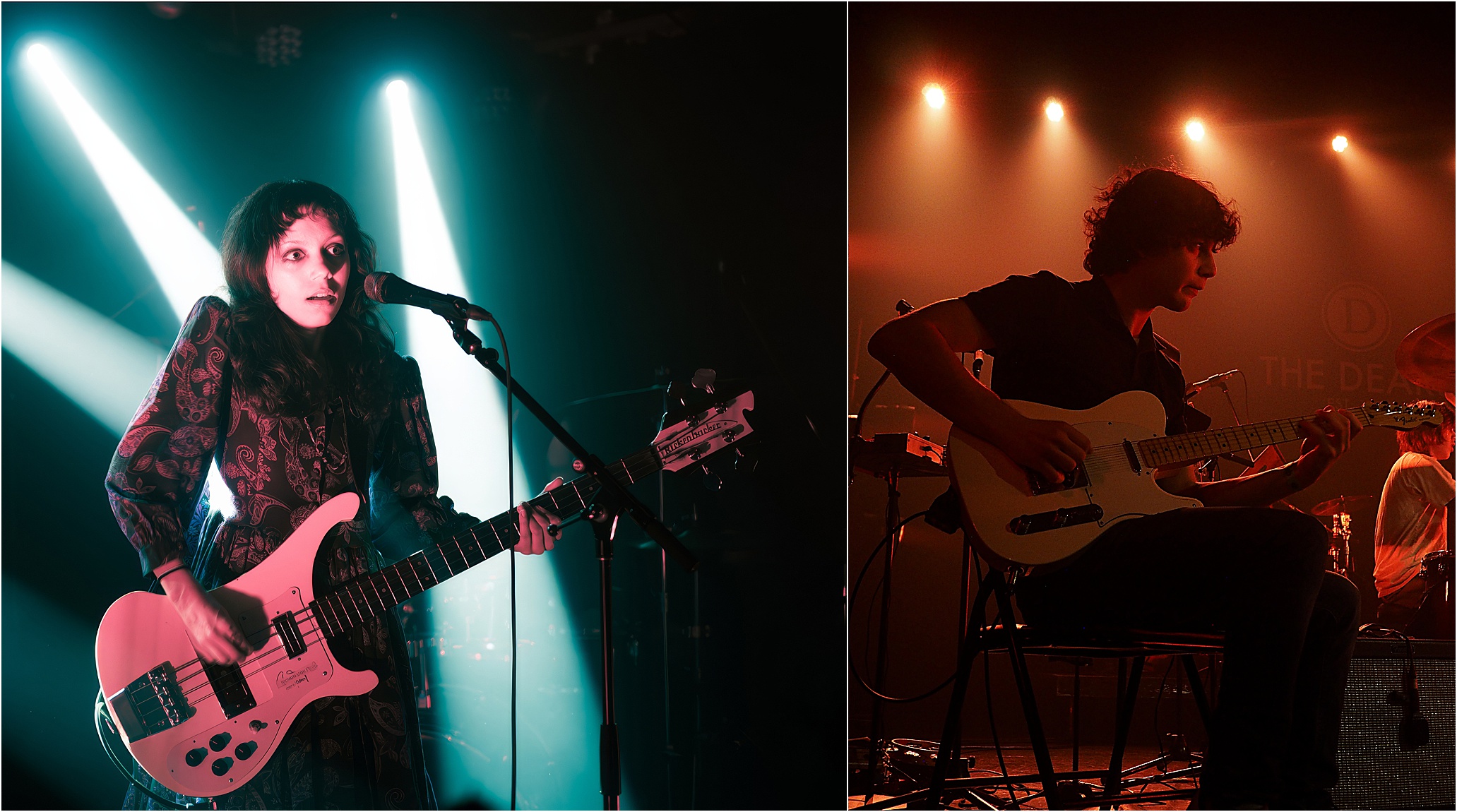
The band recorded Galleria as a trio, but Raffaele had done guitar overdubs on the record that needed someone to cover them live. “We brought in Xan Pim to play with us live to replicate the guitar overdubs I did on the record. His role quickly expanded beyond just that and his style meshed so well with ours that he is now a full member of the band and is involved in the songwriting process.” Neptune is blunt about what Xan changed. “Recruiting Xan has been a massive game changer, because he fills in all the gaps and dead air there might have been while performing as a trio.”
Xan comes from a different angle on what it even means to call the band progressive rock. “To me, identifying as a progressive rock band goes beyond just striving to emulate the bands I’ve grown up loving like Rush, Yes, or King Crimson. It’s fun to make music that goes beyond the limits of what you thought you could do. The knocking down of those boundaries is what I think is progressive about our music.”
The two-guitar setup inside Mellonella does not work the way most two-guitar setups do. Raffaele has thought about this. “We definitely don’t operate in a rhythm/lead framework. I don’t really believe in that model and think it’s a bit old-fashioned. We kind of both alternate with who’s playing the chordier part and who’s playing the more melodic part based on what works for the song, and often what just comes naturally to us.” Xan puts it more simply. “It is more a matter of doing whatever fits the song as it unravels, rather than just sticking to our roles as exclusively lead or rhythm players. A lot of what I play is more textural or ambient. In many ways Ralph and I have very contrasting approaches to guitar, but it all melds together into one big sound in the end.”
Ask them what they have been listening to lately and you get four very different answers. Raffaele is deep in the British prog canon, Yes, King Crimson, Genesis, while also watching what is happening in experimental and indie rock now. Gaël rattles off The Ladies, Fall of Troy, Chon, Number 12 Looks Like You, Mahavishnu Orchestra, Hail The Sun, Nomeansno, Train Breaks Down, and adds: “My main goal is to always keep the songs developing and smooth, to keep it as groovy and listenable/enjoyable as possible.” Neptune has been in a very different place. “Lots and lots of Stereolab, Gainsbourg and Françoise Hardy. A lot of French yéyé-ish stuff and 60s music in general. Fripp and Eno No Pussyfooting, Discreet Music, Evening Star. I’ve also recently been introduced to the Soft Machine, Fela Kuti, XTC, and Nick Drake. Really great stuff.” Xan has found something he cannot stop playing. “I’ve been listening to a lot of Xiomara Fortuna‘s first album, super lo-fi merengue music from the 80s with insane horn sections, very ghostly and beautiful music. I’ve also been listening to a lot of toe, At the Drive In, System of a Down, Gal Costa, Don Caballero, and Willie Colon. I think all of the stuff we listen to influences the music in some way or another.”
The album name Galleria ties back to the band’s name, Mellonella being the scientific name for the greater wax moth, Galleria Melonella. Neptune explains where it went from there. “We decided to really lean into the moth theme. And in a way it works with the way the album progresses musically and what each song is technically about. It’s almost a gallery of thoughts and emotions, Moonlight being loosely about fear around falling in love, Return to Sender being a sort of retaliation against unfortunate luck.” The visuals pulled in a few collaborators. “Noah manipulated images of things mentioned in the songs to create this really cool amorphous artwork that fits the music very well. A huge aspect of the visual concept for this era of the band couldn’t have been possible without our good friend Emeline Blue Hawkins. She’s in her second year of Film Production at Concordia and had the idea to do a highly stylized experimental and artistic documentary about the band. She built a little universe out of our music. The doc is coming out sometime in April and I can’t wait for everyone to see it.”
Mellonella’s songs get figured out on stage as much as anywhere else. “The songs are kind of birthed from a live setting,” Neptune says. “For me personally at least, I’m not fully comfortable with a Mellonella song until we’ve played it live a few times. It’s more that we’re translating the songs from a live setting to a studio setting.” Anyone planning to catch them should adjust their expectations accordingly. “They can expect a very loud and very fast performance where each of us give our all.”
The second album is already underway, and Neptune says it is heading somewhere more deliberate. “We’re currently in the process of writing what will become the second Mellonella album, and so far it’s taking a much more conceptual direction in the lyrical sense, more songs about mythical creatures and journeys and fantastical things. We really wanna take our time with this next one so we can put out as many songs as possible. With Xan on board, I feel like the music is only going to get crazier and crazier.”
Galleria is out now.
Photos – Emeline Blue, Melih Nehir and Michael Shintani
Share this :


