

Walking into Place Bell for Laufey’s show felt like stepping into a vintage postcard from a more glamorous era. Glittering dresses, oversized bows, and a stage borrowed from a 1930s art-deco film set. The Laval crowd buzzed with that quiet anticipation unique to audiences who know they’re about to hear something delicate and sincere. This was different from my usual diet of noisy guitars and walls of amps, but I was curious to see how Laufey’s blend of jazz, orchestral pop, and romantic melancholy would translate to an arena.
Suki Waterhouse opened with an effortlessly cool set that split the difference between dreamy indie rock and smoky lounge pop. She’s got the kind of unhurried charm that makes you think she’d sound good singing anything. Starting with a surprisingly rockier vibe, she seemingly saved her poppier songs for the end of her set. Her breakout hit “Good Looking” elicited an enthusiastic sing-along, and by the time she departed from the stage, the audience had settled into a gentle, anticipatory silence reminiscent of the calm before Laufey’s performance.

Then the lights dimmed. The show began like an old Hollywood overture. A black-and-white title card flickered across the big screens: Act I. The orchestra swelled, the dancers froze in place, and Laufey appeared at the top of a grand staircase, shimmering like a human metronome. She opened with “Clockwork,” the lead track from A Matter of Time, and suddenly the arena didn’t feel like an arena anymore. Her voice carried with such clarity that it sliced right through the reverberation, elegant and steady.
What struck me most was her poise. Laufey doesn’t perform with the self-seriousness you sometimes get from classically trained artists. Instead, she projects warmth, humour, and a touch of theatrical mischief. Between songs, she laughed, teased the crowd, and occasionally poked fun at her own perfectionism. “I can’t believe you are all here for me,” she remarked early on, her smile conveying a mixture of bashfulness and disbelief. “Sometimes I still feel like the orchestra kid who wasn’t cool.” The audience adored her for it.

Her story about feeling “different” as a Chinese-Icelandic girl growing up in Reykjavik set up one of the evening’s emotional peaks: “Snow White.” Before playing it, she confessed, “Sometimes I feel perfect. Many days I really, really don’t.” Mirrors rolled onstage as she sang, reflecting her from every angle. The song’s delicate phrasing and wistful lyrics landed even harder live, her voice quivering just enough to sound human rather than polished. It was one of those rare big-venue moments that felt small in the best possible way.
Throughout the night, Laufey switched between piano, guitar, and cello, each change eliciting a new wave of appreciation from the crowd. The musicianship was top-tier: a tight four-piece band on one side and a string quartet on the other, anchored by a rhythm section that understood the assignment. Swing, but never smother. The arrangements were lush without being syrupy, and the sound mix left room for every instrument to breathe. You could hear the brush of the snare, the soft thud of the upright bass, and the quiet intake of breath before she hit a long note.

Midway through the set, Laufey introduced what she called “my little jazz club.” The giant staircase faded into warm amber light, and she gathered the band around her like they were playing the late set at a basement speakeasy. They swung through a few jazz standards and reimagined versions of her own songs: “Valentine,” “Fragile,” “While You Were Sleeping.” It was stylish, spontaneous, and proof that she isn’t just a pop singer with jazz trimmings. She’s a genuine musician who can live inside those chord changes.
If the first half of the concert was about elegance, the second was about energy. Songs like “Mr. Eclectic” and “Tough Luck” brought out her cheekier side. “This one’s for the performative men,” she announced, grinning as dancers strutted across the stage in mock-swagger. The humour gave her an edge that set her apart from the ethereal image often projected online.

The show’s production was dazzling without tipping into spectacle. Each act had its own aesthetic: a swirling carousel backdrop for “Forget-Me-Not,” floating chandeliers for “Goddess,” and a sudden explosion of strobes during “Sabotage” that made everyone jump in sync. It felt like a carefully storyboarded film where every visual cue amplified the emotion in the music. Even the encore, “Letter to My 13-Year-Old Self,” was staged beautifully simple: just Laufey, a spotlight, and a faint piano echo. After all the theatrical flourishes, ending on something so stripped-down felt almost cinematic.
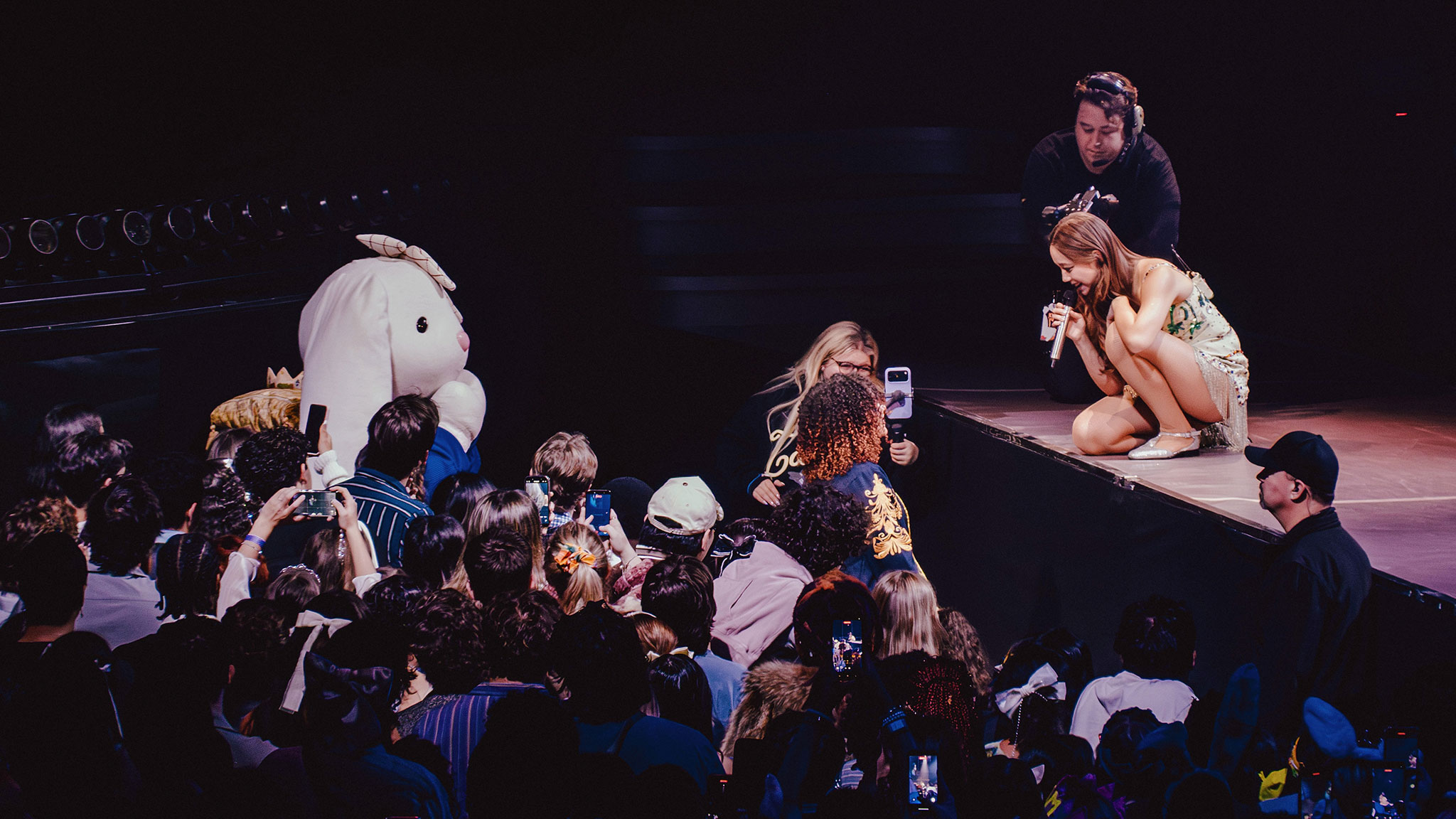
What lingered wasn’t just the precision or polish. It was the sense of intimacy she managed to create. Laufey’s audience isn’t passive; they participate. During “Promise,” she lowered her mic and let the crowd sing the bridge back to her, visibly moved. You could see her mouth thank you into the dark. Later, she crowned a fan from the audience as her “Best Dressed Guest,” complete with a bunny mascot named Mei Mei performing the ceremony.
Laufey’s appeal lies in that duality: old-soul sophistication paired with online-age sincerity. She can channel the lush orchestration of Ella Fitzgerald one minute and the relatable vulnerability of Phoebe Bridgers the next, and it never feels forced. The result is a sound that bridges generations. Your grandmother might recognize the jazz phrasing, while your teenage niece will relate to the diary-like confessions. Few artists could pull that off in a venue the size of Place Bell.
Her band deserves their flowers too. The interplay between the string quartet and rhythm section gave songs like “Falling Behind” and “Silver Lining” real dimension. During “Let You Break My Heart Again,” Laufey sat at the piano under soft blue light while the cello wept quietly beside her. It was restrained and gorgeous, like she was holding the audience’s heartbeat in her hands. Then she would shift to “Bored,” delivering the line “Baby, keep talking but nobody’s listening” with comedic timing so precise it could cut glass.

By the final act, “Sabotage” turned the entire room electric. The pulsing lights and frantic drumming matched the emotional chaos of the song. Her calm demeanour suddenly overtaken by a storm of sound. It was the most visceral part of the night, the moment where all that composure finally cracked open.
As the applause thundered and Laufey returned for her encore, she spoke softly to the crowd. “This is for anyone who ever felt too different. You deserve to take up space.” Then she played “Letter to My 13-Year-Old Self,” with such quiet conviction that even the ushers stopped moving. It was less a farewell than a benediction.

Walking out into the Laval night, I realized that what makes Laufey’s show special isn’t just the immaculate vocals or cinematic production. It’s her ability to make vulnerability feel like strength. She’s the rare artist who can turn an arena into a confessional and make it feel like everyone inside has been personally invited.
For someone like me, more accustomed to distortion pedals and mosh pits, it was an unexpectedly moving night. Laufey doesn’t just sing beautifully. She makes beauty feel like a kind of rebellion. And honestly, that’s pretty rock ‘n’ roll.


Photos – Steve Gerrard
Share this :


