
Seven years ago, Crown Lands were the two-person opener at the Corona Theatre, loud enough to make you double-take. When I bumped into them that night, I told them two things: they made a lot of noise for a duo, and the next time I saw them they’d be headlining.
They laughed when I brought it up this week. Then they basically proved the point all over again.
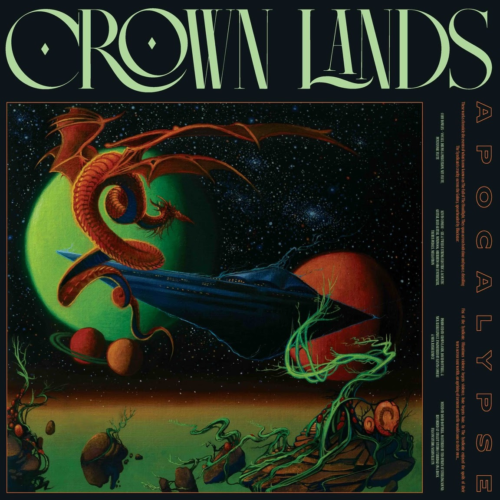
The Canadian progressive rock duo, Kevin Comeau and Cody Bowles, are in the middle of a major chapter with Apocalypse, their most demanding and fully realized album to date. It came out in May, and it feels engineered for the old-school “drop the needle and disappear for a full side” experience. It is heavy, narrative-driven, and unapologetically long-form. The closing title track runs 19 minutes, the kind of swing that makes radio programmers joke about bathroom breaks, and makes everyone else grin because the band is clearly done trying to fit in a box.
“It would be nice to see that song on radio,” they tell me, laughing. “It would give the DJ a chance to go make a coffee and hit the bathroom.”
That’s Crown Lands in a nutshell: serious craft, zero posturing.
A record that’s dark, but not hopeless
On paper, a title like Apocalypse reads as pure doom. In the room, they frame it differently. Yes, it tells a story about the downfall of worlds and the consequences of hate, fear, and violence spreading across a galaxy. But there’s a glimmer of hope built into it. The fantasy lore is the vehicle, not the escape hatch.
The album’s sci-fi narrative is also doing double duty as a mirror. They wanted to write about “the bad guys” in their universe, and about the way power and indoctrination work in real life. The point isn’t to lecture, it’s to take what they’re watching happen globally and translate it into something you can feel in your chest.
That translation is where Crown Lands have leveled up.
Total control, selective outside firepower
Comeau and Bowles recorded most of Apocalypse in their own studio in Uxbridge, north of Toronto. They’ve been working in that room since 2020, and the comfort of it matters. There’s a difference between capturing a performance where it naturally lives, versus recreating it under fluorescent lights in a downtown studio while the clock runs.
That confidence came directly from recording Ritual I and Ritual II, their 2025 instrumental releases on InsideOutMusic, and their first attempt at doing everything in-house. “Rituals was our first real, concerted effort to do everything ourselves,” Comeau explains. “That record gave us the confidence to realize we could make a Crown Lands album in our own space, without a major-label budget or a big, fancy studio.”
For Apocalypse, they brought in two producers at key moments, and the contrast between them was deliberate. Nick Raskulinecz (Foo Fighters, Rush, Alice in Chains) worked with them at Rock Falcon Studio in Nashville. “Working with him felt like going back to university,” Comeau says. “Watching how deep he’d go into drum sounds and production pushed me to become a better producer myself.” David Bottrill, who also worked on Fearless, provided the counterbalance. “Where Nick is pure creative energy, David is the master of analysis. He’ll stop you at bar 453 and explain exactly why a transition doesn’t work, and he’s always right.”
The center of gravity, though, stayed in Uxbridge. That control shows up in the pacing and the confidence of the arrangements. Nothing feels squeezed into place to satisfy an external expectation.
The band finished the album last year, but Apocalypse didn’t land until May for one very real reason: vinyl manufacturing. They’d wanted it out earlier, but pressing plants move at their own speed now. When the final pressings finally arrived, you could hear the relief.
This is a record that wants to be played on wax.
“We wanted you to feel like you’re on a trip”
At one point I tell them what the album did to my brain on first listen. Not in a “here are my genre tags” way, more like a memory. It reminded me of being a kid, dropping a record on the turntable, not touching it, and lying on the floor with your head near the speakers while the whole thing played out. A full side as a single experience. No skipping, no optimising.
They light up immediately.
“Sweet. Yes. Perfect. That’s exactly what we wanted,” they say. The goal is to take you from start to finish, disorient you a little, then have it click by the end. A journey that resolves. Not background music, not playlist bait.
That’s why Apocalypse feels experimental even when it’s grounded in classic prog DNA. You’ll catch Rush in the muscle memory, Pink Floyd in the cinematic pacing, and in “The Fall,” a fifth-track moment that nods hard toward the “Run Like Hell” energy of The Wall. Bowles confirms it without hesitation: “That was the biggest influence on that song, without a doubt. Musically, big time.”
The band doesn’t shy away from that lineage because they grew up inside it. Rush, Pink Floyd, AC/DC, Neil Young, Queen, Triumph. That mix matters. It’s not just virtuosity, it’s songs, and a sense of drama.
Harmonically, Apocalypse also pushes into new territory. “We usually live in modal worlds because of my open tunings,” Comeau notes. “On this album, we made a conscious effort to modulate between sections, moving by fifths or major seconds, so every part feels like it enters a new space.” Layered harmonies appear throughout, something the band had previously avoided. “This felt like the right moment,” Bowles says.
“We like stories, we like complex music, and marinating those two is awesome,” they tell me.
No more chasing radio, just chasing the thing
A huge part of this era is Crown Lands giving themselves permission to stop writing for the gallery. They’re not anti-radio, they’re just realistic about what they’re built to do. If a song happens to land at three and a half minutes, fine, send it out. But that isn’t the goal anymore.
The goal is to make the music they want to hear.
They bring up the Rick Rubin idea that “the audience comes last,” then immediately complicate it with something more honest: you can’t be totally unaware of who’s listening, because live music is still a conversation. The twist is that Crown Lands’ crowd tends to be culturally aligned with them anyway. They’re seeing it more and more as they headline: Rush shirts, Queen shirts, Genesis shirts, nerdy conversations about King Crimson after the set.
They aren’t trying to convert a casual crowd into prog heads. They’re building a home for the people who already want this.
The conversation drifts, productively, into the current state of the genre. Quebec City’s Gendron-Between comes up, and both members engage seriously with what their success means. Comeau sees a historical pattern: the OCS blew up, then King Gizzard arrived, now Gendron-Between. “It’s the same thing as when Tame Impala blew up and a renewed interest in Australian psych rock showed up again.” Bowles pushes back, arguing something more structural is shifting, that algorithmic platforms mean listeners no longer have to be passive recipients of monoculture. “No one has to worry about being exposed to music that they don’t want to be.” Neither position fully cancels the other, which is kind of the point. The appetite is real, however long it lasts.

The Angine de Poitrine question
Inevitably, the conversation turns to Angine de Poitrine. The Saguenay duo, known only as Khn and Klek de Poitrine, had already been building momentum on the Quebec festival circuit when their KEXP session dropped in February and promptly accumulated millions of views. By the time I’m talking to Crown Lands, the band has sold out shows across three continents, earned praise from Dave Grohl, and landed on the front page of the New York Times. This week, both their albums debuted on the Billboard 200. The moment is real. The question is what it means.
Comeau and Bowles have genuinely different reads on it, and neither backs down.
Comeau sees a familiar arc. The OCS blew up, then King Gizzard arrived, then Tame Impala renewed interest in Australian psych. Now Angine de Poitrine. “It’s a trend, and that’s okay,” he says. “They’re going to have their 15 minutes, and they’re going to disappear into more of an obscure space. The core fans will always be there. But I think it would be foolish to expect everyone who’s along for the ride right now to still be there in an album cycle.” He points to Adrian Belew playing 500-cap rooms as a benchmark for where truly niche music eventually lands, regardless of the player’s pedigree.
Bowles isn’t having it. “King Gizzard isn’t getting any smaller, they’re just getting bigger, which is crazy. I think we’re getting into a more mixed bag when it comes to people who just want something digestible versus something challenging. We’re seeing more people who have a wider taste of music.” His argument is structural: algorithmic platforms mean listeners are no longer passive recipients of whatever monoculture decides to push. Nobody has to sit through music they don’t want anymore. The audience for difficult, ambitious music isn’t a niche waiting to shrink back down. It’s expanding.
There’s a Zappa thread running through this, too. They’ve both seen Dweezil play the catalogue live, they both love the records, and they both agree that Zappa’s genius was sharpest when he balanced absurdist humour with impossible musicality, which is precisely what Angine de Poitrine are doing in their own way. The microtonal guitar built by hand, the papier-mâché masks, the invented language in interviews: it’s Dada and it’s technically rigorous, and the combination is exactly what Comeau and Bowles have always respected. They’re not surprised the world caught up. They’re just debating how long it stays.
For what it’s worth, both Vol. I and Vol. II debuting on the Billboard 200 in the same week suggests Bowles might be winning the argument. But the conversation isn’t settled, and Crown Lands are honest enough to leave it that way.
The costumes, the characters, and the joy of committing
If you’ve seen Crown Lands lately, you know Apocalypse isn’t just a record. It’s a show. They’ve been bringing two additional musicians onstage for this material to preserve the album’s bigger arrangements, Daniel Walton on guitar or bass and Adam on drums or keyboards, while keeping a duo set for older songs. It’s a smart way to give everyone what they came for: the tight two-person spectacle and the expanded universe.
Then there are the costumes.
They talk about Captain Blackstar, foam shoulders, a cape, and the kind of theatrical commitment that feels less like rock-star branding and more like friends geeking out. The influence isn’t just KISS, though they toured with KISS. It’s early Genesis, Peter Gabriel-era theatricality, and their collaborator Luke Perron, a theatre-minded creative partner who also happens to be Bowles’ Dungeons and Dragons DM.
Comeau’s character is harder to pin down. Officially, he’s somewhere between factions in the album’s lore, nominally aligned with the Syndicate’s foot soldiers but operating undercover. The best detail is also the funniest: his goggles fog up almost immediately under stage lights, and he can barely see anything. He wanders backstage with a flashlight, being redirected by bandmates like it’s part of the plot. He has been offered the suggestion of simply getting better goggles. He is not interested.
“I feel like it wouldn’t be the same if I could see through them,” he says.
Prog as play, not prog as homework.
Montreal, Quebec City, and the question they keep asking
Near the end, the conversation circles back to the part Montreal Rocks readers will care about most: they love playing here, and they do not understand why they aren’t getting booked in Quebec more often.
“Montreal and Quebec City are some of our favourite cities to play,” they say, and they’re not being diplomatic. They mean it. They talk about Quebec crowds engaging with this kind of music differently, with a more European appetite for theatre and outside-the-box structure. They reference Harmonium. They wonder aloud whether something about navigating a bilingual culture keeps different parts of the brain more open. Then they joke that they need to go bug their agents.
But underneath the joke is something real. I first predicted they’d headline Montreal the next time I saw them, at the Corona Theatre in 2019. Two years later, they did, at Pierrefonds Campus. The trajectory has been exactly that consistent.
Apocalypse is exactly the kind of big-swing rock record that hits hardest in a room full of people who came to lock in for the whole trip. Not for a hook, not for a clip, not for a chorus you can scroll past, but for a full album side that leaves you a little stunned when it ends.
Crown Lands are still doing what they’ve done since the beginning: turning two people into something that feels impossibly massive.
Now someone just needs to put them back on a Montreal stage where they belong.
Watch the full interview below:
Interview – Annette Aghazarain
Apocalypse is out now


