

There was no easing into it. Before a single note, two masked figures stood centre stage at Club Soda, fingers forming a triangle, holding it there just long enough for the crowd to catch on. Within seconds, the whole floor mirrored them. No explanation, no introduction. You’re in, or you’re not.
Most people were very in.
Angine de Poitrine have figured out how to build that kind of instant connection without saying anything remotely conventional. No small talk, no “How are you doing tonight, Montreal?” Just gestures, sounds, and a shared understanding that seems to click faster than it should.
I first caught Angine de Poitrine at a rooftop party during POP Montreal 2025, one of those nights where you’re not entirely sure what you’re about to see but you go anyway, thanks for the invite, Danny, and since then, they’ve gone stratospheric. What felt like a word-of-mouth curiosity has turned into something much bigger, the kind of momentum you can’t really fake, and now it seems like everyone has an opinion, or at least a story about the first time they saw them.

Tonight, the room had been primed well before they walked out. Crabe opened things in their usual unpredictable way, bending structure, throwing in moments that felt like they might fall apart but never quite did. DVTR followed with something more direct, louder in attitude, tighter in form, and by the end of their set the floor had already started to move like it belonged to a much smaller, sweatier venue. I’ve wanted to see them for a long time and they did not disappoint.
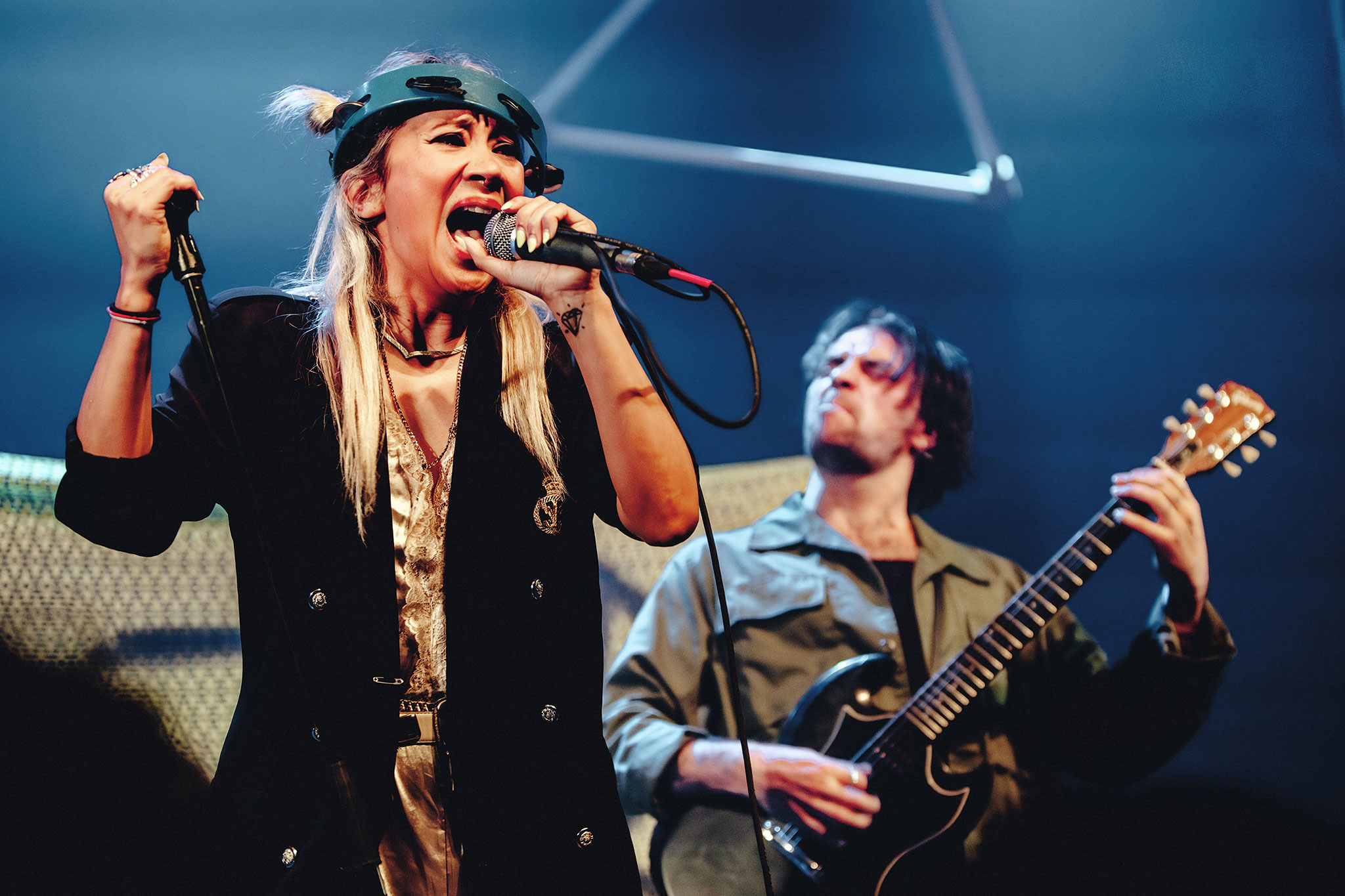
By the time the curtains closed and reopened, the anticipation felt less like excitement and more like pressure building.
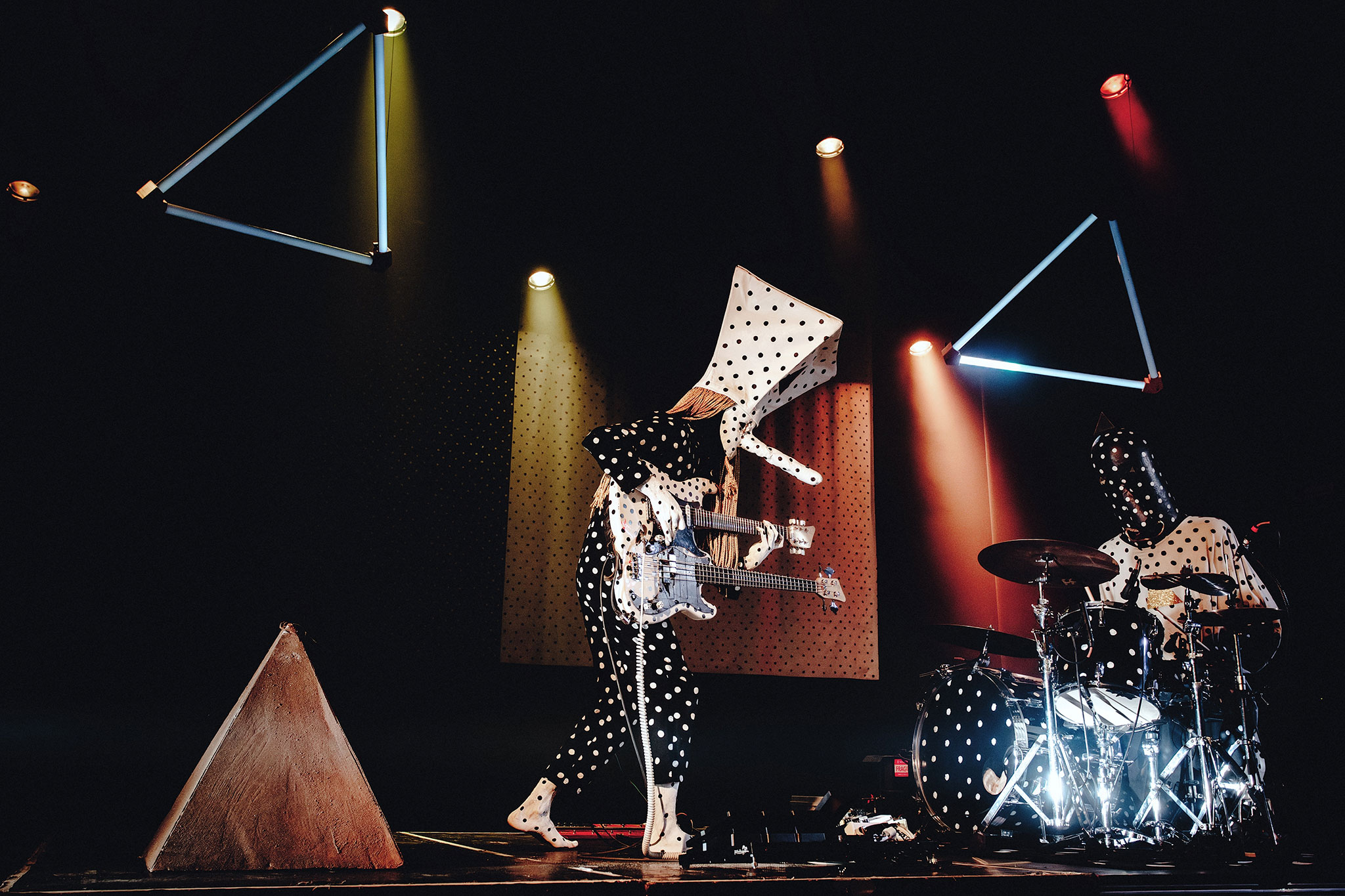
The stage itself was stripped back but intentional. Black and white everywhere, long vertical canvases framing the setup, Klek’s polka-dot drum kit sitting slightly off-centre, and Khn’s double-neck guitar-bass hybrid waiting like a piece of equipment you’re not entirely sure how to approach. It looks a bit ridiculous until it doesn’t.
They opened with Vol. II, released earlier that day, and committed to playing it straight through. That kind of decision can test an audience, especially with music this dense, but here it barely registered as a challenge. People leaned forward, not back.
Live, the microtonal stuff doesn’t feel technical. It feels slightly off, like something has been nudged just out of alignment. Notes don’t land where you expect them, but they still make sense. Khn moves between guitar and bass parts without drawing attention to it, just shifting roles mid-phrase like it’s nothing. Klek holds everything together but never pins it down too tightly, which is probably why the whole thing never feels rigid.

Mid-set, “Fabienk” started to tighten its grip. The loops stacked, locked, then slipped just enough to keep everyone paying attention. You could feel the room adjusting, not in some dramatic wave, just a subtle shift where people start moving in the same rhythm without realizing it.
Upstairs, the balcony crowd took it in more calmly, watching, processing. Down on the floor, it was a different story. Mosh pits kept opening, collapsing, and reforming elsewhere. Crowd surfers appeared at regular intervals, which felt slightly absurd given how intricate the music is, but also completely right. The smell of beer gave way to sweat pretty quickly.
What’s surprising is how little irony there is in any of it. The masks, the polka dots, the invented language, it could easily become a joke that wears thin after ten minutes. It doesn’t. The humour is there, but it sits alongside a real sense of purpose. When they “speak,” in that strange, half-processed vocal tone, you don’t understand a word, but you don’t really need to. The meaning gets through anyway.

At one point, a third figure drifted between the stage and the crowd, camera in hand, weaving through bodies like part of the performance. Not introduced, not explained, just there. It added to the feeling that this whole thing operates on its own internal logic.
You can pick out influences if you want to play that game. Bits of prog, flashes of math rock, ideas borrowed from outside Western tuning systems. But it never feels like a collage of references. It feels more like they’ve taken all of that, shaken it loose, and rebuilt it in a way that doesn’t point back too clearly.
The set never chased a single peak. Instead, it kept shifting, tightening, loosening, pulling back just enough before pushing forward again. That pacing mattered. It stopped the complexity from turning into fatigue.

They closed with “Sherpa,” one of the more immediate pieces from earlier material, and it landed differently. Less tangled, more direct, but still carrying that same strange energy. When they walked off, that was it. No encore, despite the noise from the crowd. The lights came up slowly, and people stuck around for a bit, like they weren’t quite done with it yet.
What stayed with me wasn’t just how good they are, although they are; it was how quickly the room bought into something that, on paper, shouldn’t work this easily. Instrumental, experimental, deliberately odd. And still, nobody held back.
Rock shows can sometimes feel like people watching something happen. This didn’t feel like that. It felt like people were inside it.
Outside, the air felt weirdly quiet after all that.
If you managed to grab a ticket for the second night on the 18th, you already know what you’re walking into. For everyone else who missed this one, there’s another shot coming soon. They’re set for a main stage slot at the Montreal International Jazz Festival this summer, which will be a very different kind of chaos, less sweat, more open air, and a whole lot more people trying to figure out what they’ve just stumbled into.



Review & photos – Steve Gerrard
Share this :


