
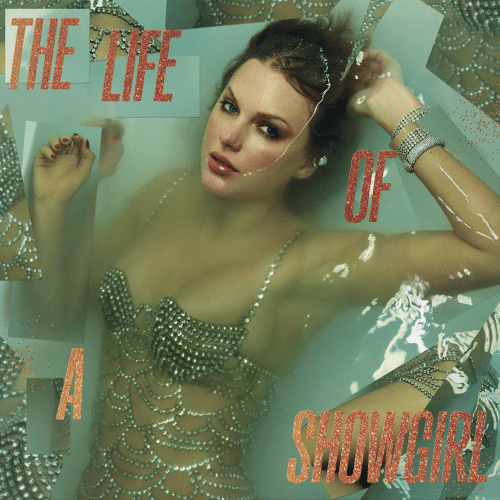
Taylor Swift returns with The Life of a Showgirl, her twelfth studio album and first collaboration with Max Martin and Shellback since Reputation. After the sprawling The Tortured Poets Department and the quieter folk textures of folklore and evermore, this feels like a promised reset: compact, polished, explicitly pop. Yet what arrives is something stranger, more tentative, and harder to love—a record caught between looseness and precision, never quite finding its pulse.
The production gleams without quite dazzling. Martin and Shellback trade the synth-pop punch of 1989 for something softer, more restrained. Satin synths, tidy percussion, mid-tempo glide. The template works in patches; there are smart chord moves tucked into “Wi$h Li$t,” as well as unexpected key changes that give the song a gentle lift. But too often the songs settle into sameness, each verse finding the same conversational pocket, each chorus arriving on schedule without much to announce.
Swift has always written best when tension runs through the frame, when the stakes feel present and unresolved. “Ruin the Friendship” finds that thread. It’s a small song, just Swift revisiting a high school crush who died before anything could happen, whispering at his grave that she should have kissed him anyway. The melody holds, durable and unforced. The regret reads as genuine rather than performed. You believe her here in a way the album rarely earns elsewhere.
The domestic daydreams scattered across Showgirl could have carried weight if Swift leaned into the ambivalence, the tension between wanting the driveway and basketball hoop while also wanting the Plaza Athénée and the best booth at Musso & Frank. Instead, “Wi$h Li$t” tries to split the difference, insisting she only wants the simple life while name-checking Real Madrid and Balenciaga shades. The framing collapses under its own contradictions, the perspective muddled by a vantage point she seems unable to see from anymore.
Then there’s the score-settling, which has curdled from sharp to small. “Actually Romantic” seemingly aims at Charli XCX, responding to “Sympathy is a Knife,” a song about feeling inadequate in Swift’s presence, by proving the point. The tone lands somewhere between defensive and smug. There are a few clever jabs (the toy Chihuahua line has teeth), but the whole exercise feels like punching down from a height Swift can’t quite gauge. Worse is the inexplicable decision to build the track around the exact chord progression from Pixies’ “Where Is My Mind?,” which only invites unflattering comparisons.
“CANCELLED!” treats years-old discourse like breaking news, wrapping stale ideas in a chant-along hook that overstays its welcome. The song wants to be defiant but mostly sounds tired, like someone still arguing a point everyone else moved past. When Swift claims she likes her friends cancelled, it’s hard not to think about which friends she means and whether the joke lands the way she imagines.
“Wood” swings for burlesque playfulness and lands somewhere clinical. The Jackson 5-inspired groove has promise, but the awkward extended metaphors about her fiancé’s anatomy read more earnest than cheeky. It’s the kind of song that makes you wish she’d either committed fully to the bit or left it in the vault.
At this stage, Swift’s discography feels like a referendum on fame itself, on how to stay candid when your life has become the canon, when every detail gets archived and debated. Showgirl doesn’t solve that problem. It documents the strain without quite reckoning with it, stuck between the impulse to reveal and the instinct to control the narrative.
The title track arrives too late to rescue the concept, though it hints at something richer, a cabaret-tinted meditation on performance and legacy, with Sabrina Carpenter bringing real theatre to her guest verse. For a moment, you can hear the album this could have been, one that actually grappled with what it means to keep putting on the costume and walking back onstage. Instead, the showgirl framing mostly decorates the cover art.
Swift’s voice stays close-miked and controlled throughout, fewer stacked harmonies than Midnights, less gauze than the pandemic-era albums. The delivery suits the material, though it rarely surprises. She’s found a comfortable register and rarely strays from it, even when the songs might benefit from rougher edges or wilder turns.
There’s craft here, polish, occasional moments of genuine feeling. “Ruin the Friendship” will outlast the rest. “WiSh Li$t” sneaks in some melodic intelligence. The closing moments gesture toward something more theatrical and considered. But the album sags under the weight of its mid-tempo uniformity and its fixation on old grievances. The best songs look outward, finding shared experience. The weakest spiral inward, refighting battles that stopped mattering to everyone except the person still keeping score.
The Life of a Showgirl isn’t a disaster. It’s something more frustrating—a competent, tasteful recalibration that plays it safe when it could have taken genuine risks. The feathers sparkle, the surfaces gleam, but underneath there’s less substance than Swift has shown herself capable of delivering. After folklore and evermore proved she could still surprise us, this feels like a retreat into formula, executed with skill but little conviction. The showgirl keeps dancing, but the routine feels rehearsed.
Share this :


