
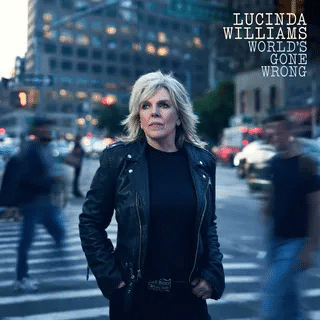
Lucinda Williams opens World’s Gone Wrong with a scene rather than a thesis. A nurse and a car salesman drive through boarded-up stores and thinning prospects, the radio somewhere between comfort and noise. It feels lived-in. A song about money stress and exhaustion that never raises its voice, even as the guitars grind and Rob Burger’s Hammond B3 swells behind her. The chorus lifts without pretending things are okay underneath. That balance has always been one of Williams’ strengths, and here it sets the tone for her sixteenth album.
Williams has spent decades working inside the overlaps of folk, country, blues, and rock, not as a stylistic flex but as a practical language. On World’s Gone Wrong, that language tightens. The lyrics are plainspoken, sometimes blunt, and they land harder for it. Her voice carries the record. Tremulous, weathered, occasionally ragged, it holds grief and resolve in the same breath. The wobble isn’t hidden. It’s central. You hear a singer who has earned every syllable and isn’t interested in sanding anything down.
The title track sketches a broad social unease without getting abstract. Empty factories, confused headlines, a sense of moral static. It could have turned preachy. It doesn’t. The hook does the work, opening the song outward, almost skyward, the way a good chorus can momentarily suspend disbelief. That sense of release runs through the album, even when the subject matter refuses relief.
Something’s Gotta Give leans into a dark-country blues groove, thick with low-end grit and coiled tension. The guitars snarl and circle each other, Marc Ford and Doug Pettibone trading lines that feel less like solos than arguments. Britney Spencer’s backing vocals add muscle without smoothing the edges. Williams sings about erosion, ethical and structural, with a steadiness that makes the anger more unsettling. No theatrics. Just accumulation.
That theme of collapse gets counterweighted by moments of communion. Low Life, co-written with Adrianne Lenker and Buck Meek, drops us into a bar where the prices are frozen in another era and the jukebox still matters. Harmonica, organ, a loose gospel sway. Williams’ voice here is cracked but warm, leaning into the room rather than preaching from the doorway. Community doesn’t need to be grand. It needs to be real.
Covers can feel ornamental this late in a career. The version of So Much Trouble in the World avoids that trap. Joined by Mavis Staples, Williams reframes Bob Marley’s reggae lament into something slower and weightier, the groove relaxed but not casual. Staples brings gravity and a kind of hard-earned reassurance. The song carries sorrow without resignation, a small but meaningful distinction.
Sing Unburied Sing, inspired by Jesmyn Ward’s novel, pushes the album back toward electric heat. The guitars recall Neil Young’s rougher late-period sprawl, with a whiff of Billy Gibbons’ grease. Backing vocals from Maureen Murphy and Siobhan Kennedy blur the line between roadhouse and revival, the title turning chant-like, almost incantatory. It feels haunted, not in a gothic sense, but in the way unresolved history tends to linger.
Black Tears sits deep in the swamp. A slow, stomping blues that references burned churches and deferred dreams without turning them into slogans. The Langston Hughes echo lands quietly, carried by Williams’ unhurried phrasing. The atmosphere is thick, humid, closer in spirit to the worn patience of Time Out of Mind than to protest music as spectacle.
The album closes with We’ve Come Too Far to Turn Around, and it earns its place. Piano and organ set the frame. Norah Jones’ backing vocals and piano ground the song, offering lift without distraction. The melody feels old, almost traditional, like something that could survive being passed hand to hand. Williams sings it without irony. The conviction is calm, not triumphant. More endurance than victory.
Co-produced by Tom Overby and Ray Kennedy, World’s Gone Wrong sounds stripped but intentional. Nothing is there by accident. The arrangements leave space for the words and for the grain of Williams’ voice, which remains the album’s most persuasive instrument. The record doesn’t argue that music can fix what’s broken. It insists, more modestly and more convincingly, that naming the damage still matters, and that shared songs can hold people together when other structures fail.
After more than four decades of recording, Williams continues to work from instinct rather than nostalgia. World’s Gone Wrong feels engaged with the present moment without chasing relevance. It listens as much as it speaks. In a time crowded with noise, that restraint carries its own weight.
World’s Gone Wrong is out now via Highway 20 Records and Thirty Tigers.
Photo – Mark Seliger
Share this :


