
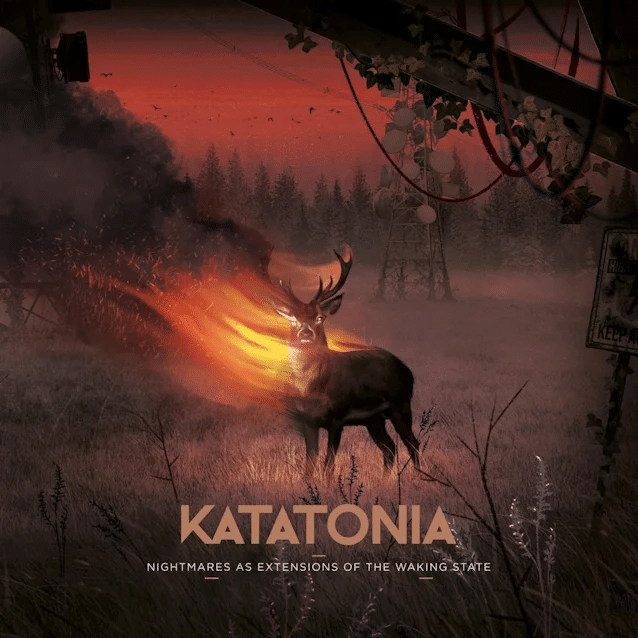
What do you do when the band you’ve followed for decades refuses to stay in place? When the sound that first pulled you in—bleak, beautiful, weighted like winter—morphs, evolves, tiptoes away from heaviness and into something more elusive? For Katatonia, the answer has always been the same: you don’t look back. Or if you do, you squint.
Nightmares as Extensions of the Waking State, their 13th album, feels like it both acknowledges that refusal and leans further into it. Gone is co-founder Anders Nyström, one of the last links to their death-doom beginnings. What remains is Jonas Renkse, whose voice still sounds like it’s coming from the other side of a sleepless night and whose songwriting now orbits something softer, stranger, but no less affecting.
Let’s get this out of the way early: Katatonia haven’t made a “metal” album here. At least not in the way that word is typically used. There are heavy guitars. Dense, even suffocating moments. But this is an album shaped more by atmosphere than aggression. More tension than release. If anything, it feels like the culmination of a long arc that started with Dead End Kings, ran through The Fall of Hearts, and was given shape and structure on Sky Void of Stars. Nightmares doesn’t reinvent their sound—it distills it.
The opening track, “Thrice,” lays down the blueprint: a brief, distorted lurch of chords before everything collapses into hush. Guitar lines shimmer rather than shred. Renkse’s voice hovers. The chorus doesn’t explode—it seeps in. It’s five minutes of restraint with undercurrents of dread, and it’s beautiful. Not “epic” beautiful. Not grandiose. Just… fragile, and meticulously constructed.
This album deals in a different kind of weight. “The Liquid Eye” flirts with menace, driven by a tight, muscular rhythm section and jagged guitars that stop just shy of violence. “Wind of No Change” is more explicit: a brooding crawl underscored by a choir and an unsettling invocation of “Hail Satan” that lands not as provocation but as weary sarcasm—less rebellion, more resignation. And yet, even here, nothing ever really explodes. Katatonia have mastered the art of edging toward catharsis, then pulling back at the last second. It’s infuriating. It’s compelling.
The production is clean, almost too clean at times. Every note, every reverb-drenched snare hit feels precision-placed. There’s an airlessness to some of the mixes—like you’re listening from inside a sealed room. But that clinical sheen serves the songs. It creates space, lets the subtler elements shine. “Lilac,” one of the album’s more accessible moments, benefits from that clarity. The guitars chime. The vocals drift in and out like a thought you can’t quite hold. It’s the kind of track that would feel right at home on Viva Emptiness, if you stripped away the angst and added a little more grace.
But this isn’t all ambience and introspection. “Temporal” anchors the midsection with one of the album’s most memorable choruses, its climbing vocal line echoing early-2000s alt-metal but filtered through Katatonia’s increasingly post-everything sensibility. And then there’s “Warden,” a track that toys with dub-like low-end and off-kilter rhythms, as if someone slipped a bit of Coil into the session and no one objected. It’s these moments—when the band allows weirdness to creep in—that feel the most alive.
Now, some listeners might find the album’s second half to be, let’s say, less immediate. After the slow-burn architecture of the first few tracks, songs like “Departure Trails” and “The Light Which I Bleed” seem more subdued, even inert on first listen. But give them time. These are not songs that announce themselves. They’re content to sit in the corner, whispering to themselves. And if you listen closely, they’ll reveal things that weren’t obvious the first—or fifth—time through.
And then comes “Efter Solen.” A curveball, if not a full swerve. Sung in Swedish, the song is barely there: skeletal piano lines, flickers of synth, a beat that could have been lifted from some ambient-techno side project. It doesn’t sound like Katatonia. And yet, it completely does. It feels like walking through snow with no destination. Cold, yes—but oddly comforting. The experience is disorienting in a way that invites rather than repels.
Closer “In the Event Of…” ties it all together. There’s a grandeur here, but it’s earned. The structure is loose, drifting between motifs without ever settling too long. It resembles a dream sequence rather than a traditional finale. By the end, it feels like the record has folded in on itself, leaving you somewhere vaguely familiar but irrevocably changed.
There’s a meta-narrative humming underneath all of this. Nyström’s absence is notable, not just because of his decades of contributions, but because it makes this record entirely Renkse’s vision. It’s introspective to the point of claustrophobia. But that singularity of voice—literal and figurative—is what makes Nightmares coherent. You can feel the weight of history in these songs, but also a desire to not be trapped by it. Katatonia are not interested in nostalgia. They’re more likely to walk into the fog than to look back.
And that’s the trick, isn’t it? After more than thirty years, Katatonia haven’t gotten louder or faster. They’ve gotten weirder. Quieter. More deliberate. And somehow, that makes their music feel heavier. Not in a genre sense. In a way that lingers.
Nightmares as Extensions of the Waking State isn’t an album for everyone. It doesn’t beg for your attention. It doesn’t offer easy hooks or cathartic payoffs. But sit with it. Let it soundtrack your 3 a.m. thoughts. Let it drift into your headphones as you walk through the early morning silence. Eventually, it’ll click. And when that moment arrives, you’ll wonder how you ever listened to Katatonia while expecting them to remain unchanged.
Nightmares as Extensions of the Waking State is out now on Napalm Records.
Photo Credit: Terhi Ylimäinen
Share this :


