
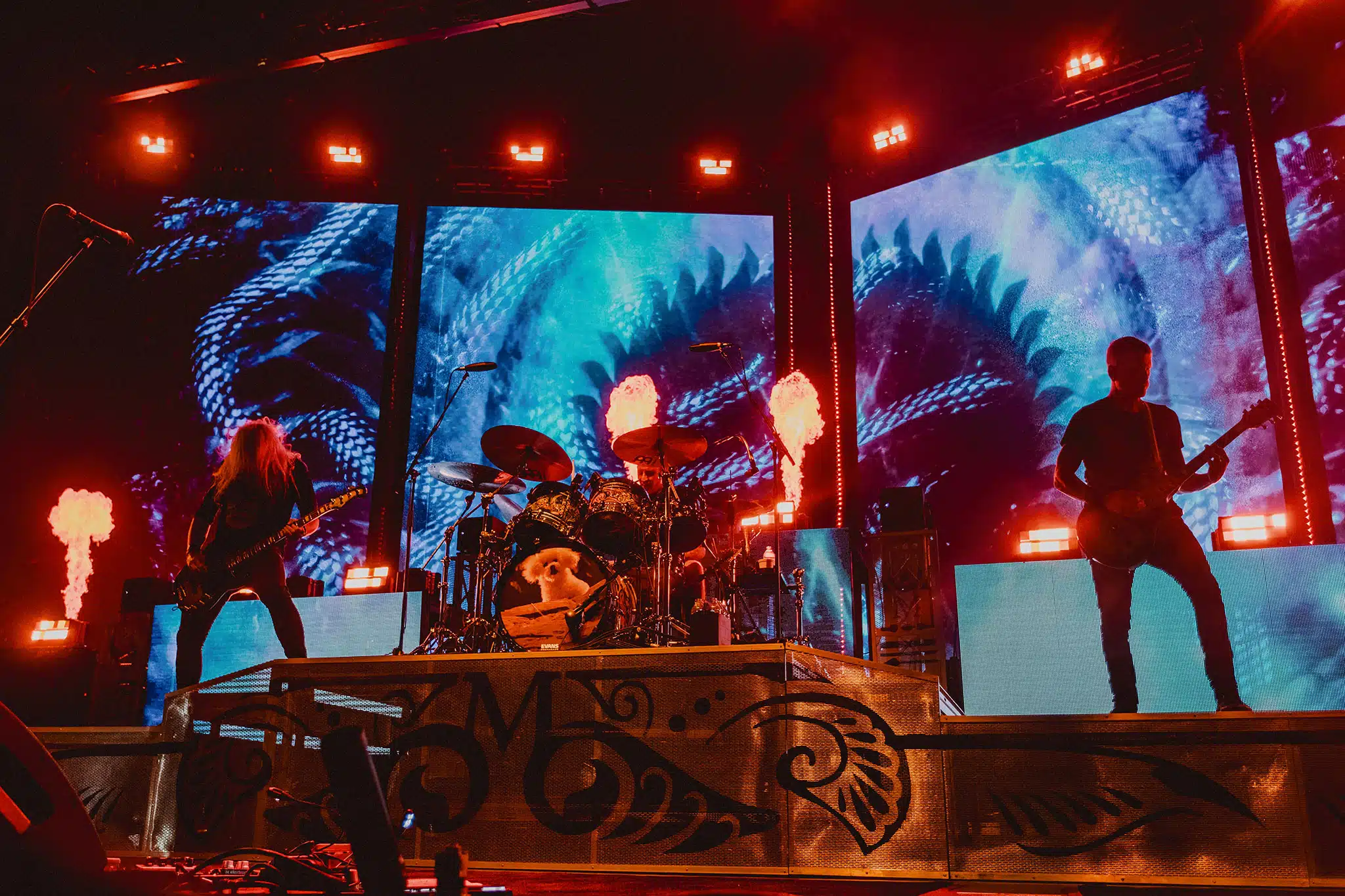
Brann Dailor has spent a good chunk of the summer alone behind a drum kit, playing the same songs over and over until they are perfect. “I’ve been going through the set down in my basement, sweating my ass off,” the Mastodon drummer and singer says. “It’s been really fun.”
Once the band settles on a set, it mostly stays locked. “We keep it so we can try to make it as perfect as possible. It’s fun to go through and try to nail it every night. Then you get it two weeks in and you’re like, okay, this thing has one big piece. The show is the show. Plus we have a lot of video content, and it all matches to certain songs, so we want to keep those in there.”
The trouble, after 25 years, is deciding what to leave out. “We’ve got 10 albums worth of songs, so it’s hundreds of songs. Not saying we know all of them, but we’re trying to resurrect some oldies for the people. That’s fun to try to pull off. I’ve been practising some songs we haven’t played in a long time.”
All that rehearsal is in service of Marrow Deep, out August 28 on Loma Vista Recordings. It is the Atlanta band’s first album since 2021’s sprawling double LP Hushed and Grim, and the first since founding guitarist Brent Hinds parted ways with Mastodon and then died in 2025, months after the death of Dailor’s mother, Michele Lawrence. Two decades into a career that takes in a Grammy and a permanent place in modern metal’s canon, it lands as both an elegy and a reintroduction: a new lineup with Nick Johnston on guitar and keyboardist João Nogueira, recorded at the band’s own West End Sound, co-produced with Patrik Berger and Kurt Ballou, and mixed by Andrew Scheps. Dailor, typically, refuses to oversell it.
“I feel great about it,” he says. “We poured over that thing for a long time and worked really hard on it. It doesn’t feel that much different from everything we’ve really done, but we paid special attention to every nook and cranny to make it something we could love. And so we got there.”
They got there. Marrow Deep is unmistakably Mastodon, the interlocking riffs, the hairpin turns, Dailor’s drumming behaving less like timekeeping than a second lead voice, but grief has pulled the songs into stranger, roomier shapes. Snakes for Dinner rides a hypnotic chant from Josh Homme before the band drops the floor out from under it. The Vanishing drifts for minutes in a narcotic, Planet Caravan haze, all echo and space, until a wall of death-metal weight comes crashing through. It is a heavy record that is not always loud, and it is strongest when it lets the quiet sit.
The heaviness starts behind the kit, and recording at home has not softened Dailor’s approach. “When I start my drum tracks, I want to do them. I don’t want to fuck around. I get in the zone. It’s physically demanding, an athletic thing as much as it’s an artistic, creative thing. When I’m at the top of Drum Mountain, physically, and I’m hitting all my stuff with ease, I just want to keep rolling and get more takes. With drumming, day to day, your performance changes a little bit. So if you’re feeling really good, you want to continue that. Let’s get the next one. For me, it’s business as usual.”
The words are another matter. “When I’m done with my drum tracks, I get to do my least favourite thing, and that’s write lyrics and come up with vocal melodies for a big chunk of the record,” he says. “I hate writing lyrics. I have to dig in. It’s therapy session time, and I don’t necessarily want to go to all those places. I just want to hang out and have fun. But no, I’ve got to go explore my feelings and think about shit I don’t want to think about. And then I’ve got to figure out how I’m going to play the drums and sing about it.”
He sets the bar high anyway. “I want to be honest. I want to be authentic. I want to say what’s on my mind and connect with the audience. But I also want the phrasing to be aesthetically pleasing. I want lines one and three to rhyme, and two and four to rhyme.” The pursuit tends to humble him. “It is disheartening to see the edge of your intelligence. When I’m writing lyrics I’m like, God, I wish I had better vocabulary. It’s like, why am I so stupid? Those are hard things to be confronted with.”
He is stubbornly analogue about all of it. “I’ll never rely on ChatGPT. I’ll sit there and suffer through it and figure it out on my own,” he says. “It’s all very pencil and paper, and me.” To find the right headspace he cracks open the Odyssey, or puts on Rosemary’s Baby, a Jodorowsky film, 2001, The Exorcist, anything that gets him “in the mental space I need to be in to think up some cool shit to sing.”
What he will not do is protect himself from the material. He does not let himself dwell on having to relive these lyrics night after night. “That’s the last thing I’m thinking about, even though I probably should,” he says. “But I don’t want to shy away from anything based on a future feeling I don’t even know yet. Plus I’m pretty good at locking that gate emotionally, from years of practice with my sister’s death and a number of things that happened early in my life. I can talk about stuff with nothing. I have the ability to close everything down and speak to you clinically about a tragic situation I went through.”
That control, he says, is part of the gig. “You need to have that, because you crying and singing doesn’t sound good.” And yet Marrow Deep forced the gate open more than once. “There were times in the studio that I did get emotional. I had to stop and pull back and say, give me a minute. Which I think is good. I wanted to be emotional in the studio, because then I knew I was at the place where I need to be. That’s important. I want it to be real, because the things that happened were real, and emotions are real. These people meant the world to me.”
His mother came first. “It doesn’t get much bigger than losing your mom, and I was lucky enough to have a very special, awesome relationship with her,” he says. “But the examination of her life, and the raw deal she was given, made it that much more profound. She endured so much that was unfair, like the illnesses she went through. When your body doesn’t cooperate with your mind for many, many years, and she still had a smile on her face. I don’t know how she did it for as long as she did.”
Hinds was family of another kind. “The loss of Brent was massive. That was my brother for 25 years. I wasn’t even mad at him. I just wanted him to be happy, and he wasn’t. I felt like taking a break for a while might help. But then he goes and dies, and it’s like, are you kidding me? So there was a lot to unpack.”
The timing was brutal. “We went in the studio maybe 10 days after Brent died. I really questioned if it was the right thing to do. But luckily I didn’t verbalize that to anybody. I just dragged my sad carcass to the studio every day, got behind the drums, and worked it out. Every day I came home to my wife and we had dinner, and I felt incrementally better each day we started digging in. The preoccupation of micromanaging every little nook and cranny of every note definitely helped put my mind somewhere else.”
The band survived it by closing ranks. “We leaned on each other like those warriors in 300. They just got together and put up a bunch of shields, and we were like, let’s just work on this record. So we’re not sitting and stewing in the car in a Kroger parking lot.”
The grief followed him behind the kit anyway. “I said it out loud while we were tracking. I was like, man, I keep seeing Brent, he’s right here. It’s so weird, it gives you this little jolt, and then you remember it’s impossible. So I verbalized it to everybody. I keep seeing him. And I keep hearing the chains on his belt.” He compares it to the way a house feels after a pet is gone. “It’s like when you lose a dog. You always expect him. You’ll hear his chain in the distance and think, oh, here comes my dog. But no, they’re gone.”
That is where the songs came from. Lead single Your Ghost Again is a tribute to both Hinds and Lawrence; Snakes for Dinner is what Dailor calls “both my mom and Brent wrapped up in a little bundle of sadness.”
The band told the rest on camera, in the short film The Mastodon in the Room. For Dailor, it was less about closure than about honesty. “I’m not interested in closing any doors,” he says. “But maybe it helps us move on with our fans, because we were so tight-lipped about everything, even when he was having his little rants in the comments sections. I felt like we needed to address it and tell our side of things, and be honest without throwing him under the bus. I knew he wasn’t there to defend himself. But I don’t think we said anything out of school. All the things we talked about were pretty well documented in the press already. We’re just providing a truthful, honest account of how we felt. And we still love him.”
He refuses to flatten a complicated man into a tidy story. “It was very complicated. He was a complicated dude, and that came with his brilliance. That’s how people are, and we’re no angels. But we love being in Mastodon, and we just want to do this thing we’ve been building for 20-something years. He just didn’t seem too interested. I thought, that’s OK, man, you can go do something else. But he didn’t want to step away from it either. It was kind of a purgatory we were all in. We had to make a change, and that was a sad moment too. So we felt like it was necessary for all of us to move on into this new chapter.”
That chapter includes a hard practical question: how do you play songs Hinds wrote and sang? Dailor is still working it out. “It’d be a good idea to bring somebody out to sing, at least,” he says. “We wouldn’t try to find somebody who’s going to do an imitation. We’ve been talking about it and thinking about it. We’ll see.” Bassist Troy Sanders put it plainly in the album notes: “All of us know that nobody is filling Brent’s shoes. That’s an impossible task.”
If Marrow Deep is a record about absence, it is also crowded with friends. “We’ve always had guests, some albums more than others,” Dailor says. “Blood Mountain had four, maybe. Leviathan had one or two. We’re always looking for spots for some pals. But this one, it seemed like we had more than a few.”
Homme’s cameo, his first with Mastodon since Blood Mountain, was almost accidental. “Josh sang on Colony of Birchmen back in the day, and he was in the forefront of my mind the day after Brent passed,” Dailor recalls. “We were in Alaska, about to play a show, and I woke up and Josh was calling me. I figured he wanted to talk about Brent, but he just had some funny little thing. He wanted to say he was upset with me for keeping some tasty food item a secret from him. I was like, OK. But I appreciated it, because it was just Josh checking in on me, making sure I was OK. So he was in my mind, and I was listening through Snakes for Dinner and thought, man, I can hear Josh on here. I hit him up and sent him the song, and they happened to be in the studio doing the new Queens of the Stone Age record, so it lined up perfectly. He was like, dude, I love the song. I sent him a little poem, and he made his lyrics around that and did this chant kind of thing.”
For the spoken-word passage in Three Fates he wanted Neil Fallon of Clutch, and he was nervous about the ask. “Nobody can do a cool spoken word, it’s hard not to sound cheesy,” he says. “I wrote the whole thing and sent it to him and said, tell me if this is stupid. Just be honest. If you don’t want to do this, I totally understand, and if you think these lyrics are dumb, then write your own, because I respect Neil’s lyricism so much. He’s such a wordsmith. I was embarrassed to send him my lyrics, but I did. And he was like, I love these, they’re great. I’m like, OK, are you sure you’re not lying? He was into it. When he sent it back I was like, oh my God, it’s totally perfect. That’s exactly what I was hearing in my mind.”
From there the list only grew. Randy Blythe of Lamb of God and Nate Newton of Converge trade gang vocals on A Vampire’s Demeanor; Joe Duplantier of Gojira surfaces at the end of The Vanishing. “It’s this very cosmic, Planet Caravan-sounding thing all the way through, and then all of a sudden this super heavy thing happens,” Dailor says. “I was like, got to get some death metal growls right there. Joe was perfect for that.”
The intro to that same song belongs to a hero. “That was Geezer Butler on the intro for The Vanishing,” he says. “We were so steeped in Sabbath from the Back to the Beginning concert, and even before that, my whole life. Every metalhead has a relationship with Black Sabbath. But my parents were hippies. Not Grateful Dead hippies, more Black Sabbath hippies, or Frank Zappa hippies. The cool hippies.”
And Sabbath, for Dailor, leads straight back to his mother. “When I was a kid there were Sabbath records around. My mom’s band did a couple of Sabbath covers, so they’ve always been in my life. My mom’s favourite member was Geezer. I remember watching Sabbath videos with her on YouTube, and she’d say, man, look at Geezer’s silver platform boots, with that little vest. So The Vanishing is sort of for her as well. Just to have Geezer on there is incredible. Such a huge honour.”
He is still a little astonished the record got made and that so many people helped him make it. “I really feel like the metal community and our friends just wanted to help us out. I could feel the love from them,” he says. “I think they knew this one was tough for us to get through and that we were giving it all we had. So they wanted to help. I appreciate them to the moon and back for it.”
The ghosts, he knows, are not going anywhere. Neither, after everything, is he.
Marrow Deep is out August 28 on Loma Vista Recordings. Mastodon play MTelus in Montreal on September 27 with Deafheaven and Alcest, on The Poisonous Weapons Tour.
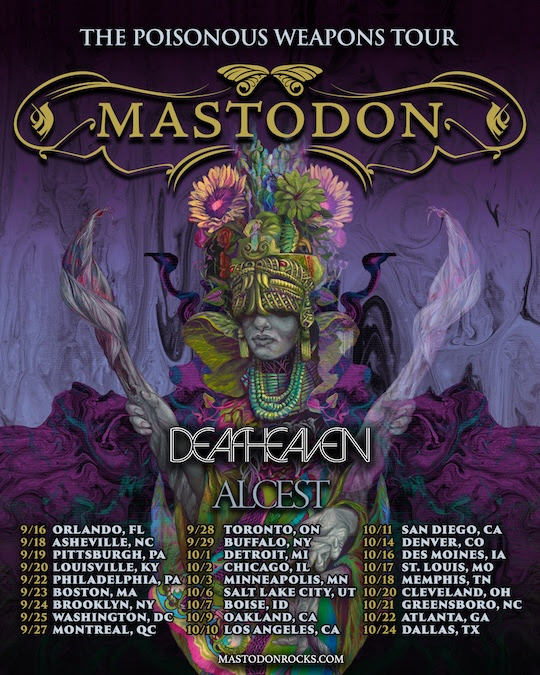
Photo credit: William Lacalmontie & Steve Gerrard
Share this :


