
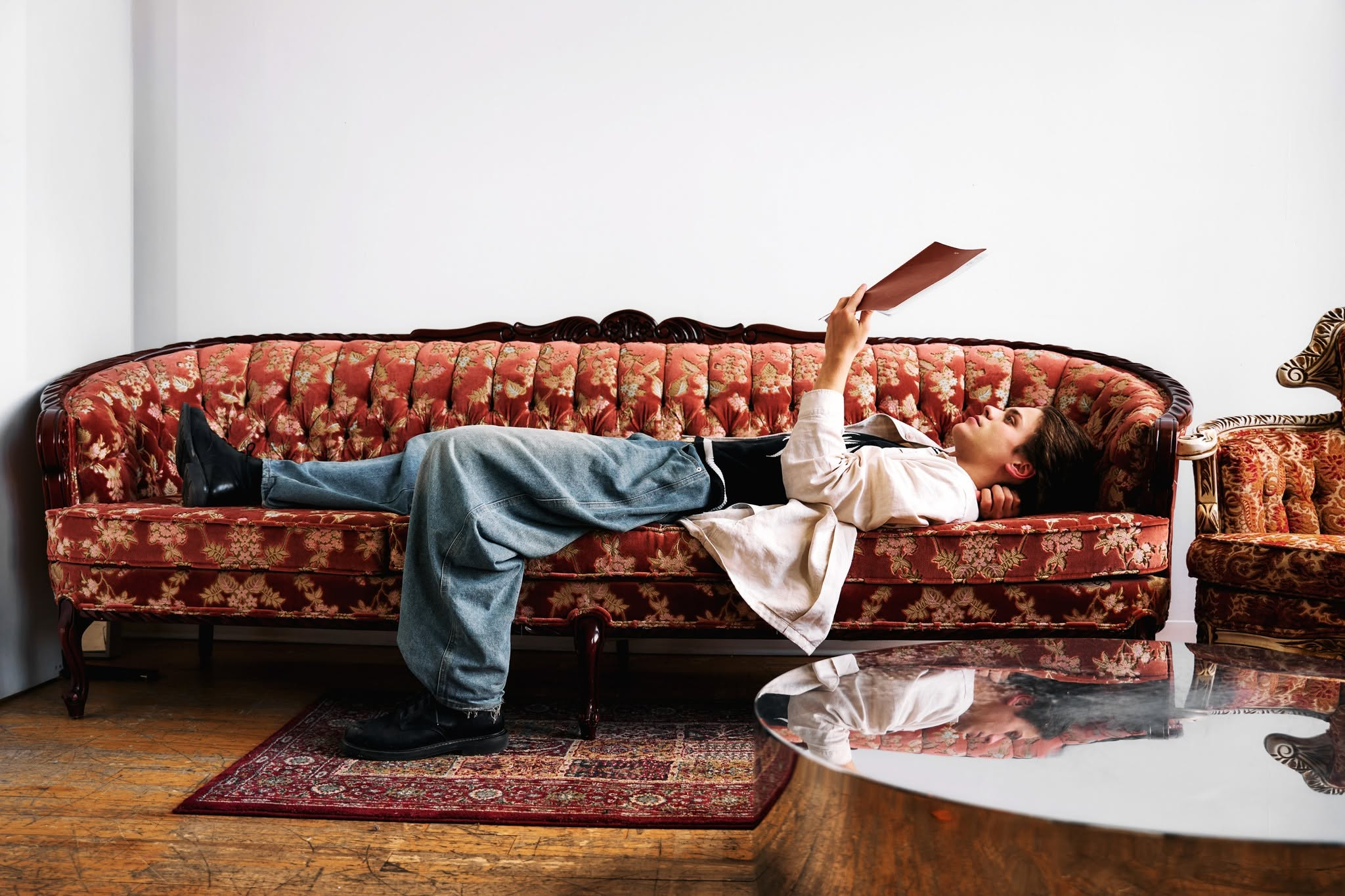
Theo Day talks about Leave You Behind as if it were inevitable, not because he planned it, but because he recognizes the pattern in himself. When life tips into a certain kind of chaos, he writes. When the pressure becomes constant enough that it starts to feel normal, he turns it into a song before it turns him into someone he does not recognize.
“I wrote this song back when I was having a hard time,” he says. “I was struggling mentally with the weight of expectations from everyone around me. I felt as though every conversation I had was about how I wasn’t doing enough.”
What he describes is not a single dramatic moment, it is erosion. Expectation becomes atmosphere. The smallest tasks start to feel impossible because he is carrying the fear underneath them, the fear that he is failing people, that he is letting them down, that he is not measuring up to whatever version of him they have decided should exist.
“Carrying that weight constantly became so hard that the smallest things overwhelmed me,” he says. “My biggest fear had always been letting people down.”
The basics went first. “A lot of the time I was isolated, not eating or sleeping, I just became a ghost of myself.” He was “exposed to it for so long” that it wore him down until his mental health “finally broke.” When he tried to name what was happening, even that backfired. The conversations he hoped would offer some relief became another place where he was judged.
“Because I couldn’t endure that, I tried talking about it but everyone I talked to seemed to see it as the perfect opportunity to list new grievances on what I was or wasn’t doing enough for them. So I just stopped talking about it.”
That line lands heavily because it explains the emotional logic behind the song. Leave You Behind is not written from the clean, reflective distance people like to imagine artists have. It comes from the moment after he stopped asking for understanding and started trying to survive by shape-shifting.
“I tried to be whatever version people wanted just so they’d stop throwing jabs at me constantly or trying to make me feel small because I didn’t agree with their opinions about myself,” he says. “I didn’t realize until later on that I was losing myself.”
There is a decisive turn in the way he talks about what followed. “Since then I promised that I would never bend to the wants of somebody else while losing who I am. Nowadays, I may stand too strongly on the side of fighting for my mental health but that’s because I know the consequence of not doing so.”
When he explains why he knew the experience would become a song, he makes it sound almost straightforward, like a rule he cannot break even if he wanted to. “I usually write songs that resonate with how I feel emotionally,” he says. “Writing songs that I don’t resonate with would be kind of against the whole reason I like doing this.”
Then he gives you the line that feels like it belongs in the liner notes to his whole catalogue. “Every chapter’s a story and every page is a song.”
That sense of writing as a document, as proof that something happened, is threaded into the chorus, where he sings, “I found you in darkness, the darkest of times.” The line reads like a message to another person until he explains who he was really addressing.
“I was writing about how I was basically a walking zombie until I woke up and realized the damage I had done to myself was too large for me to also carry,” he says. “That’s when it felt like someone flipped a switch. My biggest fear was no longer disappointing people. My biggest fear became losing myself.”
So the “you” is him. Or at least, it is the version of him he is trying to reach, the self he nearly misplaced. Still, he did not want the lyric to be a closed door.
“I was talking to myself but I knew it would resonate with more people if I gave them room for their own interpretation so I didn’t make the lyrics too specific to my interpretation,” he says.
That openness matters because it explains why the song has connected quickly in rooms where nobody knows him yet. He played it live at School Night Toronto and Departure Festival before it was officially out, which is a particular kind of risk. If the crowd does not come with you, there is nowhere to hide. If they do, you feel it immediately.
“It’s always a wholesome moment for me when I sing something that resonates with people emotionally,” he says. “Especially when I see a room full of strangers bobbing their heads to my work.”
He talks about performance like a brief suspension of distance, like the usual boundaries between people soften for a minute. “My songs are full of emotional confessions and stories so when someone comes up to congratulate me and tell me they resonate with the words I’m saying, I feel connected to complete strangers that I know nothing about. But somehow, in that moment, I understand them and I feel understood.”
Earlier tracks like Somewhere Shallow, Medicine Cabinet, and Caravan Song were stripped-back and close, the kind of recordings that feel built for headphones. Leave You Behind reaches for something bigger, a wider frame, a larger lift in the chorus. He does not describe that choice like a calculated bid for radio, he describes it like a way to make the feeling physical.
“I’ve grown fondly of different band arrangements and production,” he says. “It’s fun to see what you can do just by adding a few elements to a song. I knew I needed the chorus to have a larger production so that the audience would feel the emotions of the music, the careless and uplifting nature of the melody.”
That bigger sound was shaped with a specific team: lucatheproducer on production, with mixing and mastering handled by Daniel Cinelli at Planet Studios. Theo frames collaboration as part of his growth, not a compromise of independence. He likes having specialists in the room, people who are great at things he does not pretend to know.
“Luca is a phenomenal producer, he has years of experience in areas I know nothing about,” he says. “We feed off each other’s ideas very fluently and I’ve found I work better having a writing room with specialists in different areas rather than having everyone be a jack of all trades.”
On Cinelli’s work, he sounds like a fan as much as a client. “Daniel Cinelli came out with one of the most awesome mixes I’ve heard, I love his work,” he says. “Working with this calibre of professionals naturally elevates your own skills and experience level and I think it’s necessary to push the limits of what you can do.”
Outside the studio, the scale is changing quickly. He has sold out L’Escogriffe. He is headed to LASSO Festival in Montreal, his biggest festival date yet, on a lineup headlined by Mumford & Sons, an influence he has cited. If you want a clean narrative arc, it is right there, the kid who attended the festival now playing it. He does not over-romanticise it, but he does not hide the shock of it either.
“Playing at LASSO is going to be so surreal,” he says. “I used to come to this festival and now I’m going to be playing at it. The fact that I’m going to be playing on a lineup that has so many amazing performers with Mumford & Sons headlining, is just such a blessing to be in that atmosphere.”
Even with editorial support and radio attention, he still talks like someone who is not fully convinced he is allowed to be here yet, like he is waiting for the moment it becomes real. When asked if any of it has sunk in, he answers immediately.
“Nope,” he says. Then he explains why, and the answer is not false humility, it is identity. “I’m just somebody who does what he loves and the fact that other people have reacted the way they have to it is so heart warming. I feel very blessed every time I get to play and because of the confidence and support people give me I work hard like a bull to show them that their faith in me isn’t misplaced.”
The pace is only accelerating. Theo is planning a release schedule that brings new music roughly every six weeks for the rest of 2026. That kind of output can sound like pressure from the outside, but he does not describe it that way. He describes it like an increased capacity to live in the thing he loves most.
“I love making music above all else, it drives me every day,” he says. “When I’m feeling sick or overwhelmed or when I’m super excited about something I always end up with a guitar in my hand.”
He does not deny that it is relentless. He just refuses the idea that it is forced. “I wouldn’t really say that I feel pressured by it,” he says. “I’m being put in a situation where I can do what I absolutely love at a greater pace because I now have the resources to make that happen. The music output just reflects my team’s efficiency around me and my love for making music.”
That is also where The Road to LASSO comes in, a behind-the-scenes series leading up to August. He wants it to show something a press release cannot, the ordinary human mess behind the performance.
“I’m hoping to show the truly human element behind every singer who takes the stage,” he says. “We’re all just grown up kids who loved to make music and that’s why we play shows, go to the studio all the time and write songs when we’re home alone.”
He ends it on the simplest version of the point, the version that makes everything else make sense. “We do it because we are just people who truly love music. It’s pure human passion that drives music and I’d love for people to see the less polished and serious side of our lives.”
Press Photo – Nicolas Glen
Share this :


