
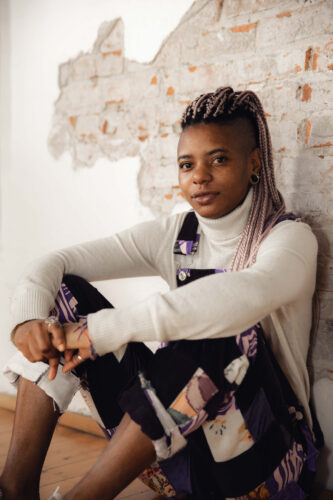
For Tamara Weber, Destinations doesn’t sound like a reinvention so much as a catching up. The Montreal-based singer-songwriter and producer has spent years circling different sounds, different places, and different ways of working, and this is the point where they finally start lining up.
“I think it was a natural shift. I started out more in folk music because I was learning and mostly writing songs on my own with just my guitar. As I began exploring audio production, I started approaching music the way I actually heard it in my head. I’ve always been drawn to different kinds of music, but I didn’t necessarily have the skills to express that before. So I wouldn’t say I’m changing, just expanding my horizons.”
That idea of expansion feels more accurate than any clean genre shift. The early songs came from what was available at the time, a guitar, a voice, a room. The newer ones feel like they’ve been given more space to stretch out, not because the intent changed, but because the tools did.
Her story doesn’t really sit still either. Born in Haiti, raised in St-Georges de Beauce, shaped by years in Quebec City, then Montreal, then everywhere else for a while. She talks about it without turning it into a narrative arc.
“I was born in Haiti and adopted as a baby. I grew up in St-Georges before moving to Quebec City, where I studied and lived for six years. I then moved to Montreal and began travelling the world, busking in many countries for another six years, living part-time in Montreal and part-time in hostels. I only really settled in Montreal when the pandemic hit and I could no longer travel. All of this has deeply shaped my musical journey and this Destinations record.”
You can hear that movement in the album, even when it slows down. The electronic textures, the late-night feel, the sense that the songs are happening somewhere between places rather than rooted in one.
“I always had a cinematic aesthetic in mind, but I didn’t yet have the tools or vocabulary to bring it to life. By learning audio production, I also learned to create the musical landscapes I had in mind and also to stand by my ideas. I guess I was just a little limited by my production skills. I’m glad the Destinations making process allowed me to experiment with these textures and atmosphere.”
For a lot of people, the first time they saw Weber was on television or through the audition clip that’s now been watched tens of millions of times. That kind of moment tends to follow artists around, whether they want it to or not. She doesn’t seem particularly interested in pushing back against it or leaning into it either.
“I still relate to it because I love the song and am still proud of that performance. I’ve never felt pressured by it in any way. It was a special moment where I was simply being myself, so I feel like all I have to do, whether I’m writing or performing, is stay true to who I am. I’ve also released two EPs since then that I’m really proud of: Us Wild Folks in 2019 and Février in 2021.”
Same with The Voice France and La Voix. No dramatic break from that part of her career, no sense of needing to distance herself from it.
“It definitely gave me more confidence. I don’t feel like I had to leave anything behind, except maybe a bit of privacy.”
That line lands quietly, but it says a lot about what comes with visibility. The album circles that idea from a different angle, especially on “I’m Here,” which strips things back to something blunt and hard to hide from.
“Music is my safe space. It’s always been where I can express my deepest thoughts with honesty and vulnerability. I believe that if I feel this way, others probably do too. Music that spoke to me like that made me feel less alone, and I’d feel truly grateful knowing mine could do the same for someone else. In that sense, exposing myself through music is a kind of therapy for me and I hope it can be that for others who feel the same.”
There’s no attempt to dress that up into something more abstract. It’s direct, and it stays that way. Even when the production gets bigger, that core doesn’t really shift.
What does shift is how those emotions sit inside the songs. “See the World” moves with a kind of lightness that doesn’t quite match what it’s saying, at least not on the surface.
“I used to write very dramatic music when I was younger. I still carry a love for it, but I’ve learned that not everything needs to live in that intensity. I love pop music and am drawn to songs that hold something heavy while still inviting you to move. Where sorrow and rhythm coexist. Stromae helped me see the beauty in that delicate contrast.”
It’s a tricky balance, letting something feel open without sanding down what’s underneath it. The album leans into that tension instead of trying to resolve it.
Some of the more unexpected moments come from setting limits rather than removing them. “Tout ce qu’il reste” started with a challenge, using the pan flute as a starting point instead of an afterthought.
“I often work with challenges, but I usually set them for myself. That said, I get even more excited when they come from someone else. It pushes me out of my comfort zone. I write a lot of songs, but like anyone, I have my automatisms. Challenges like this help me break free from the traps I unconsciously set for myself.”
There’s a similar shift when she moves between English and French. It’s not just a stylistic choice, it changes how the writing behaves.
“Actually, writing in French is still relatively new to me, and in many ways, it feels like I’m learning how to write songs all over again. The rhythm of the language, the phrasing, the way emotions sit in the words are completely different.
French songs tend to lean more into storytelling. There’s something about French that pushes me to be precise, to paint clearer images, to structure the narrative carefully. English, on the other hand, feels more instinctive to me emotionally. It flows in a way that allows me to express raw feelings more directly, almost without thinking. It’s not that I’m willing or not to share more in one language than the other, but I would say the rhythm of the words just feels different.”
Out on the road, those choices shift again. The album leans on electronics in places, but the live show pulls it back toward something more immediate.
“There are a lot of electronic elements on the album, and while we could use backing tracks to recreate it perfectly live, I really prefer playing with just the band. Of course, it sounds different, but it brings a sense of authenticity and spontaneity that I love. There’s a kind of magic in being fully present on stage.
The musicians I play with are four badass women, also close friends offstage, and I think that connection really comes through. People often tell us how much they feel that chemistry, and I find that incredibly special.”
Destinations is out now.


