
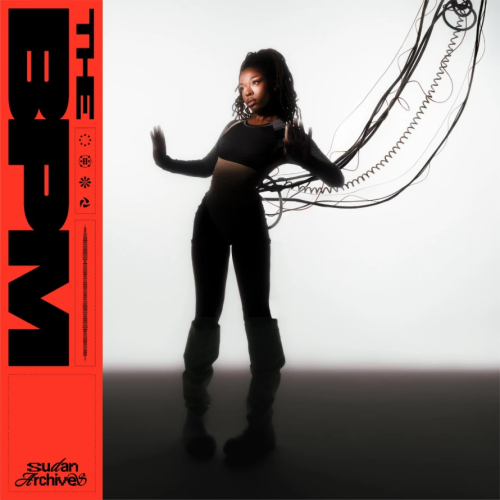
Sudan Archives arrives on THE BPM with intent. The Los Angeles-based songwriter, violinist, and producer uses rhythm as architecture and persona as framing device. A figure she calls Gadget Girl appears as an alter ego, not a costume but a workflow, a way to embrace technology as an instrument. The result is a diary written for the club, precise about feeling and generous with groove.
The production pulls from Detroit and Chicago, where her parents have roots, folding in Jersey club, drum and bass, and glossy electro. Tempos sit higher than on previous records, but patterns lurch and glide rather than flatten into utility. Breaks snap like cold air. Sub-bass presses forward, then retreats for strings or a vocal aside. You can hear continuity with earlier work, but the intent here is kinetic. She wanted bodies to move.
Strings remain the signature, though rarely as centrepieces. Her violin functions as rhythmic hook or harmony smear: short figures at the edges of the stereo field, doubling vocals, shadowing kicks. On “She’s Got Pain,” the instrument arrives late and drops the temperature by a few degrees, the way a breeze shifts a room. Processed fiddle phrases behave like synth leads, blurring acoustic and electronic.
Vocally, she toggles between clear melody, conversational half-rap, and vocoder-tilted textures. Hooks land without pandering. Verses carry small details that reward repeat plays. Stacked harmonies become call and response with herself, a dialogue that suits a record preoccupied with self-definition. Lyrical motifs track mental health, desire, ambivalence, and new infatuation. Technology shows up as both tool and metaphor. The songs do the explaining.
Family and long-time friends collaborate rather than outside producers, which keeps the album’s voice consistent across piano-house lift, clipped footwork patterns, and trap-leaning pop. Even the noisiest passages feel deliberate, texture rather than provocation. “A Bug’s Life” rides bright chords and four-on-the-floor momentum without losing harmonic quirks. “Noire” tightens the drums and lets the vocal sit dry enough to carry attitude. “A Computer Love” pushes processed falsetto against frantic percussion, playful and disorienting in the same breath.
The Gadget Girl concept gives coherence to these shifts. Early tracks feel bruised even when they sparkle. Mid-sequence, confidence takes the wheel. By the time the title track arrives, the mission statement has been earned through repetition, not proclamation. Rhythm becomes a way to keep moving through personal detritus. If the closing stretch carries melancholy in its afterglow, it suits a project that treats the dance floor as both refuge and mirror.
Fifteen tracks invite drift for those seeking only obvious peaks. A tighter runtime might have sharpened impact. But the length lets her test variations and allow quieter gestures to breathe. On headphones the detail work comes into focus. On a decent system, the low-end choices make perfect sense.
What lingers is control. The hand on the fader that knows when to push and when to leave well enough alone. Sudan Archives treats technology as an extension rather than a filter, and her persona becomes a useful mask for honest writing. THE BPM is a dance record that reads like a self-portrait, drawn with drum patterns, stray violin lines, and a voice that carries both bite and light in the same bar.
THE BPM will be released October 17th on Stones Throw.
Photo – Yanran Xiong
Share this :


