
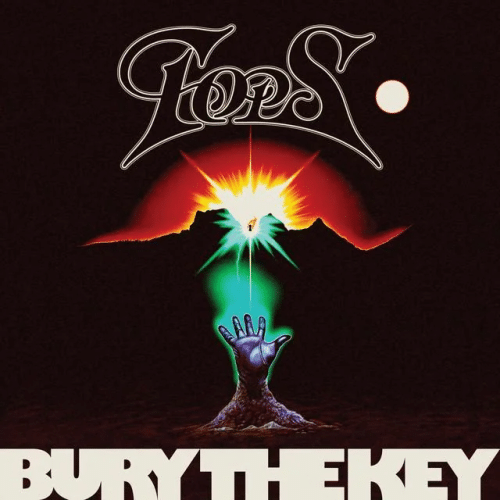
TOPS have always been a curious kind of Montreal export. They emerged from the city’s fertile DIY scene in the early 2010s with a sound that never quite fit into the prevailing indie rock categories of the time. Too lush to be lo-fi, too off-kilter to be glossy pop, their songs were marked by a strange duality: soft-focus melodies that seemed to shimmer in from the past but somehow carried an unmistakably modern tension. A decade later, with Bury the Key, they’ve sharpened that tension into something stranger, darker, and more pointed than anything they’ve done before.
The joke among the band was that they were making an “evil TOPS” record. The phrase is tongue-in-cheek, of course—Jane Penny’s vocals, gentle as they often are, still float with an unflappable sweetness but there’s truth to the idea. These songs wrestle with detachment, disillusionment, and the messiness of being alive in a world where headlines rarely invite optimism. If their earlier records sometimes leaned toward a hazy romanticism, Bury the Key often feels like waking up from that dream, blinking in fluorescent light.
It opens with Stars Come After You, the album’s longest track at just over four minutes. That length isn’t indulgent, but it allows space for atmosphere to settle: drifting synths, understated percussion, and Penny’s voice nearly dissolving into the mix. It’s a scene-setting song, suspended in the twilight between the hopeful and the doomed. Right away, you sense that the record is less about delivering neatly wrapped hooks than letting unease run its course.
By the time Wheels at Night kicks in, things get tighter, the synths stabbing with more urgency, the rhythm section leaning forward. It’s one of the album’s highlights, a breakup narrative that was once imagined as a widow’s lament. That shift, between character study and personal confession, runs throughout the record. The lyrics often blur perspective, as though the band are less interested in autobiography than in exploring how intimacy and estrangement echo through different voices.
Then there’s ICU2, which edges closer to indie rock than TOPS usually tread. David Carriere’s guitar juts in with an almost punky confidence, reminding us that the band’s palette is broader than the soft pop associations that sometimes shadow them. He’s clearly having fun roughing up the edges, and the song benefits from that grit. It gives Penny’s vocals a counterpoint, forcing them into stranger territory.
The first real moment of exhilaration arrives with Outstanding in the Rain, when Penny’s flute, always a wildcard in their arrangements, slices through the haze. The groove is irresistible, with drums and keyboards finding a dance-floor pulse without abandoning the band’s characteristically delicate touch. It’s both playful and melancholic, a trick TOPS have pulled before but rarely with such conviction.
That sense of duality extends to Annihilation, another pre-release single, which leans into disco-tinged production. It’s a reminder that TOPS are unafraid of pulling from the supposedly unfashionable corners of the past. If you grew up hearing soft rock on FM radio and rolling your eyes, this might feel familiar in ways you didn’t expect to welcome. Still, the reverb, the shimmer, the carefully layered synths, there’s a deliberate coolness here that keeps the nostalgia from curdling into kitsch.
Falling on My Sword is where Carriere’s guitar really takes centre stage, pushing the song toward chaos before cutting it off abruptly. At under three minutes, it feels like a flash of something dangerous, over before it can be neatly resolved. Contrast that with Call You Back, barely two minutes long but one of the record’s purest pop moments. It’s easy to miss if you’re not paying attention, but it proves how economical the band can be: the melody lodges instantly, and the arrangement doesn’t waste a second.
Later, Chlorine slows things down, pulling us into an almost noir-ish atmosphere, piano notes hanging ominously before the track unfolds into something more intimate. It’s one of the most affecting songs here, the emotional anchor of the record. In a way, it’s the opposite of the breezy, nostalgia-tinged TOPS people might expect. Instead of floating above the fray, Penny sounds grounded, the weight of the lyric carried in every word.
The back half of Bury the Key moves between restraint and release. Mean Streak is brooding, simmering with frustration, while Your Ride stretches out into one of the most expansive arrangements TOPS have attempted. The chorus bursts with energy, and by the song’s final minute, it feels like the band have let themselves tumble into the kind of catharsis they usually sidestep. Standing at the Edge of Fire keeps that momentum alive, rhythm pushing harder, vocals straining to match.
Closer Paper House brings it all back down, and fittingly so. It’s a fragile track, tender almost to the point of collapse. Yet it feels necessary. After the twists of the previous eleven songs, there’s a sense that TOPS wanted to leave listeners not with resolution but with lingering questions, something unresolved flickering at the edges.
Across its twelve songs, Bury the Key clocks in at just over half an hour, yet it rarely feels slight. The band pack a lot into that span: moments of disco shimmer, hints of punk urgency, and plenty of sophisti-pop sheen. But what lingers most is the mood, the sense of a band unafraid to stare down the contradictions in their own work. Sweetness and cynicism, groove and melancholy, retro flourishes and modern unease.
Montreal is all over this record, even when it’s not explicit. There’s the city’s history of DIY experimentation, its fascination with mixing nostalgia and futurism, and its knack for producing music that feels both intimate and slightly aloof. TOPS embody that tension, and Bury the Key is perhaps their clearest statement yet: they’re not chasing trends, but neither are they standing still.
Listening through, you get the impression that “evil TOPS” was less a joke than a way of giving themselves permission. Permission to lean into darker themes. Permission to muddy the polish. Permission to question what their band can be after more than a decade together. And if the songs sometimes feel uneven, that’s part of the point. This is TOPS pushing against their own formula, and the results are often compelling, sometimes disarming, occasionally messy, but always recognisably theirs.
That’s the real achievement of Bury the Key: it sounds like a band still restless, still curious, still figuring out what to do with their strange little corner of pop music. After all these years, TOPS aren’t interested in nostalgia for its own sake. They’re searching for something murkier, harder to define. And if they don’t quite find it, the search itself is worth hearing.
Bury the Key is out now on Ghostly International.
Share this :


