
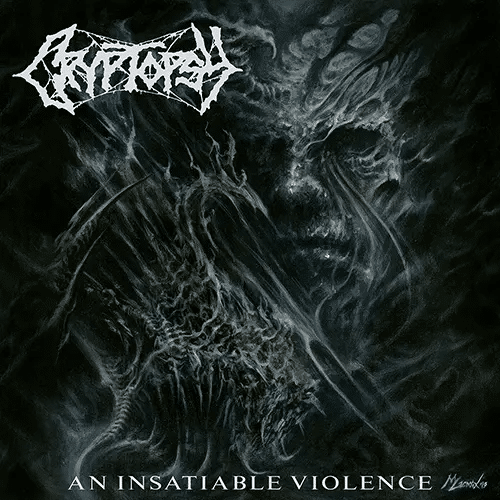
There’s something profoundly unsettling about watching someone destroy themselves for entertainment. Cryptopsy understands this particular brand of modern horror better than most, and their latest offering, An Insatiable Violence, transforms that discomfort into eight tracks of calculated brutality that feel both familiar and unnervingly prescient.
The Montreal legends have spent the better part of two decades wrestling with their own legacy. Since the seismic shift of 2008’s The Unspoken King, every subsequent release has been measured against the impossible standard of None So Vile, that 1996 masterpiece that essentially wrote the blueprint for technical brutality. But here’s the thing about Cryptopsy in 2025: they’ve stopped apologizing. This isn’t a band trying to recapture past glories anymore. This is a band that’s figured out how to weaponize everything they’ve learned.
The album opens with “The Nimis Adoration,” a track that immediately signals intent through its subject matter alone. Inspired by the disturbing world of mukbang videos, where performers consume grotesque quantities of food for online audiences, it sets the thematic tone for an album obsessed with digital-age compulsions. Matt McGachy’s vocals hit depths that would make Lord Worm proud, while Flo Mounier’s drumwork remains as surgically precise as it is completely unhinged. The production here deserves particular mention—crisp enough to catch every nuance of Christian Donaldson’s angular riffwork, yet retaining the chaotic energy that made the band’s early work so visceral.
What strikes you most about An Insatiable Violence is how deliberately it’s constructed. These aren’t random outbursts of technical showboating (though there’s plenty of that). Each song serves the larger narrative about our toxic relationship with social media and digital validation. “Our Great Deception” stands as the album’s philosophical centrepiece, examining how online personas create unbridgeable gaps between our digital and physical selves. The track’s unusual structure—beginning with deceptively melodic passages before descending into calculated chaos—mirrors the false comfort of our curated online lives.
Bassist Olivier Pinard emerges as an unexpected star throughout the album. His contributions to tracks like “The Art of Emptiness” add layers of complexity that elevate the material beyond mere brutality. There’s a moment midway through that particular song where his bass lines create this hypnotic undertow beneath Donaldson’s razor-wire riffs, and you realize you’re hearing something genuinely innovative within the confines of a genre that’s often accused of creative stagnation.
The band’s evolution since As Gomorrah Burns is most apparent in their willingness to embrace dynamics. “Until There’s Nothing Left” manages to be simultaneously crushing and oddly melodic, finding hooks within the hurricane. It’s a trick that shouldn’t work—catchy brutality feels like a contradiction in terms—yet Cryptopsy makes it sound inevitable. This is death metal for the streaming age, designed to grab attention in a landscape where every band is competing for fleeting moments of listener engagement.
McGachy deserves particular credit for his vocal performance across the album. His range has expanded considerably since his early days with the band, moving fluidly between the guttural extremes that genre purists demand and the more varied textures that contemporary extreme metal requires. On “Fools Last Acclaim,” he channels the spirit of the band’s classic era while making it entirely his own. The guest appearance by former vocalist Mike DiSalvo on “Embrace the Nihility” feels less like nostalgia-baiting and more like a respectful nod to the band’s lineage.
The album’s concept becomes most explicit on its title track, where the metaphor of an insatiable digital appetite transforms into literal sonic violence. McGachy has described the inspiration as a dream about someone who builds a torture device they willingly subject themselves to nightly—a pretty apt metaphor for our relationship with social media platforms designed to exploit our psychological vulnerabilities.
Musically, the band has found a way to integrate elements from their controversial middle period without compromising their essential brutality. The deathcore influences that caused such uproar among purists are still there, but they’re deployed strategically rather than dominating the sound. “Malicious Needs” closes the album with a groovy stomp that wouldn’t have been out of place on The Unspoken King, but here it feels earned rather than imposed.
The production, handled with obvious care, strikes that delicate balance between modern clarity and old-school chaos. Everything is audible without feeling sterile, allowing the band’s technical prowess to shine while preserving the organic feel that made their early work so compelling. Mounier’s drums, in particular, sound massive without losing their humanity to over-triggering.
If there’s a weakness to An Insatiable Violence, it’s that the concept, while clever, occasionally feels heavy-handed. The social media critique, however valid, sometimes lacks the subtlety that made the band’s earlier lyrical explorations so compelling. But this is a minor complaint about an album that succeeds on almost every other level.
More significantly, this feels like the album where Cryptopsy finally reconciles all the different versions of themselves. The technical wizardry is still there, the brutal assault remains uncompromising, but there’s a maturity to the songwriting that suggests a band comfortable with both their legacy and their current incarnation. They’re no longer trying to recreate None So Vile because they don’t need to. They’ve created something different but equally vital.
An Insatiable Violence confirms what their recent touring has suggested: Cryptopsy in 2025 is a band operating at peak efficiency. They’ve absorbed the lessons of their experimental period while rediscovering what made them special in the first place. The result is an album that respects the past while pushing boldly into the future, addressing contemporary anxieties through the lens of expertly crafted extreme music.
Share this :


